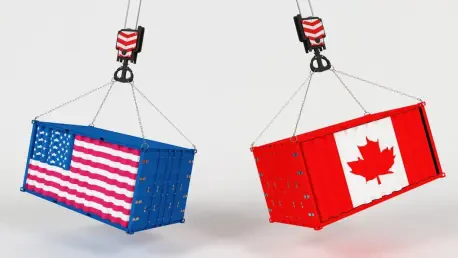

At the helm of Government Curated, a leading policy and legislation analysis firm, Donald Gainsborough has become one of the most trusted voices on the intricacies of Canadian governance. With decades of experience navigating the corridors of power, he offers a sharp, unvarnished perspective on the seismic shifts in Canada’s foreign and trade policy. Today, he joins us to dissect the Carney government’s urgent, and at times chaotic, scramble to redefine Canada’s economic future in the shadow of a protectionist America. We’ll explore the high-stakes strategy of trade diversification, the internal Cabinet dynamics shaping it, and the ambitious, perhaps perilous, diplomatic pivots being made toward Europe and Asia.
The PM’s office is treating trade diversification as an “emergency.” Beyond this “all hands on deck” approach, what specific, measurable steps has the Carney government taken to begin shifting the C$1.3 trillion trade relationship away from the U.S. since taking office?
It’s a fascinating mix of structural change and targeted action, though it still lacks a central, public-facing roadmap. On the structural side, the most visible move was carving out the Canada-U.S. Trade Minister portfolio for Dominic LeBlanc, effectively isolating the American file so the rest of the trade machinery can focus elsewhere. More concretely, we’re seeing a significant pivot on defense as a trade tool. The government quietly eased export policies for dual-use goods this year and, crucially, joined the EU’s Security Action for Europe program, which is a loan-for-weapons initiative. This opens a direct channel for our defense industry. The commitment to NATO’s 3.5-percent investment target is another piece of this puzzle, signaling to European partners that Canada is a serious security contributor, which in turn lubricates the wheels of trade. But the fact that the formal diversification strategy, once promised for the fall, is now pushed to the new year tells you they’re still building the plane while flying it.
The article highlights overlapping mandates for ministers like LeBlanc and Joly, sowing confusion. From your perspective, how effective is this “all hands on deck” strategy in practice? Could you detail the risks of this approach, such as sending mixed signals to partners or creating bureaucratic gridlock?
In practice, the “all hands on deck” strategy looks less like a coordinated naval fleet and more like a regatta where everyone is trying to win the same race. The intention is noble—to signal urgency and bring all resources to bear. But the outcome is confusion. You have Dominic LeBlanc managing the C$1.3 trillion U.S. relationship, but International Trade Minister Maninder Sidhu is still the lead on global trade, and both report into Global Affairs. Then you have Industry Minister Mélanie Joly traveling the world courting investment and even shopping for submarines, which steps directly into the National Defense Minister’s territory. The primary risk is sending muddled messages to potential partners. Who is the ultimate decision-maker? If a foreign counterpart is talking to three different Canadian ministers about overlapping issues, it creates uncertainty and slows things down. Internally, it fuels a competitive environment where ministers are trying to impress the new boss, Carney, by being “closers,” which can lead to bureaucratic turf wars rather than cohesive action.
Europe is Carney’s top priority, yet the CETA deal remains partially unratified, and only 4% of exports go there. How realistic is this focus on “low-hanging fruit”? Can you outline the practical steps needed, especially regarding defense, to truly capitalize on this agreement?
Calling Europe “low-hanging fruit” feels incredibly optimistic, almost a bit of a political sales job. The reality is that fruit is still quite high up the tree. You’re right, only 4% of our exports go there compared to over 70% to the U.S., and the fact that 10 EU countries still haven’t ratified the CETA deal after all these years is a major hurdle. The pathway to making this a reality lies almost entirely through defense and security. Prime Minister Carney’s pledge to meet NATO’s 3.5-percent investment target is the single most important lever. It’s a message that Canada is finally pulling its weight, which builds immense goodwill. This isn’t just about talk; it means record defense spending, the most since 1952. The goal is to use those procurement dollars to build up our domestic defense and aerospace sectors, then leverage that enhanced capacity to integrate with European supply chains. Becoming the first non-EU country to join their loan-for-weapons program is a tangible step in that direction. It’s less about convincing Europe to buy more of our traditional goods and more about becoming an indispensable partner in security and defense.
Carney is planning trips to China and India, described as “dramatic U-turns” in policy. What is the strategic calculation behind re-engaging these powers now, and what are the primary diplomatic and economic challenges Ottawa must overcome to make these new relationships fruitful?
The strategic calculation is one of stark necessity. When your largest trading partner, the U.S., becomes your biggest source of economic volatility, you have no choice but to look for counterweights, however imperfect they may be. The “U-turns” are dramatic because they require us to compartmentalize deeply challenging diplomatic files—the detention of the two Canadians in China and the accusations about India’s role in a political assassination on our soil—from economic opportunities. The primary challenge is trust. Both Beijing and New Delhi will be wary of Canada’s intentions, seeing us as a U.S. ally seeking leverage. Ottawa’s approach seems to be to find low-risk avenues for re-engagement, like environment and energy with China, while drawing clear “guardrails” around sensitive areas like AI. The risk is immense; Ottawa must navigate these relationships without alienating Washington or compromising national security. It’s a diplomatic tightrope walk where the economic prize is significant, but a single misstep could have severe geopolitical consequences.
Prime Minister Carney described his doctrine as “variable geometry”—creating bespoke alliances. How does this cerebral concept translate into a tangible trade strategy, and does it risk looking like the “throwing things at the wall” approach his critics suggest? Please provide a specific example.
“Variable geometry” is Carney’s intellectual framework for a world that’s no longer unipolar or neatly multilateral. It means abandoning a one-size-fits-all foreign policy and instead building custom alliances for specific purposes. In practice, this means engaging with the EU as a key security and defense partner to unlock trade, while simultaneously approaching China as a transactional partner on climate change. It’s a tailored, issue-by-issue strategy. A perfect example is the contrast between the U.S. and Europe. With the U.S., the government is in a defensive crouch, trying to manage tariffs and a mandatory trade review. With Europe, it’s on the offense, using defense spending and security pacts to build a deeper economic bridge. To critics, this can absolutely look like “throwing things at the wall,” because it lacks a single, simple narrative. When you sacrifice a policy like the digital services tax to appease Washington, only for talks to collapse anyway, it looks reactive and chaotic. But from the government’s perspective, it’s a pragmatic adaptation to a multipolar world where you need different tools for different partners.
What is your forecast for Canada’s trade diversification plan? Considering the internal scramble, the long timelines for new deals, and Washington’s immense leverage, what is the likelihood that Ottawa can successfully double its non-U.S. exports within the next decade?
My forecast is one of necessary, grinding, and incremental progress rather than a revolutionary shift. The goal of doubling non-U.S. exports in a decade is incredibly ambitious, perhaps even aspirational. The internal scramble we’ve discussed is a real headwind; a cohesive strategy is still pending, and ministerial competition can hinder execution. Furthermore, trade relationships with Europe and Asia are not built overnight; they are the work of decades, requiring deep investment in logistics, language skills, and cultural understanding that we are only now beginning to seriously consider. The biggest factor, however, remains the gravitational pull of the American market. The C$1.3 trillion relationship isn’t just a number; it’s a deeply integrated reality of supply chains, regulations, and business culture. So, while I believe the direction of Carney’s policy is correct and, frankly, unavoidable, I am skeptical about the timeline. We will likely see modest gains in Europe, particularly in the defense and aerospace sectors, and some new inroads in Asia, but doubling the figure in ten years seems unlikely. Success shouldn’t be measured by that single metric, but by whether Canada can build enough resilience to withstand the next economic storm from the south.