
The Gulf’s status as a global leader in the energy transition now rests on its ability to resolve the logistical friction that is hampering its ambitious renewable rollout. The desert sun has long been viewed as an infinite resource for the Gulf Cooperation Council states, yet the bridge between capturing that radiance and powering a modern economy is proving more treacherous than initially projected. As national strategies like Saudi Vision 2030 and the UAE’s Energy Strategy 2050 reach critical implementation phases, the initial excitement surrounding record-breaking bids has encountered the reality of global trade and regional stability.
This shift from visionary planning to granular problem-solving marks a defining moment for the region. The challenge is no longer about proving that solar energy is cheap, but rather ensuring that it can be reliably delivered to a domestic grid that was never designed for such rapid fluctuation. This era demands a transition from financial optimism to rigorous engineering. To succeed, regional stakeholders must look beyond the spreadsheet and address the physical constraints that threaten to stall the momentum of the world’s most ambitious solar expansion projects in the current decade.
The Disconnect Between Financial Benchmarks and Operational Reality
Strategic Marketing Versus Physical Execution
The Gulf has successfully positioned itself as a global leader in renewable energy costs, achieving solar tariffs as low as 1.04 cents per kilowatt-hour. These figures serve as powerful marketing tools for attracting foreign investment and demonstrating a commitment to a post-oil future. However, a growing consensus among energy analysts suggests that a low tariff is merely a financial commitment on paper rather than a guarantee of immediate energy production. The transition from these headlines to operational power stations is becoming increasingly difficult as logistical and technical hurdles accumulate.
Developers are finding that while the cost of capital remains manageable, the cost of project delays and regulatory bottlenecks is rising. This creates a paradox where the region celebrates winning bids while the actual capacity additions lag behind official targets. The gap between signing a Power Purchase Agreement and connecting a utility-scale plant to the consumer has widened significantly since early 2026. Closing this gap will require more than just low-cost financing; it requires a streamlined permitting process and a commitment to resolving the land-use conflicts that frequently arise during the late stages of project development.
Supply Chain Volatility and Shipping Disruptions
A sharp decline in solar hardware imports during early 2026 highlights the region’s vulnerability to global supply chain instability. In the UAE, monthly photovoltaic imports plummeted from 760MW to 160MW, a trend driven largely by conflict in the Strait of Hormuz and broader regional tensions. These geopolitical disruptions have caused project timelines to slip by up to a year, proving that the Gulf’s solar ambitions are heavily dependent on trade routes that remain susceptible to sudden closures or delays. When shipping lanes are compromised, the specialized components required for bifacial panels become stranded in transit.
This fragility underscores the need for localized manufacturing, a goal that remains in its infancy across much of the GCC. Without a more resilient approach to procurement, even the most well-funded projects remain at the mercy of external political shocks that are beyond the control of local energy ministries or private developers. Furthermore, the rising cost of maritime insurance for vessels entering the Gulf has added an unforeseen layer of financial pressure on contractors. To mitigate these risks, regional players are now exploring alternative land-based trade corridors and investing in domestic assembly facilities to reduce reliance on long-haul shipping.
Navigating Technical Infrastructure and Capital Allocation
Grid Stability and the Modernization Mandate
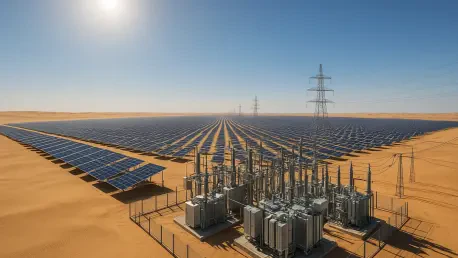
Even when solar projects are physically completed, the existing national grids in countries like Saudi Arabia are struggling to absorb the new capacity. Major plants have recently faced output restrictions imposed by grid operators who cite stability concerns and technical limitations of an aging infrastructure. These restrictions have led to substantial financial losses for developers, signaling that without massive investment in grid modernization, the influx of intermittent solar power could be throttled before it ever reaches consumers. The inherent variability of solar generation requires a level of grid flexibility.
Integrating large-scale battery storage and implementing advanced grid-balancing software have become urgent priorities rather than secondary considerations. The technical challenge is compounded by the extreme heat of the region, which degrades equipment performance and increases the complexity of maintaining steady voltage. Moving forward, the focus must shift from pure generation to the holistic resilience of the entire energy delivery system. This includes upgrading transmission lines to handle high-voltage direct current and establishing regional interconnectors that allow GCC states to share surplus renewable energy during peak demand periods.
Diversification and the Global Competition for Funds
As domestic bottlenecks persist, major Gulf developers like Masdar are increasingly looking abroad, diversifying their portfolios across Europe, Central Asia, and Southeast Asia. This shift creates a new internal competition for capital where domestic projects must compete for funding against international opportunities that may offer fewer logistical headaches. With sovereign wealth funds like Saudi Arabia’s Public Investment Fund adopting a more disciplined, return-oriented approach, local solar initiatives are under increased pressure to prove their operational viability to remain prioritized in a crowded market.
The global market for renewable energy has become highly competitive, and capital naturally flows to jurisdictions where project execution is most efficient. If regional obstacles like grid constraints and supply chain delays are not addressed, there is a risk that the very entities designed to drive the local transition will find better returns in foreign markets. This evolution of capital means that national pride is no longer a sufficient justification for investment; projects must now demonstrate technical readiness and long-term profitability on par with global standards. Developers are now prioritizing projects that include integrated storage solutions to ensure a steady return.
The Strategic Pivot Toward Resilient Systems
The path forward necessitated a fundamental reassessment of how renewable energy projects were integrated into the national economy. It became clear that the era of relying solely on headline-grabbing tariffs ended when the complexities of the physical world intervened. Stakeholders recognized that the solution lay in three distinct areas: the decentralization of manufacturing to insulate projects from shipping lane volatility, the aggressive deployment of long-duration energy storage, and the harmonization of regional power grids. By prioritizing these structural changes, the GCC states sought to transform their energy landscape.
Leaders acknowledged that the transition was less about the abundance of sunlight and more about the sophistication of the systems that managed it. The shift toward a localized supply chain and modernized grid management provided the necessary foundation for sustained growth in a volatile world. Ultimately, the successful navigation of these 2026 hurdles proved that technical pragmatism was the only viable partner for political ambition in the quest for a carbon-neutral future. This era of adjustment allowed the region to move beyond simple installation targets and toward a truly integrated, resilient, and economically viable green energy ecosystem.