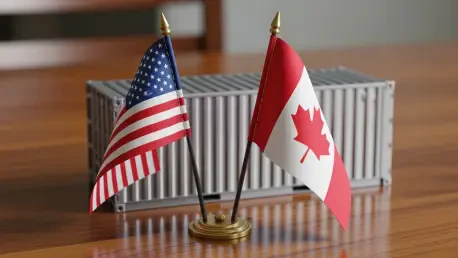

The long-standing predictability of North American alliances has fractured, forcing nations once considered steadfast partners to navigate a landscape where economic coercion can be directed at friends as easily as foes. For Canada, the era of relying on a stable, rules-based relationship with its southern neighbor is over, prompting a fundamental recalibration of its foreign and economic policies to secure its future in a turbulent world.
The Unraveling Alliance: Why Ottawa Is Recalibrating Its Relationship with Washington
The “America First” doctrine has profoundly shaken the U.S.-Canada partnership, replacing decades of cooperative integration with a transactional and often adversarial dynamic. This shift has created an urgent need for Ottawa to safeguard its economic and diplomatic sovereignty against the rising tide of American protectionism. In response, the Canadian government is deploying a strategic triad: engaging conditionally with U.S. initiatives, aggressively diversifying its trade partnerships, and decoupling key policies from Washington’s lead when national interests demand it. This bold new approach signals a clear break from the past, positioning Canada as a more independent actor on the global stage.
This recalibration is not a matter of choice but of necessity. Facing an unpredictable partner, Canada can no longer afford to have its economic fortunes so tightly tethered to a single market. The new strategy is a calculated effort to build resilience by creating a network of international relationships that can buffer the Canadian economy from the shocks of sudden tariffs or geopolitical power plays emanating from Washington.
A Calculated Response to Unpredictable Pressures
Playing the Inside Game: Carney’s Calculated Seat at Trump’s “Board of Peace”
Canada’s decision to accept an invitation to President Trump’s “Board of Peace” for Gaza governance is a prime example of its new conditional engagement. Rather than a full-throated endorsement of the U.S. plan, Ottawa views its participation as a strategic necessity. An anonymous Canadian official emphasized the importance of having “a seat at the table to shape this process from within,” suggesting that influence is best wielded through direct involvement, not from the sidelines.
Further distinguishing this from purely transactional diplomacy, the official clarified that Canada’s participation comes with no fee attached, nor has one been requested. This move is complemented by parallel diplomatic efforts, as evidenced by leader Carney’s recent discussions with Qatar’s Emir, Sheikh Tamim bin Hamad Al Thani. Their strong alignment on the board’s necessary functions shows Canada building a consensus with other key players to bolster its position and advocate for a multilateral approach within the U.S.-led initiative.
The Greenland Gambit: How Transatlantic Sanctions Became a Tipping Point for Ottawa
The shockwave from President Trump’s decision to sanction major European allies to pressure them into facilitating a U.S. purchase of Greenland served as a stark warning to Ottawa. The tariffs, which targeted nations like Denmark, France, and Germany, demonstrated a willingness to use economic coercion against even the closest partners. This punitive action forced an immediate re-evaluation of Canada’s own deep economic dependency on the United States.
Carney described the sanctions as a “serious situation,” an assessment that underscored the precariousness of traditional alliances. The Greenland gambit illustrated that no partner was immune to unilateral pressure, compelling Canada to accelerate its efforts to forge more predictable and cooperative international relationships. In contrast to this coercive American strategy, Ottawa’s subsequent diplomatic overtures have prioritized stability and mutual respect.
The Eastern Overture: Pivoting to Beijing to De-escalate Economic Hostilities
As a direct counter-maneuver to U.S. pressure, Carney and Chinese President Xi Jinping signed a preliminary trade agreement, marking a significant pivot in Canadian foreign policy. The landmark deal includes critical concessions, with China agreeing to cut tariffs on Canadian canola. More strikingly, Canada broke from a shared policy with the U.S. by agreeing to an initial annual import cap of 49,000 Chinese electric vehicles, a move expected to attract Chinese joint-venture investment into the Canadian auto sector.
The U.S. reaction to this détente has been revealingly fractured. While some Trump administration officials expressed irritation at Canada’s independent move, President Trump himself appeared unconcerned, reportedly stating that Canada “should do that” if it can secure a good deal. This divided response highlights a lack of policy cohesion in Washington and creates an opening for middle powers like Canada to pursue their own interests with greater autonomy.
Beyond North America: Building New Economic Anchors in the Gulf
Carney’s historic visit to Qatar, the first by a sitting Canadian leader, signaled a deliberate strategy to diversify the nation’s economic and geopolitical anchors. By strengthening trade and defense relations in the Gulf, Canada is building alternative economic lifelines that reduce its reliance on the North American market. This is not a short-term fix but a long-term vision for a more globally integrated and resilient Canadian economy.
This proactive diplomacy marks a departure from Canada’s historically North America-centric foreign policy. In the past, such a move might have been seen as secondary to managing the U.S. relationship. Today, it is a central pillar of the new Canadian strategy, demonstrating a clear-eyed recognition that in a fractured world, influence and security come from a distributed network of strong, independent partnerships.
The Carney Doctrine: A Modern Playbook for Middle Powers
The core tenets of Canada’s emerging foreign policy—the “Carney Doctrine”—are clear: selective cooperation with the U.S., proactive diversification of trade, and a firm willingness to break from allied consensus when national interests diverge. This playbook offers actionable insights for other middle-power nations navigating a world dominated by unpredictable superpowers. The strategy is built on creating economic and diplomatic leverage, turning dependency into a source of strategic flexibility.
For industries heavily reliant on U.S. trade, the message is equally clear. The time has come to develop robust contingency plans and actively explore opportunities in the new markets that Ottawa is now targeting. This strategic shift at the national level requires a corresponding adaptation in the private sector to ensure long-term stability and growth.
Redrawing the Map: Canada’s New Place in a Fractured Global Order
The central thesis of this new era is that Canada is no longer a passive follower but an active agent shaping its own destiny. The nation’s strategic pivot is a direct response to a volatile international environment where old assumptions no longer hold. The long-term implications are significant, potentially leading to fundamental shifts in North American supply chains and the establishment of new global trade corridors that bypass traditional routes.
This realignment forces a critical re-evaluation of Canada’s place in the world. It marks a profound change, moving the country from a position of comfortable alignment to one of strategic independence. This raises a thought-provoking question for allies and adversaries alike: Is Canada’s calculated new course a temporary survival tactic for a turbulent time, or does it represent the dawn of a permanent, more assertive foreign policy?