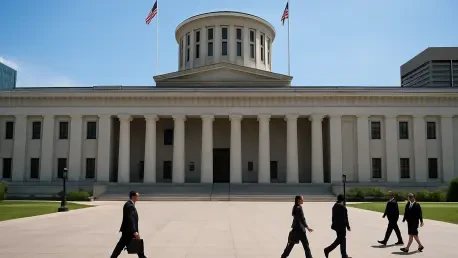

The proposal to abolish the income tax hinges on the belief that cutting state spending on non-essential services like parks will provide a massive stimulus for residents. As Vivek Ramaswamy maneuvers through his gubernatorial campaign in 2026, his vision for Ohio has sparked a national dialogue about the limits of fiscal conservatism and the necessity of state-funded infrastructure. This bold initiative seeks to dismantle the traditional tax structure that has defined the region for decades, replacing it with a leaner model designed to entice high-net-worth individuals and corporate entities. While the candidate frames this as an essential modernization of the Buckeye State’s economy, the transition represents a high-stakes gamble with the state’s social fabric. Critics and supporters alike are currently locked in a debate that transcends simple partisan politics, touching instead on the fundamental role of a state government in the modern era and how it can best serve a diverse population in a rapidly changing global market.
Historical Ideology: Economic Justifications for a Leaner State
Philosophical Roots: Limited Government and Market Freedom
The philosophical foundations of this proposal trace back to a classic American tension between limited government and social intervention that has intensified over the last several decades. Observers note that the rhetoric echoes the 1964 conservative movement, prioritizing market freedom over state-led economic management in a way that feels both nostalgic and radical. By framing the income tax as a direct barrier to individual liberty, proponents aim to minimize the government’s footprint significantly. They suggest that a leaner state apparatus is fundamentally more conducive to long-term prosperity and personal financial independence for all citizens regardless of their economic bracket. This ideology posits that when individuals retain more of their earnings, they are more likely to invest locally, thereby creating a self-sustaining cycle of wealth generation that eventually renders many state programs redundant or unnecessary in a truly free and open market system.
Competitive Markets: Challenging Low-Tax States for Investment
Supporters believe that eliminating the income tax is the only viable way for Ohio to remain competitive against rapidly growing low-tax states like Florida and Texas. The primary argument is that a zero-tax environment will act as a powerful magnet for capital investment, drawing in tech startups and manufacturing giants while reversing the state’s historic population decline. From this perspective, the resulting economic growth and the strategic trimming of non-essential government spending would easily offset the immediate loss in tax receipts. The goal is to create a more robust private sector that benefits every resident by lowering the cost of living and increasing the density of high-paying jobs. This strategy relies on the assumption that a surge in consumer spending and corporate activity will generate enough secondary revenue to support the state’s core functions without requiring a direct levy on the personal wages of the hard-working labor force.
Fiscal Risks: Addressing the Massive Revenue Gap
Budgetary Impacts: The Threat to Public Safety and Infrastructure
Despite the optimistic outlook presented by the campaign, non-partisan researchers warn of a looming $9.8 billion annual budget shortfall if the plan is enacted as proposed. This massive revenue gap represents the funds currently used to sustain public safety, healthcare access, and critical infrastructure projects across the state’s diverse counties. Critics argue that without unprecedented and immediate population growth, which is historically difficult to trigger on demand, the state would be forced to implement draconian service cuts. Such reductions would fundamentally alter the quality of life for millions of Ohioans who rely on state-funded programs for everything from road maintenance to emergency services. The concern is that the infrastructure that makes Ohio attractive to businesses, such as reliable transit and safe communities, would be the first to suffer under these new budgetary constraints, potentially negating the benefits of the tax cuts.
Property Tax Implications: The Math of Budgetary Shifts
To bridge this significant financial chasm, experts suggest the state might be forced to shift the tax burden onto property owners, creating a new set of economic pressures. Estimates indicate that property taxes could surge by as much as 20 percent to compensate for the loss of income tax revenue, which represents a significant policy contradiction within the platform. Because the proposal also includes promises to lower property taxes to pre-pandemic levels, many regional economists argue that the current plan is mathematically impossible to execute without incurring massive debt. This fiscal tension could eventually bankrupt local municipalities and school districts that lack the authority to generate alternative revenue streams. The potential for a real estate bubble or a housing affordability crisis becomes a secondary risk, as the increased costs of homeownership could drive away the very same middle-class families that the candidate claims to be championing.
Lessons From the Past: Empirical Data vs. Ideological Purity
Historical Precedents: The Kansas Experiment and Educational Stability
Opponents frequently cite the “Kansas experiment” as a cautionary tale for Ohio’s leadership. In that instance, aggressive tax cuts led to credit downgrades and the gutting of public services without producing the promised economic boom, eventually forcing a legislative reversal. This historical precedent serves as a primary piece of evidence for those who believe that Ramaswamy’s plan ignores empirical data in favor of ideological purity. Simultaneously, the education sector stands as the most vulnerable area under the proposed fiscal changes. Educators warn that removing state funding would exacerbate existing deficiencies in school budgets, leading to larger class sizes and the loss of essential services. There is a growing concern that such a move would violate constitutional obligations to provide adequate schooling, leaving students with disabilities and those in low-income districts without the necessary resources to succeed in a modern economy.
Strategic Resolutions: Building a Sustainable Fiscal Framework
The resolution of the tax debate highlighted the need for a balanced approach to state fiscal policy that combined growth incentives with social responsibility. Policymakers ultimately pursued a strategy that prioritized the modernization of the tax code through gradual adjustments rather than abrupt eliminations. They implemented a series of targeted tax credits for emerging industries while establishing a dedicated reserve fund to protect public education and infrastructure from market volatility. This shift ensured that the state remained competitive without sacrificing the essential services that residents valued most. Actionable next steps for the legislature included the creation of a bipartisan oversight committee to monitor economic shifts and the development of a diversified revenue portfolio that reduced reliance on a single tax stream. By focusing on sustainable, long-term investments in human capital and community resources, the state secured its economic future.