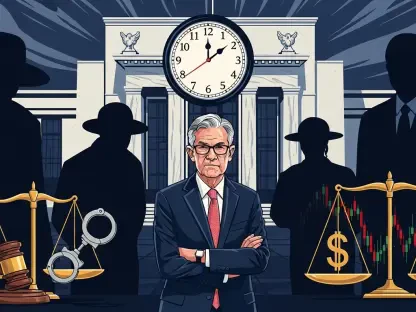
In the quiet corridors of the White House, a debate rages not just over a name but over the very philosophy that will guide the American economy through its next chapter, and at its center is the polarizing figure of Kevin Hassett. As the search for a new leader for the Federal Reserve intensifies, the National Economic Council director has emerged as a candidate who is simultaneously championed as an intellectual titan by his supporters and questioned as a passive manager by his critics. The decision carries immense weight, forcing the administration to confront a fundamental question: Does the world’s most powerful central bank need an academic architect or a commanding institutional leader?
The Billion-Dollar Question Dividing the White House
The prospect of Kevin Hassett taking the helm of the Federal Reserve has cleaved a stark divide within President Trump’s inner circle. On one side, allies view him as the intellectual powerhouse perfectly suited to steer the American economy, the quiet force who provided the academic scaffolding for “MAGAnomics.” On the other, concerned officials privately voice doubts, suggesting his leadership style is a critical liability for an institution that demands a firm, coordinating hand. This is not merely a personnel choice; it is a referendum on the type of leadership deemed necessary to execute the administration’s economic vision.
This debate represents a billion-dollar question because the Federal Reserve Chair holds unparalleled influence over global financial markets, domestic interest rates, and the everyday economic realities of American families. The person in that seat must inspire confidence not only in the White House but also on Wall Street and among international partners. As President Trump openly scours for a replacement for Jerome Powell, the choice of a figure as debated as Hassett amplifies the stakes, making the internal deliberations a high-wire act with profound consequences for economic stability.
Setting the Stage Why the Next Fed Chair Matters More Than Ever
The appointment comes at a moment of exceptional economic fragility. The next leader of the Federal Reserve will be tasked with navigating the treacherous waters of persistent inflation and a cooling job market, a combination that leaves little room for error. Any policy misstep could risk tipping a slowing economy into a recession, making the selection process one of the most consequential in recent memory. The environment demands a leader with not only deep economic expertise but also impeccable judgment and the ability to act decisively under immense pressure.
Adding another layer of complexity is President Trump’s explicit mandate for the role. The administration has made no secret of its search for a “dovish” leader, one willing to aggressively slash interest rates to stimulate growth and align monetary policy with its broader economic goals. This public directive has politicized the appointment to an unprecedented degree, shifting the criteria from traditional central banking credentials toward a perceived loyalty and willingness to follow the president’s lead on rate policy.
This entire drama unfolds against the backdrop of the Powell precedent. President Trump’s relentless and public criticism of the current Federal Reserve leadership has shattered long-standing norms of central bank independence. This context is crucial for understanding the search for a successor. The administration is not just looking for a new chair; it is seeking a fundamental reset in its relationship with the Fed, aiming to install a leader who is seen as a dependable partner in its economic agenda rather than an independent check on its policies.
The Dueling Portraits of Kevin Hassett
At the heart of the conflict over his candidacy are two starkly different portrayals of his leadership style. Critics from within the administration paint Hassett as more of a passive advisor than a hands-on coordinator, a spectator rather than a key player in major policy rollouts. One official pointed to his limited role in the implementation of the tariff regime, a cornerstone of the administration’s economic strategy, as evidence of a detached approach ill-suited for the commanding role of Fed Chair. This view suggests a leader who provides analysis but does not actively drive or manage the complex interagency processes required to turn policy into reality.
In stark contrast, supporters, including multiple Cabinet secretaries, laud him as the quiet architect of the administration’s economic successes. They credit Hassett with providing the “intellectual firepower” and academic foundation for key initiatives like the GOP tax package. Housing and Urban Development Secretary Scott Turner described him as “incredibly influential in shaping” that legislation. This portrait is of an indispensable thinker whose contributions are substantive and deep, even if he avoids the spotlight. His allies argue that his value lies in his rigorous economic analysis, not in a “super hard-charging” management style.
Further complicating the picture is an ideological ambiguity. Some insiders question whether Hassett, with his long affiliation with the free-market American Enterprise Institute (AEI), is a true believer in the administration’s protectionist tariff agenda. This raises concerns about a potential misalignment between his core conservative principles and the president’s policies. However, others counter that his views have evolved and that a single presidential term would grant him the independence to make his own decisions, free from political pressure. Adding to his unique profile is Hassett’s own vision for reform. Leveraging his past experience as a Fed staff economist, he has been a vocal critic of the institution’s weaknesses, particularly in its economic forecasting, positioning himself not just as a follower of directives but as a leader with his own agenda for change.
Voices from the Inside a Chorus of Contradiction
The case against Hassett often comes from unnamed administration officials who express concern that his managerial approach is not suited for forging consensus among the Fed’s powerful and independent committee members. These sources argue that leading the Federal Reserve requires a unique ability to persuade, cajole, and steer a group of strong-willed economists, a skill they perceive Hassett as lacking. His candidacy is often contrasted with others in the running; Kevin Warsh is framed as the institutional “overhauler,” while Christopher Waller is seen as the more effective “persuader” capable of winning over skeptical colleagues.
On the other hand, Hassett’s endorsements are both numerous and vocal. Altimeter Capital CEO Brad Gerstner identifies him as the “lead adviser” on the economy, whose “thoughtful and mature” contributions are regularly sought by the president. Longtime colleague Tomas Philipson defends Hassett by highlighting his “dual skill” as a top-tier researcher and an effective public messenger who would champion needed transparency and reform at the central bank. This chorus of support paints a picture of a deeply respected and influential advisor whose impact is felt at the highest levels of government.
A Framework for Evaluation the Defining Criteria for the Next Fed Leader
Ultimately, the choice boils down to a fundamental dilemma over what kind of leader the Federal Reserve needs at this juncture. Is the priority to find a proven consensus-builder and institutional manager capable of commanding a vast and complex organization through turbulent times? Or is it more important to install a brilliant academic and loyal policy advisor who can provide the intellectual justification for a new and more aggressive economic direction? The two profiles are not mutually exclusive, but the emphasis on one over the other will dictate the final selection.
When balancing Hassett’s strengths and weaknesses, a clear picture emerges. His assets are undeniable: unquestioned economic expertise, a clear vision for institutional reform, and a proven track record of providing the intellectual underpinnings for the administration’s agenda. His liabilities, however, are equally significant in the eyes of his critics: a perceived lack of hands-on, coordinating leadership and lingering questions about his ability to steer a committee of strong, independent voices toward a common goal.
The intense debate over Kevin Hassett’s candidacy was more than a simple vetting process; it was a reflection of a broader struggle to define the future of American economic policy. The conflict between his perceived strengths as an intellectual force and his alleged weaknesses as an institutional manager highlighted the administration’s core challenge. The final decision was not just about choosing a person but about selecting a philosophy for the Federal Reserve. It was a choice that ultimately determined whether the central bank would be steered by a consensus-driven commander or an ideological architect, a decision whose consequences shaped the course of the nation’s economy.