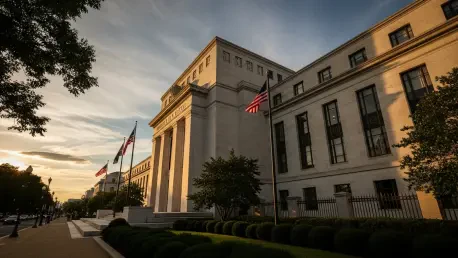

The United States Federal Reserve has navigated treacherous economic waters by enacting its third interest rate cut of the year, a move made not with the clarity of comprehensive data but under the shadow of a significant information blackout. In its final meeting of 2025, the Federal Open Market Committee (FOMC) lowered its benchmark rate by a quarter of a percentage point, settling it into a new target range of 3.50-3.75 percent. This decision, while broadly anticipated by financial markets, was a direct response to accumulating signs of a slowing domestic economy, most notably a labor market that has lost significant momentum. The central bank’s official statement pointed to a deceleration in job gains over the course of the year and a discernible uptick in the unemployment rate. However, this crucial policy pivot was executed with an unprecedented handicap: a severe lack of timely economic intelligence, forcing policymakers to chart their course using outdated maps in a rapidly changing environment.
Navigating an Economic Data Blackout
The primary complication for the central bank was the lingering effect of a record-breaking 43-day government shutdown that had only recently concluded. This protracted halt in government operations severely hampered the ability of key statistical agencies, such as the Department of Labor, to collect, process, and release vital economic indicators. As a result, the FOMC was forced to make its consequential decision without access to a full slate of contemporary data. Critical missing reports included figures on import and export prices, the producer price index, and the state-level employment and unemployment statistics for October. This information void meant that policymakers were largely reliant on data from as far back as September, a snapshot showing the unemployment rate at 4.4 percent and core inflation running at 2.8 percent. Basing a late-year monetary policy decision on information that is several months old is a highly unusual and precarious position for an institution that prides itself on being data-dependent.
Operating with such a significant informational deficit dramatically increases the inherent risks of monetary policy. Without a clear and current picture of inflation, employment, and production, the Federal Reserve walks a finer line than ever between two potential policy errors. Easing policy too aggressively based on stale data could risk reigniting inflationary pressures that have only recently shown signs of moderating. Conversely, not acting decisively enough could fail to support a weakening economy, potentially hastening a downturn. This dilemma is further compounded by what some analysts are calling the potential for a “jobless expansion,” a scenario where Gross Domestic Product (GDP) continues to grow but without a corresponding increase in employment. The absence of real-time labor market data makes it exceedingly difficult for the Fed to distinguish between a healthy, gradual cooling and the onset of a more serious contraction, making each interest rate decision a high-stakes gamble.
A House Divided Amid Political Storms
Even with the limited information available, the path forward was far from clear, a fact starkly illustrated by the internal divisions within the committee itself. The decision to lower rates, though expected by markets with an 89 percent probability, was not unanimous, revealing a growing schism among policymakers. One of the dissenting votes came from Stephen Miran, a Trump appointee to the Fed board, who argued for a more aggressive approach, favoring a larger half-percentage-point cut to provide a more substantial boost to the economy. On the other side of the debate, governors Austan D. Goolsbee and Jeffrey R. Schmid voted to maintain the current rates, signaling their belief that the economic cooling did not yet warrant further intervention. This three-way split underscores the deep uncertainty plaguing the central bank. Fed Chair Jerome Powell, navigating this fractured consensus, publicly acknowledged that the labor market was indeed cooling, but perhaps “a touch more gradually than we thought,” a cautious sentiment reflecting the difficulty of making definitive judgments.
Compounding the challenge of internal disagreement is the intense and sustained political pressure being exerted on the central bank, chipping away at its long-held tradition of independence. President Donald Trump, now serving his second term, has been a persistent and vocal critic of the Fed’s policies, repeatedly calling for more significant and rapid rate cuts to stimulate economic growth. This pressure has been formalized through the appointment of loyalists like Miran and has been made explicit in the President’s recent statements. He has indicated that a commitment to immediate rate reductions will be a prerequisite for his nominee to succeed Chair Powell, whose term is set to expire in mid-May 2026. This dynamic adds another layer of complexity to the Fed’s mandate, with an upcoming Supreme Court decision on whether the President has the authority to remove Fed Governor Lisa Cook serving as a critical test of the central bank’s autonomy in an increasingly politicized landscape.
A Legacy of Calculated Risk
Ultimately, the Federal Reserve’s final policy decision of the year was a testament to navigating extreme uncertainty. Faced with a cooling economy, a deeply divided committee, and unprecedented political headwinds, the rate cut was not a routine adjustment but a calculated risk made with an incomplete toolkit. This move set a cautious tone for the year ahead, establishing a period where the central bank would likely remain on the sidelines, awaiting the delayed economic data needed to form a clearer picture. The decision underscored a new reality where future policy actions would be extraordinarily dependent on the eventual release of backlogged information, leaving the economy in a state of heightened suspense as it awaited a verdict on its true health.