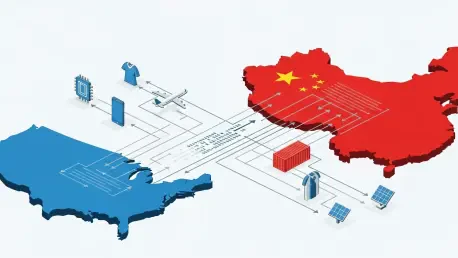

The tectonic plates of global commerce are shifting as the United States aggressively dismantles decades of industrial reliance on Chinese manufacturing in favor of a more resilient, multipolar supply chain. This historic pivot represents far more than a simple trade dispute; it is a fundamental realignment of the world’s most significant economic partnership. By prioritizing national security and domestic stability, American policymakers and corporate leaders are effectively redrawing the map of global production to favor trusted allies and regional neighbors.
Strategic necessity now dictates every facet of procurement, moving beyond the simple search for the lowest possible cost. In this high-stakes environment, the drive for supply chain resilience has become a non-negotiable requirement for survival in a volatile geopolitical landscape. Consequently, the transition from deep dependency to strategic diversification is accelerating across every major industrial sector, signaling the end of an era defined by unhindered globalization and the beginning of a more fragmented, yet secure, trade model.
Tracking the Shift: Data and Industrial Transformation
Statistical Evidence: The Decoupling Trend
Hard data now confirms the dramatic erosion of China’s dominance within the American market. For instance, the toy and game sector has seen a staggering decline, with China’s market share falling from a peak of 80% to a mere 53% in recent years. This trend is even more pronounced in the electronics market, where video game console imports from China plummeted from 86% to approximately 25%. Such figures illustrate a systematic withdrawal from traditional manufacturing hubs that once seemed irreplaceable.
The computing equipment sector provides perhaps the most striking evidence of this divorce. While total U.S. imports reached a record high of $251 billion, the share originating from China has collapsed. Simultaneously, the pharmaceutical industry has marginalized Chinese contributions to less than 3% of the total market. These shifts are not isolated incidents but part of a coordinated effort to insulate critical infrastructure from external political pressures and potential supply disruptions.
Sector-Specific Applications: Regional Pivots
Major shifts are occurring as the furniture and apparel industries migrate toward Mexico and Vietnam to take advantage of proximity and lower political risk. This geographic evolution is mirrored in the electronics sector, where Taiwan, Thailand, and Vietnam have emerged as the primary hardware hubs for American tech giants. These “friend-shoring” strategies allow corporations to maintain production efficiency while significantly reducing the threat of sudden trade barriers or logistical bottlenecks.
Moreover, the rise of these alternative manufacturing centers has transformed regional economies, creating new industrial clusters that challenge the old status quo. While China remains a major producer of plastics and basic electronics, its influence over high-value components continues to wane. By diversifying their geographic footprint, U.S. companies are effectively hedging against the uncertainty of a single-source model, ensuring that a disruption in one region no longer paralyzes an entire global operation.
Expert Perspectives: Trade Diversification and Enforcement
Trade economists remain focused on the “transshipment” phenomenon, where Chinese-made goods are rerouted through third-party nations to evade existing tariffs and regulations. This practice complicates the decoupling narrative, as it suggests that some degree of indirect reliance persists despite the visible shift in direct trade data. Analysts emphasize that while the origin labels on products may change, the underlying components often still trace back to Chinese factories, requiring more rigorous enforcement and transparency.
Supply chain strategists are also weighing the significant costs associated with moving from “just-in-time” to “just-in-case” inventory models. While this transition enhances security, it often results in higher overhead and potential inflationary pressures for the end consumer. Experts argue that the price of resilience is a permanent increase in logistics complexity, forcing firms to balance the immediate need for profit with the long-term requirement for geopolitical stability and procurement agility.
The Future of Global Supply Chains: Regionalization and Risk
The trajectory of global commerce points toward an increasingly bifurcated trade system characterized by competing technological standards and localized blocs. As friend-shoring becomes the standard operating procedure, the challenge of replacing China’s massive manufacturing infrastructure remains a significant hurdle. No single nation possesses the sheer scale of production capacity that China developed over decades, suggesting that the future will be defined by a network of smaller, specialized hubs rather than a single replacement.
Furthermore, this regionalization could lead to a permanent divergence in global innovation as different trade blocs adopt unique regulatory frameworks. While this fragmentation increases security, it may also slow down the pace of universal technological advancement. Navigating this new reality requires a sophisticated understanding of both international law and regional politics, as the era of seamless global integration is replaced by a more cautious and calculated approach to international business.
The strategic revaluation of the US-China trade relationship reached a definitive turning point as businesses prioritized geopolitical awareness over short-term savings. Organizations that successfully adapted to this fragmented landscape did so by building agile procurement networks capable of absorbing sudden shocks. Moving forward, the most successful enterprises focused on securing domestic production capabilities while fostering deep partnerships with emerging manufacturing centers. This shift ensured that supply chains remained functional even as traditional trade routes faced unprecedented political and economic pressure.