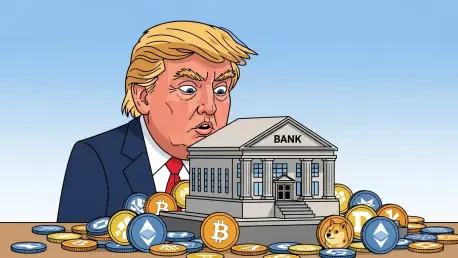

A digital currency company with extensive financial and foundational links to Donald Trump and his family has ignited a political firestorm by applying for a federal bank charter, a move that would place the Trump-linked enterprise directly under the regulatory oversight of his own administration. This unprecedented bid by World Liberty to establish a national trust bank has triggered profound conflict of interest alarms among ethics watchdogs and political adversaries. They argue that granting such a charter would represent an unparalleled fusion of presidential power and personal financial enrichment, blurring the lines between public service and private enterprise. The application now sits with the Office of the Comptroller of the Currency (OCC), thrusting a typically staid federal regulator into the center of a high-stakes debate over ethics, power, and the future of financial regulation in the digital age. The outcome could set a new precedent for how a president’s business interests are handled while in office.
A Web of Political and Financial Connections
The application submitted by World Liberty is not for a minor operational license but for a national trust bank charter, a designation that would fundamentally alter its position within the U.S. financial system. Securing this charter from the Office of the Comptroller of the Currency would grant the company significantly more direct control over the assets of its customers. Specifically, the proposed bank would be tasked with overseeing the issuance of World Liberty’s proprietary stablecoin, known as USD1, and managing the vast reserves of customer funds—totaling in the billions of dollars—required to back it. The controversy stems directly from the regulatory structure: the OCC is a federal agency that ultimately reports to the Trump administration. This creates an environment where a regulator appointed by the president would be responsible for supervising a financial institution in which the president’s family holds a substantial financial interest, raising questions about impartiality and the potential for preferential treatment.
The Trump family’s deep-seated involvement with World Liberty is explicitly detailed and goes far beyond a simple investment. An affiliated entity connected to Donald Trump and various family members commands an approximate 38 percent ownership stake in World Liberty’s holding company, making them major beneficiaries of the company’s potential success. The company’s leadership structure further cements these ties, with Donald Trump himself listed in a prominent “co-founder emeritus” role. His sons, Donald Trump Jr., Eric Trump, and Barron Trump, are all officially named as co-founders of the venture. The intertwining of political and business interests is further underscored by the proposed leadership for the new bank. The institution is slated to be led by Zach Witkoff, another one of World Liberty’s co-founders and, significantly, the son of Steve Witkoff, who serves as a White House envoy. This intricate network effectively embeds the crypto enterprise within Trump’s immediate familial and political circles, making the regulatory review process exceptionally sensitive.
Diverging Views on Presidential Ethics
The move has been met with swift and severe condemnation from critics, who view World Liberty’s application as a blatant and deeply concerning example of a conflict of interest. Corey Frayer, who formerly advised on crypto policy at the Securities and Exchange Commission, characterized the effort as a “pretty straightforward smash-and-grab while the president has control over economic and regulatory policy.” His comment highlights a widespread belief that the Trump family is actively leveraging the power of the presidency to secure a unique and potentially unfair competitive advantage in the highly regulated financial sector. Senator Elizabeth Warren, a senior Democrat on the Senate Banking Committee, took direct action by formally urging the Comptroller of the Currency, Jonathan Gould, to refuse to even review the application until every financial conflict involving Trump and his family was fully resolved. Reinforcing this sentiment, Noah Bookbinder, the former head of the ethics watchdog group CREW, articulated the broader risk, stating, “It’s hard to be confident that anything he does is unaffected by his potential business interests. And that seems like a dangerous place to be.”
Conversely, the White House, the Trump Organization, and World Liberty have mounted a vigorous defense, vehemently denying any wrongdoing and dismissing all allegations of conflicts of interest as baseless. White House press secretary Karoline Leavitt issued a categorical denial, asserting that Trump and his family “have ever engaged, or will ever engage, in conflicts of interest” and labeling the accusations as politically motivated fabrications by the media. David Wachsman, a spokesperson for World Liberty, framed the bank application not as an attempt to sidestep regulations but as a proactive effort to embrace them. He argued that obtaining a federal charter would subject the company “to more regulation, not less” and would ultimately serve to “increase transparency and consumer protection.” He also sought to downplay the Trump family’s influence by clarifying that their stake in the trust company is a “nonvoting interest” and that they would not be involved in the day-to-day operations of the business. Donald Trump himself has appeared unconcerned by the criticism, justifying his family’s business pursuits by stating he learned from his first term that “nobody cared.”
Navigating a Politicized Regulatory Landscape
Positioned at the epicenter of this political and ethical maelstrom is the Office of the Comptroller of the Currency, the agency tasked with making a decision on the charter. The OCC has publicly stated that its review process is “inherently apolitical” and that it conducts “rigorous reviews” of all applicants based on a consistent set of statutory criteria. Comptroller Jonathan Gould, while declining to comment on the World Liberty application specifically, has firmly affirmed this neutral stance, stating, “If they meet the statutory factors, if they can meet our high supervisory expectations, then we will grant them a charter.” The agency has previously granted conditional approval for similar charters to five other cryptocurrency companies, suggesting a consistent procedural framework is in place. However, Gould’s refusal to heed Senator Warren’s demand to halt the review underscores the intense political pressure surrounding a decision that is now viewed through a partisan lens, regardless of the agency’s claims of impartiality.
The controversy unfolded against the backdrop of the Trump administration’s overtly pro-crypto policy agenda, which represented a significant departure from previous regulatory postures. This shift created a more favorable environment for the industry through actions such as the SEC dropping high-profile lawsuits against crypto giants, the Justice Department scaling back on enforcement actions, and the president himself signing a bill aimed at integrating stablecoins into the mainstream financial system. This crypto-friendly climate, while celebrated by industry players, also fueled suspicions among critics. Even some Republicans, like noted crypto advocate Senator Cynthia Lummis, expressed that certain promotional events for a Trump-branded crypto token gave her “pause.” As the debate raged, Democrats attempted to insert conflict-of-interest guardrails into pending crypto legislation but failed to secure bipartisan agreement. With legislative remedies stalled, critics viewed the upcoming midterm elections as their primary opportunity to gain the political leverage necessary to launch formal investigations into what they considered to be serious ethical breaches at the highest level of government.