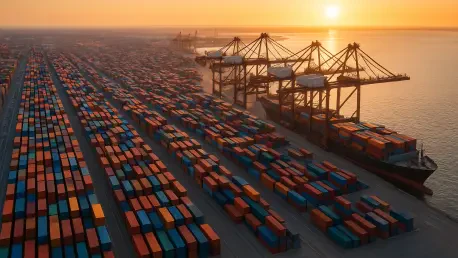

The rapid dismantling of the globalized trade architecture has reached a fever pitch as American borders now function more like fiscal walls than conduits for international commerce. This shift represents a stark departure from the multi-decade consensus on free trade that dominated the late twentieth century. In its place, a robust framework of protectionism has emerged, fundamentally reshaping how goods enter the domestic market and how businesses plan their supply chains. The transition from a low-tariff environment to one characterized by aggressive barriers marks a historic pivot in the nation economic posture, signaling a new era of industrial policy where the government takes a central role in picking winners and losers through customs duties.
The scope of the current trade escalations encompasses several legal mechanisms designed to prioritize domestic production over foreign procurement. Key segments of this policy include Section 232, which addresses national security concerns regarding pharmaceuticals and metals, and Section 301, which targets perceived unfair trade practices by global competitors. Additionally, Section 338 has been utilized to implement retaliatory measures against specific trading partners, creating a layered defense of American industry. This posture is increasingly driven by a desire for technological sovereignty and a significant domestic manufacturing resurgence, reflecting a belief that the country must decouple from global supply chains to maintain its competitive edge.
Mapping the Seismic Shift in U.S. Trade Policy and Protectionism
American trade policy has undergone a fundamental transformation that prioritizes protectionist frameworks over the previous preference for open markets and global cooperation. The current strategy aims to insulate the domestic economy from international volatility by raising the cost of imported goods, thereby incentivizing local manufacturing. This is not merely a collection of isolated duties but a comprehensive shift toward a more insular economic model. By leveraging a variety of statutory authorities, the administration has successfully pivoted the country toward an industrial strategy that views trade through the lens of national power and economic resilience.
The influence of technological sovereignty has become a cornerstone of this new trade posture, with barriers erected to protect critical sectors from foreign encroachment. Domestic manufacturing priorities are now the primary driver of trade policy, leading to the creation of new barriers that would have been unthinkable a decade ago. These measures are intended to foster an environment where American firms can thrive without the pressure of low-cost international competition. However, this seismic shift also forces a reconfiguration of global alliances and trade routes, as nations respond to the more aggressive American stance with their own protective measures.
Shifting Market Dynamics and the Return of Mid-Century Tariff Levels
The New Normal: Transitioning from Open Trade to Aggressive Protectionism
The transition from open trade toward aggressive protectionism has established a new normal for both consumers and businesses operating within the United States. Current trends indicate a decisive move toward protectionist levels not seen since the 1960s, as the government seeks to reverse decades of outsourcing. This shift has triggered significant changes in consumer behavior, as the rising cost of imported finished goods forces households to reevaluate their purchasing habits. Businesses, too, are adjusting their strategies, often choosing between absorbing the higher costs or passing them on to a weary public in the form of higher prices.
Market drivers in the current environment are largely defined by the push for a domestic industrial resurgence, often referred to as the goal of a new liberation day for American workers. This movement is characterized by a belief that high tariffs are the most effective tool for bringing factories back to the states and securing the supply chain for essential products. As these policies take root, the economic landscape is becoming more fragmented, with domestic producers enjoying a degree of insulation while importers face increasingly daunting fiscal hurdles. The resulting market dynamics are volatile, requiring constant vigilance from corporate leadership to navigate the shifting sands of trade regulations.
Gauging Economic Heat: Historical Rate Spikes and Revenue Benchmarks
A historical comparison reveals the sheer magnitude of the current rate spikes, as the weighted average tariff rate has climbed dramatically from its 2022 level of 1.5 percent. Current projections suggest that as temporary measures transition into more permanent fixtures, these rates will hit an 11.8 percent benchmark. Such a leap represents a monumental change in the cost of doing business, placing the United States in a position it has not occupied for over half a century. The rapid escalation of these duties has caught many analysts by surprise, highlighting the administration commitment to a high-tariff regime regardless of historical precedents for lower rates.
Performance indicators for the effective tariff rate show that the nation has reached levels not seen since 1947 and 1969, marking a true return to mid-century economic tactics. Forward-looking projections for customs duty collections through 2026 indicate a massive influx of cash into the federal treasury, though this revenue comes at a significant cost to trade volume. The current fiscal year is seeing the highest duty collections in modern history, reflecting both the expanded scope of the tariffs and the resilience of certain import categories. This historical rate spike serves as a heat map for the economy, signaling where the pressure is most intense and where the government is focusing its protective efforts.
Navigating the Complexities of Fiscal Leakage and Legal Hurdles
The implementation of these trade barriers has not been without significant legal and fiscal challenges, particularly regarding judicial interventions. A major hurdle emerged from the International Emergency Economic Powers Act refund requirements, which forced the government to return billions in collected duties after courts ruled certain measures overextended executive authority. This legal volatility creates a climate of uncertainty for businesses that must plan their budgets years in advance. Navigating these judicial setbacks requires a sophisticated understanding of trade law and a readiness to pivot when regulations are struck down or modified by the courts.
Furthermore, the mechanical interaction between rising tariffs and the broader tax system creates a phenomenon known as fiscal leakage, where the gains from customs duties are offset by losses in other areas. As the cost of inputs rises for domestic manufacturers, their profitability decreases, which in turn reduces the corporate tax base. Similarly, if businesses pass these costs to consumers, discretionary spending drops, impacting payroll and individual income tax collections. This erosion of the broader tax base means that the net revenue generated by tariffs is often far less than the gross collections reported by customs agencies.
Strategies for managing this volatility must account for the fact that trade policy has shifted over fifty times within a relatively short period. Businesses are forced to adopt highly flexible supply chain models that can respond to sudden changes in duty rates or the introduction of new retaliatory measures. Moreover, the persistence of the savings-investment gap suggests that tariffs alone are unable to balance the national trade account. The theoretical fallacy that trade barriers can fix a deficit without addressing underlying capital flows remains a point of contention among economists, as the nation continues to rely on foreign investment to fund its growth despite the high cost of imports.
Deciphering the Statutory Landscape and Regulatory Authorities
The current regulatory landscape is a complex tapestry of various sections of trade law, each targeting different aspects of the global economy. Section 232 has been aggressively applied to pharmaceuticals and metals, categories deemed essential for national security and public health. This authority allows for broad executive action, but it also invites scrutiny regarding the definition of security in a modern economic context. Similarly, the use of Section 338 against partners like Canada marks a significant escalation in regional trade tensions, forcing a reexamination of long-standing North American trade agreements.
In addition to these sector-specific measures, temporary Section 122 balance-of-payments tariffs have been implemented to address immediate fiscal concerns. These measures are designed to provide a short-term buffer against international trade imbalances, though they often clash with international trade standards and the rules of global bodies. Compliance requirements have become increasingly stringent as a result, with new security measures driving the reshored supply chain strategy. Companies must now provide exhaustive documentation to prove their goods do not violate the intricate web of new regulations, adding a layer of bureaucratic cost to every shipment.
The role of foreign retaliatory tariffs acts as a critical regulatory counter-weight that complicates the administration goals. These measures currently impact $223 billion in American exports, hitting the agricultural and high-tech sectors particularly hard as trading partners strike back. This dynamic creates a tit-for-tat environment that can spiral out of control, eroding the benefits of protectionism for domestic producers who also rely on foreign markets for their sales. The regulatory environment is therefore not just a domestic matter but a global chess match where every move by the United States triggers a response from its largest trading partners.
Anticipating the Long-Term Economic Trajectory and Structural Disruptions
Looking ahead, the long-term economic trajectory is marked by significant structural disruptions that could reduce long-run GDP by 0.4 percent to 0.6 percent. While certain domestic industries may see a localized boom, the overall effect on the economy is likely to be a slowing of growth as capital is misallocated toward less efficient domestic production. Market disruptors are emerging in the form of higher inflation and reduced investment in innovation, as firms prioritize tariff compliance and supply chain restructuring over research and development. This shift suggests a more stagnant economic future where the gains from trade are sacrificed for the perceived stability of isolation.
Labor market forecasts are equally concerning, with projections showing a potential loss of over 500,000 full-time equivalent jobs across various industrial sectors. While the policy aims to protect manufacturing jobs, the higher costs for raw materials and the impact of foreign retaliation often lead to layoffs in other areas of the economy. For instance, the automotive and parts sectors are particularly vulnerable to the rising cost of steel and aluminum, which can outweigh the benefits of protection for the primary metal producers themselves. This trade-off illustrates the difficulty of using tariffs to boost employment without causing collateral damage in interconnected industries.
The regressive nature of these consumption taxes also impacts household purchasing power and consumer choice, often acting as a hidden tax on those who can least afford it. When the price of everyday goods rises due to import duties, lower-income families are forced to spend a larger portion of their earnings on basic necessities, leaving less for savings or other investments. This dynamic can dampen long-term economic mobility and increase wealth inequality, as the costs are borne disproportionately by the public. Furthermore, the 10-year revenue outlook remains highly sensitive to global economic conditions and the persistence of foreign retaliation, making long-term fiscal planning a challenge for the government.
Synthesizing the Fiscal Reality and Potential Paths Forward
The fiscal reality of the current trade regime became clear when the dynamic revenue projection of $1.18 trillion was compared to the more optimistic conventional forecast of $1.6 trillion. This discrepancy highlighted how the contraction of the broader economy effectively cannibalized the very revenue the tariffs were intended to generate. It was found that the 10 percent Section 122 measures and the permanent suite of duties under Sections 232 and 301 created a fiscal landscape where gross gains were consistently undermined by systemic losses. Policy analysts observed that the net benefit to the federal treasury was smaller than anticipated, once the costs of economic distortion were fully integrated into the models.
The distributional impact of these policies was revealed to be heavily regressive, with the average American household facing an annual burden of approximately $900. This figure represented a significant portion of the disposable income for many families, functioning as the 19th largest tax hike in the country history since 1940. The investigation showed that while certain manufacturing hubs saw a modest increase in activity, the broader public experienced a measurable decline in after-tax income. Consequently, the push for industrial resurgence came at the direct expense of consumer purchasing power, creating a tension between national policy goals and the financial health of the average citizen.
Navigating the future of the industry required a shift toward more resilient and diversified business models that could withstand long-term economic distortions. Experts recommended that firms prioritize vertical integration and regional sourcing to mitigate the impact of unpredictable trade barriers. The final assessment of the period suggested that while the tariffs achieved certain political objectives regarding domestic manufacturing, they also locked the nation into a path of lower national income and persistent trade friction. Moving forward, the focus shifted toward finding a balance between protecting critical industries and maintaining the efficiencies that only international cooperation can provide.