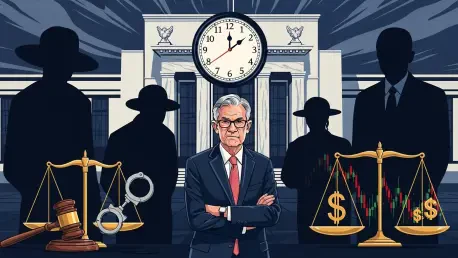

The rhythmic ticking of the economic clock has grown increasingly erratic as Jerome Powell refuses to blink in a high-stakes confrontation with the Department of Justice. While a looming federal inquiry might prompt most officials to seek a quiet exit, Powell is standing his ground, signaling that the Federal Reserve will not be intimidated by legal or political pressure. This resolve transformed from a personal stance into a institutional defense following a major court victory that many view as a shield for central bank independence.
The Stand-Off at the Federal Reserve
Powell has explicitly stated he is not stepping down, initiating a sophisticated game of chicken with federal investigators. Supported by a recent ruling that dismissed grand jury subpoenas as a “pretext” to influence interest rates, he remains fortified in his role. This defiance is a direct challenge to the idea that executive branch maneuvers can dictate the movement of the federal funds rate.
By leaning into his position, Powell is protecting the technocratic nature of the institution. He views his continued presence as a necessary barrier against the politicization of monetary policy. This struggle is no longer just about a single leadership role; it is about whether the Fed can remain an insulated body or if it will eventually succumb to the pressures of the Department of Justice.
Why the Powell-DOJ Conflict Matters to the Economy
The friction between the Fed and the DOJ reaches far beyond the walls of Washington D.C., touching every corner of the American financial system. At its core, this dispute tests the limits of executive oversight and the validity of legal maneuvers used as a smoke screen for economic agendas. In an environment where inflation remains stubborn and Middle Eastern tensions threaten energy costs, Powell’s stability serves as a primary anchor for global investors.
The outcome of this inquiry will determine the future of US fiscal credibility. If the chairmanship becomes a revolving door dictated by the DOJ, the market could lose its most vital stabilizing force. Investors are currently weighing whether the Fed remains a neutral arbiter or if it has become a tool for the executive branch to manipulate labor and price stability during volatile cycles.
Legal Maneuvers and the Road Ahead for the Chairmanship
A federal judge’s decision to block the DOJ’s subpoenas provided Powell with significant leverage, characterizing the investigation as an attempt to coerce rate cuts. Despite U.S. Attorney Jeanine Pirro’s intent to appeal the ruling, Powell’s strategy is to remain as “pro tem” chair until a successor is officially confirmed by the Senate. This tactical move effectively prevents a leadership vacuum during a period of extreme economic sensitivity.
Meanwhile, the persistent criticism from Donald Trump adds a layer of complexity to Powell’s defense of his seat. He must simultaneously manage internal divisions among Fed officials regarding productivity gains and labor market fragility while fighting a public legal battle. The “pro tem” status allows him to maintain control of the gavel, ensuring that the central bank’s trajectory is not derailed by an unconfirmed or politically appointed replacement.
Internal Perspectives on Economic Resilience and Productivity
Inside the Federal Reserve, the mood is one of cautious navigation rather than unified certainty. While the legal battle captures the headlines, policymakers are more concerned with the surge in oil prices and its potential to reignite inflation. Expert consensus within the board suggests that while rate cuts are still discussed for later this year, a “fragile labor market” has created a deep rift in how to proceed with monetary easing.
Policymakers are currently weighing the benefits of economic resilience against the risks of a premature pivot. Some officials argue that previous tax cuts have fueled productivity, while others fear that the impact of high interest rates is finally catching up with the consumer. Powell’s steady hand remains a crucial, if controversial, element of the current strategy as the board seeks a middle ground between growth and stability.
Navigating the Uncertainty: What to Watch For
To understand the trajectory of Powell’s tenure and the resulting economic impact, observers focused on three specific indicators. First, the progress of Jeanine Pirro’s appeal determined if the legal pressure would be renewed. Second, the “pro tem” confirmation process served as a barometer for Powell’s grip on power; as long as no successor reached the Senate floor, his influence remained unchallenged.
Finally, shifts in the Fed’s communication regarding oil prices and Middle Eastern stability provided the necessary justification to stay the course. Analysts looked for a transition toward a more transparent selection process for the next chair to ensure long-term market confidence. Establishing a clear roadmap for leadership succession became the most effective way to insulate the American economy from the fallout of this unprecedented institutional conflict.