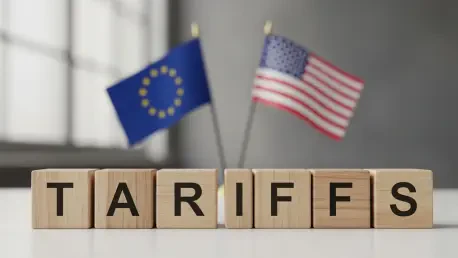

A leading voice in policy and legislation, Donald Gainsborough of Government Curated joins us to dissect the escalating trade tensions between the United States and the European Union. As tariff threats reverberate across the Atlantic, we’ll explore the potential activation of the EU’s powerful “trade bazooka,” the conflicting signals coming from financial markets, and the very real dangers of market complacency in the face of geopolitical posturing. Gainsborough will offer his perspective on what a viable path to de-escalation looks like and the high stakes for the global economy if one isn’t found.
The EU is considering activating its Anti-Coercion Instrument, which could restrict U.S. investment and intellectual property rights. What specific American industries would be most vulnerable to this “trade bazooka,” and what practical steps could they take now to mitigate those risks?
This so-called “trade bazooka” is designed for surgical strikes, not indiscriminate damage. The most vulnerable sectors are those deeply integrated with the European market. Think about American tech firms whose lifeblood is intellectual property; suddenly finding their IP protections weakened in the EU would be a devastating blow. Similarly, aerospace, defense, and infrastructure companies that bid on large public procurement contracts would find themselves locked out. The practical steps for these industries are challenging but necessary. It involves stress-testing supply chains, exploring legal protections for IP in non-EU jurisdictions, and, most importantly, engaging in frantic, behind-the-scenes lobbying to urge policymakers on both sides to step back from the brink. They need to make the economic cost of this conflict painfully clear to those in power.
The White House highlights a rising S&P 500 and lower bond yields as proof of market confidence in its policies. How do you reconcile that view with fears of a trade war, and what specific metrics should business leaders be watching to gauge the market’s true sentiment?
That’s a classic case of seeing the data you want to see. Yes, the S&P 500 is up over 10 percent, which on the surface looks like a vote of confidence. However, you have to look under the hood. That rise can be driven by domestically-focused companies or a belief that the administration’s pro-business policies outweigh the tariff risks for now. More telling is the nearly 30-basis-point drop in 10-year Treasury yields. A flight to the safety of government bonds is often a sign of fear, not confidence. Investors are buying Treasurys because they’re nervous about riskier assets. Business leaders should ignore the headline numbers and watch sector-specific ETFs for trade-sensitive industries, currency volatility between the dollar and the euro, and credit default swap spreads for major transatlantic banks. Those are the canaries in the coal mine.
Some analysts believe the market is complacent, viewing tariff threats as just a negotiating tactic. What are the primary dangers of this complacency, and could you walk us through a scenario where a negotiation fails and triggers a more severe, unexpected market reaction?
The complacency Brij Khurana mentioned is the single greatest danger right now. When the market treats every threat as mere rhetoric, it stops pricing in the real risk of a policy mistake. The danger is a sudden shock. Imagine a scenario: talks break down over the Greenland issue, which many see as peripheral. The U.S. announces a surprise 25% tariff on European auto imports. The EU immediately retaliates with its Anti-Coercion Instrument, targeting U.S. tech and finance. Because the market wasn’t hedged for this, the reaction would be a violent sell-off. We would see a liquidity crunch as investors scramble for cash, a spike in volatility, and a rapid reassessment of every company with transatlantic exposure. The “negotiating tool” would suddenly become a real economic weapon with real victims, and the market would panic because it had lulled itself to sleep.
Banking CEOs have expressed optimism about the U.S. economy but are also urging a quick resolution to these disputes. From their perspective, what does a viable “off-ramp” look like, and what are the key economic disruptions they are most concerned about if a deal isn’t reached?
When you hear bankers like Brian Moynihan or Jane Fraser urge leaders to get in a room and find a solution, they’re speaking from the heart of the global financial system. From their vantage point, a viable “off-ramp” isn’t about one side winning; it’s about re-establishing predictability. It could be a temporary truce, a mutual agreement to pause new tariffs while a formal commission addresses the core issues around defense spending and trade imbalances. They are most concerned about a seizure in the gears of global trade. A full-blown trade war disrupts supply chains, yes, but it also freezes corporate investment. Companies won’t commit billions to new factories or projects if they don’t know what the rules will be in six months. That freeze in capital expenditure is what can tip a healthy economy into a recession, and that’s what keeps banking CEOs up at night.
The Treasury Secretary has urged European leaders to take a deep breath and avoid retaliation. What are the strategic benefits for the EU in heeding this advice versus acting decisively now? Please provide a step-by-step breakdown of how each path could play out for trans-Atlantic trade.
The Treasury Secretary is essentially asking the EU to absorb the first punch. The strategic benefit of this path—Path A, let’s call it—is that it allows the EU to claim the moral high ground. Step one: The U.S. imposes tariffs. Step two: The EU publicly condemns the move but holds its fire, appealing to international bodies and backchannels. Step three: This puts the diplomatic onus on Washington and could rally other global partners to the EU’s side, isolating the U.S. The downside is that it projects weakness.
Path B is to act decisively, as President Macron suggests. Step one: The U.S. imposes tariffs. Step two: The EU immediately retaliates with its own targeted measures, hitting sensitive U.S. exports and investments. Step three: This triggers a tit-for-tat escalation, creating immense economic disruption and market volatility. The strategic benefit here is demonstrating that the EU will not be bullied, potentially forcing a quicker return to the negotiating table. The risk is immense; once this cycle begins, finding an off-ramp becomes exponentially more difficult, and both economies suffer significant damage.
What is your forecast for U.S.-EU trade relations over the next 12 months?
My forecast is for a period of sustained and uncomfortable volatility. I don’t foresee a complete breakdown into an all-out trade war, because the economic costs are simply too catastrophic for both sides. However, the era of quiet, predictable transatlantic trade is over. We will likely see a series of skirmishes—threats followed by negotiations, followed by limited, targeted actions. The baseline will be tense, with markets reacting nervously to every political statement. The most optimistic scenario is a fragile, constantly renegotiated truce. The most realistic scenario is a “managed conflict,” where both sides use trade measures as a persistent geopolitical tool, creating a challenging and uncertain environment for businesses for the foreseeable future.