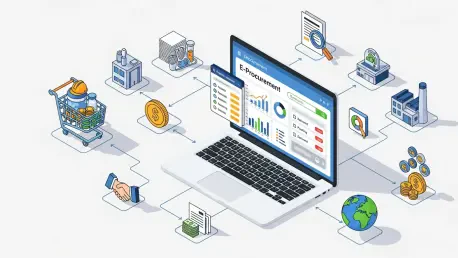

Public procurement is one of the largest levers in public finance. When budgets are tight and scrutiny is intense, paper-driven purchasing increases cost, risk, and time. E-procurement is not a shopping cart. It is the control system that turns policy into predictable outcomes across sourcing, purchasing, and payment.
What Is E-Procurement?
E-procurement is the end-to-end process of buying and selling goods and services through a digital platform that enforces policy, captures data, and creates a complete audit trail. In the public sector, it spans source-to-contract and procure-to-pay, integrates with core finance and ERP systems, and translates procurement rules into workflow and approvals.
Unlike open B2B e-commerce built for broad market access, public-sector e-procurement operates in a closed, policy-governed environment. Access is permissioned. Catalogs reflect approved contracts, framework agreements, and negotiated terms. Every action is attributable and time-stamped for audit.
According to OECD data, public procurement expenditure as a share of GDP across the OECD was about 12.9 % in 2021, and in some EU‑OECD countries it was around 14.8 % of GDP, highlighting its sizable economic footprint in government spending.
Industry estimates also note that public procurement accounts for roughly 12 to 15 % of GDP in developed economies, making governments collectively among the largest buyers.
Smarter Supply Chains Through Policy-Driven Platforms
E-procurement strengthens supply chain management by making policy compliance the default behavior and giving agencies a unified view of spend, suppliers, and risk.
Guided buying steers requisitioners to on-contract items and services, with real-time checks that enforce thresholds, competition requirements, small business goals, and sustainability criteria. Centrally managed catalogs reduce price variance, off-contract purchases, and duplicate suppliers, and updates propagate system-wide without retraining end users.
A single supplier record links contracts, performance history, insurance, certifications, and sanctions or debarment checks, which supports vendor risk management and simplifies renewal decisions. Three-way match across purchase order, receipt, and invoice creates a complete, searchable audit trail that shortens audit cycles and reduces questioned costs. When discrepancies arise, digital collaboration flags them with context and gives suppliers structured, actionable requests rather than unresolved email threads.
Resilience is also improved. Alternate items and secondary suppliers are visible at the point of need, so agencies can respond to shortages without bypassing policy.
Regulatory momentum is reinforcing adoption. In the U.S., procurement modernization is advancing through the Office of Management and Budget guidance on digital acquisition. And the Prompt Payment Act’s electronic invoicing provisions keep digitization at the center of finance modernization efforts.
Behind the Scenes: A Modern Procurement Platform in Action
A modern public-sector platform follows a clear sequence. Each step translates a procurement rule into a system control.
Supplier onboarding. Vendors register and provide tax identifiers, banking details, insurance, and certifications. Required documents and attestations are collected upfront. Debarment and sanctions lists are checked before activation.
Catalog and contract setup. Contracted items, services, and prices are loaded as catalogs tied to contract IDs, expirations, and usage conditions. Service categories define statements of work and deliverables.
Guided requisitioning. Authorized users search approved catalogs or request services through structured forms. The system surfaces compliant options first and displays negotiated prices.
Policy-based approvals. Approvals route automatically based on dollar thresholds, funding sources, category risk, and conflict-of-interest controls. Segregation of duties is enforced by design.
Purchase order issuance. The system creates and transmits a purchase order to the supplier. Changes are versioned and tracked from dispatch to acknowledgment.
Receipt and service confirmation. Requesters record receipts or completed milestones. Quantity, unit price, and terms are validated at the time of receipt to prevent later disputes.
E-invoicing and three-way match. Suppliers submit electronic invoices validated against the purchase order and receipt. Exceptions are flagged immediately, which reduces manual touches and accelerates payment.
Payment and discounting. Approved invoices flow to accounts payable with the correct terms. Where policy allows, agencies can offer early payment programs to capture discounts and improve supplier cash flow.
Analytics and audit. Every event is logged. Leaders see on-contract spend, cycle times, exception rates, and supplier performance. The audit trail is complete and exportable.
Unlocking Efficiency, Compliance, and Value
The gains from e-procurement compound when policy and process are embedded directly in the system rather than enforced through manual review.
On-contract spend rises when guided buying steers demand to approved contracts, reducing price variance and unnecessary purchases. Spend analytics surface consolidation opportunities and duplicate vendors that are invisible in paper-based systems.
Automation cuts the cost per invoice substantially. Workflow, validations, and straight-through processing reduce manual touches. Benchmarks show top performers now process invoices for under three dollars, while lower performers still spend over ten. Guided buying and auto-approvals for low-risk transactions also remove avoidable delay, allowing staff to focus on complex sourcing work rather than routine processing.
Fewer errors and disputes follow from field-level validations and three-way match, which eliminate most arithmetic mistakes and miskeyed data. Invoice exceptions drop, and suppliers receive payments that match the purchase order. Every decision, change, and approval is time-stamped and attributable, making records straightforward to produce for auditors, oversight bodies, and the public.
The supplier experience improves as well. Clear onboarding, cataloged items, and reliable payment status reduce friction for vendors, which matters especially for small and diverse businesses with limited administrative capacity.
The Building Blocks of Modern Government Purchasing
Source-to-contract covers strategic sourcing, solicitation, evaluation, award, and contract lifecycle management. It standardizes templates, scoring, and approval chains, and stores contract metadata including ceiling values, duration, pricing schedules, and performance requirements.
Procure-to-pay governs requisitions, approvals, purchase orders, receipts, invoices, and payments. It enforces funding rules, prevents duplicate vendors, and connects to the general ledger. This is where guided buying and three-way match do the heavy lifting.
Supplier relationship management consolidates supplier profiles, risk indicators, performance metrics, and communications. It enables proactive outreach on expirations and compliance updates to avoid last-minute disruptions.
Analytics provides spend visibility, exception dashboards, and KPI trend lines across on-contract spend, invoice first-pass match rate, cycle time by category, supplier performance, and small business participation.
Pitfalls, Hurdles, and How to Overcome Them
E-procurement is not a silver bullet. Several challenges recur across government programs, and the agencies that succeed address them directly in design and governance.
Dark purchasing. Buying outside approved contracts can be reduced with guided buying and controls, but only if contracts are current and catalogs are accurate. Gaps in content invite workarounds.
Long cycle times. Bottlenecks often hide in approvals, incomplete requisitions, or unclear scopes of work. Map the path of a transaction, remove non-value steps, set service-level targets for each stage, and report them monthly.
Inaccurate or fragmented data. Inconsistent supplier names, missing contract IDs, and free-text line items break analytics. Establish data standards such as UNSPSC coding and required fields, and automate validations at the point of entry.
Supplier relationship gaps. Small vendors struggle with long onboarding, unclear documentation, and unpredictable payment timing. Make supplier communications transparent and structured, and align payment terms with the Prompt Payment Act. Where early payment programs are offered, make fees clear and optional.
Integration debt. Legacy ERPs and multiple agency systems create brittle handoffs. Use modern APIs where available, set a single system of record for suppliers and contracts, and avoid duplicating master data across platforms.
Cybersecurity and access controls. E-procurement centralizes sensitive financial and vendor data. Enforce multi-factor authentication, role-based access, and audit logging. Review permissions when staff changes roles, not just annually.
Change fatigue. A new system fails without adoption. Provide guided experiences that make the right action the easiest action. Train approvers differently from requisitioners. Measure adoption and intervene early where usage lags.
Common Questions About Digital Government Buying
Is e-procurement the same as B2B e-commerce?
No. E-procurement is a closed, policy-controlled environment tied to agency contracts and rules. B2B e-commerce is open-market buying. Public agencies require approvals, audit trails, and policy enforcement that consumer-style storefronts do not provide.
Does e-procurement require replacing the ERP?
Not necessarily. Most agencies integrate e-procurement with existing finance and ERP systems. The procurement layer handles policy, catalogs, and workflow, while the ERP remains the system of record for the general ledger and payments.
What KPIs matter most?
Focus on on-contract spend percentage, requisition-to-purchase-order cycle time, invoice first-pass match rate, share of invoices processed without manual touch, exception rate by category, small business spend share, and percentage of payments made on time.
How can small and diverse businesses be included?
Make onboarding simple and digital. Publish clear documentation templates. Use catalogs for common services at standardized rates. Pay on time, communicate status transparently, and avoid policies that bundle demand in ways only large firms can service.
How is compliance with procurement rules enforced?
Rules and thresholds should be modeled in the workflow. The system should enforce competition requirements, conflict-of-interest checks, spend limits, and approvals. Every step must be attributable, time-stamped, and easy to export for audit.
What role do interoperability standards play?
Adoption of frameworks such as Peppol has increased steadily as agencies pursue interoperable electronic document exchange. (Source: OpenPeppol, Annual Report 2023) Platforms built on open standards reduce vendor lock-in and simplify future integration as mandates evolve.
Conclusion
The constraint is not awareness that e-procurement reduces cost per invoice or understanding that guided buying increases on-contract spend. Most procurement leaders recognize these outcomes. The constraint is organizational. It depends on the willingness to fund continuous catalog maintenance, which competes with other IT priorities. It also requires cross-agency coordination to negotiate framework agreements, enforce supplier data standards, and retire legacy purchasing workflows that individual departments may prefer to preserve.
Agencies remain in paper-driven or partially automated procurement despite available platforms because implementation requires decisions that procurement offices cannot solely mandate. Keeping catalogs updated with accurate pricing needs ongoing coordination with contracting officers across agencies. Enforcing data standards requires cooperation from finance, legal, and program offices, which often see data governance as bureaucratic overhead. Retiring departmental purchasing systems necessitate executive authority to override local autonomy and established vendor relationships.
The gap between agencies with 80% on-contract spend and those below 50% is evident in catalog updates, supplier onboarding, and invoice handling. Agencies that struggle to keep catalogs current may adopt e-procurement platforms, but requisitioners may still bypass them through emergency purchases and blanket orders, maintaining the facade of modernization while dark purchasing persists.