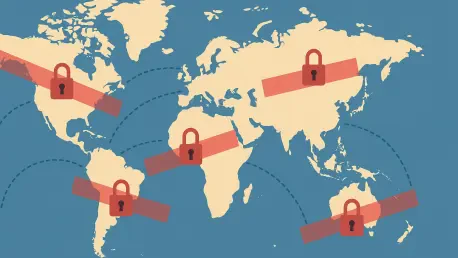

The battlefield for regional dominance has migrated from the dusty plains of the Middle East to the sterile, air-conditioned corridors of global finance where a single keystroke can freeze a military’s future. While traditional warfare is measured in territory gained, the modern struggle for regional stability is increasingly fought through digital ledgers and trade blacklists. The U.S. Treasury’s latest expansion of sanctions marks a departure from broad-based embargoes, moving instead toward a surgical dismantling of the clandestine networks that keep advanced weaponry in production.
By blacklisting a diverse array of entities across five different nations, the U.S. is testing a high-stakes hypothesis. The prevailing theory suggests that the Iranian military machine cannot survive if its global nervous system of shell companies and electronic suppliers is systematically severed. This strategy prioritizes the disruption of logistics over the destruction of physical infrastructure, aiming to create a vacuum in the procurement of essential high-tech components.
The High Stakes of Precision Economic Warfare
The current escalation reflects a shift in priority from general economic pressure to targeted technological denial. Unlike previous decades where the focus remained on oil exports, the modern objective is the disruption of the specialized supply chains that provide the silicon and circuitry necessary for drone and missile production. This precision approach seeks to degrade military capabilities without necessarily inducing a total civilian economic collapse, though the lines between these sectors are increasingly blurred.
Success in this arena depends on the ability of the U.S. government to outpace the adaptability of clandestine procurement agents. As Tehran develops new methods to mask its financial footprints, the Treasury Department must continuously refine its detection algorithms and intelligence-sharing protocols. The stakes are immense, as failure to close these loopholes allows for the continued proliferation of weapons that threaten international shipping lanes and regional allies.
Deciphering the Mandate: Operation Economic Outcast
At the heart of this escalation is “Operation Economic Outcast,” a strategic initiative spearheaded by the Treasury Department to isolate Tehran from the international financial fold. This policy shift gained momentum following the outbreak of hostilities on February 28, transitioning from a reactive stance to a proactive effort to degrade military readiness. The initiative specifically targets the Ministry of Defense and Armed Forces Logistics (MODAFL), aiming to create a bottleneck in the procurement of critical components.
The objective of the campaign is clear: leverage the dominance of the U.S. dollar to force a diplomatic pivot by making the cost of military maintenance unsustainable. Treasury Secretary Scott Bessent has positioned this operation as a non-kinetic alternative to direct conflict, emphasizing that financial isolation is the most effective tool for curbing regional aggression. By cutting off the “oxygen” of foreign currency, the administration hopes to bring a definitive end to the ongoing tensions.
Anatomy of a Global Crackdown: Disrupting Multi-National Networks
The current strategy targets the “middlemen” who obscure the origin and destination of military-grade hardware across international borders. Recent enforcement actions have focused on Hong Kong-based firms like EC Mojo Technology Co Ltd, which allegedly served as a conduit for sensitive electronics, alongside entities in Pakistan, Turkiye, and Saudi Arabia. This multi-front approach signals that the U.S. is no longer acting in a vacuum but is instead building a coalition to close historic loopholes.
A pivotal element of this crackdown is the rare level of regional cooperation, evidenced by the joint designation of Cavalier Dynamics for Technologies Company with the Saudi government. This partnership represents a significant diplomatic achievement, as it aligns regional powers against a shared logistical threat. By synchronizing sanctions lists, these nations are making it increasingly difficult for procurement networks to jump from one jurisdiction to another to escape oversight.
Evaluating the Paradox of Sanction Efficacy and Resilience
Despite the administration’s confidence that these measures will drive a new deal, historical data and expert observations present a more complex reality. While the Iranian currency has plummeted to record lows and the aviation sector faces significant grounding of flights, external analysts remain skeptical of a total collapse. There is a persistent tension between the “unprecedented” economic pressure and Iran’s decades-long expertise in navigating financial restrictions through a shadow economy.
Furthermore, the administration’s willingness to target Chinese firms while simultaneously engaging in high-level trade diplomacy with Beijing adds a layer of strategic friction. This suggests that military containment remains a non-negotiable priority over broader trade harmony, even when it complicates relations with major global powers. The effectiveness of the sanctions is thus a race between the speed of the U.S. enforcement and the innovation of those seeking to bypass it.
Frameworks for Understanding Modern Trade Compliance and Risk
The expansion of these sanctions provided a clear template for the evolution of global trade compliance. The U.S. signaled that no sector was immune—including civilian aviation—if it provided any logistical support to sanctioned regimes. Stakeholders in the financial and shipping industries operated under a framework of “extreme diligence,” where the “tremendous consequences” promised by the U.S. Treasury necessitated a deeper look into the ultimate beneficial ownership of every business partner.
This strategy moved beyond mere list-checking; it required a proactive analysis of supply chain vulnerabilities to ensure that a company’s secondary or tertiary trade partners were not inadvertently fueling military networks. The shift toward a high-transparency model redefined how international banks processed transactions in volatile regions. Ultimately, the framework established during this period forced a fundamental recalculation of risk, proving that technical diligence was the only viable path to maintaining access to the global economy.