
The lush landscapes of the Pacific Northwest are currently serving as a massive laboratory for one of the most ambitious legislative experiments in the history of American energy policy. Since the passage of the 2019 Clean Energy Transformation Act, the region has been legally bound to a trajectory that demands the total elimination of greenhouse gas emissions from its power grid by 2045. However, as the region moves through 2026, the gap between these legislative aspirations and the physical reality of the power grid has become increasingly apparent to policymakers and utility providers alike. This transition is not occurring in a vacuum; it is being challenged by an unprecedented surge in electricity demand that few experts fully anticipated just a decade ago. While the move toward electric vehicles and residential heat pumps was expected to increase loads, the meteoric rise of energy-intensive data centers supporting generative artificial intelligence and cryptocurrency mining has fundamentally altered the regional energy equation. This “perfect storm” of rising demand and aging infrastructure has created a scenario where the reliability of the grid is being tested daily, forcing a critical re-evaluation of how green energy is generated, transmitted, and regulated across the states of Washington and Oregon.
The Local Paradox: Stagnation Amidst Legislative Ambition
Nowhere is the disconnect between state-level environmental mandates and local execution more glaringly obvious than in the administrative offices of Clark County. Despite the state’s urgent call for a rapid transition to renewable sources, local development departments report a baffling absence of active green energy projects within their jurisdictions. While there are approximately 250 “shovel-ready” renewable projects identified throughout Washington, most remain in a state of suspended animation, unable to secure the final approvals or financial backing necessary to break ground. This stagnation is largely attributed to a market structure that remains poorly adapted to the needs of modern renewable developers. In the Northwest, the energy market is dominated by a handful of investor-owned utilities and the federal Bonneville Power Administration, creating a “thin” market where developers struggle to find a diverse pool of potential buyers, or off-takers, for their power. This lack of market depth discourages private investment, as the financial risks of building large-scale solar or wind farms are compounded by the uncertainty of who will ultimately purchase the electricity at a price that justifies the initial capital expenditure.
The regional market’s rigidity is further exacerbated by the fact that many industrial consumers are legally tethered to their local utilities, preventing them from seeking direct agreements with independent renewable producers. Unlike the competitive energy markets found in California or parts of the East Coast, the Pacific Northwest maintains a traditional model where utilities often prioritize their own generation assets over external green energy contracts. This structure leaves small, rural utilities particularly vulnerable, as they rely almost exclusively on the Bonneville Power Administration for their supply. Consequently, even when a community expresses a strong desire to transition to greener power sources, the lack of a robust, competitive procurement system creates a bottleneck that stifles innovation and prevents new players from entering the field. To overcome this hurdle, the region may need to consider radical reforms to its utility regulations, potentially opening the door for more direct-to-consumer power purchase agreements that could provide the financial certainty developers need to move forward with the hundreds of projects currently waiting in the wings.
Grid Connectivity: The Massive Transmission Bottleneck
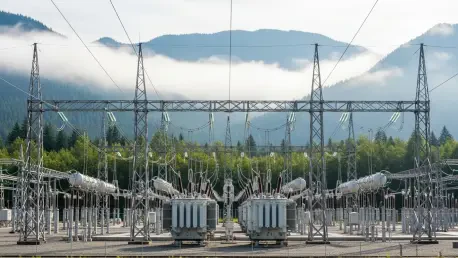
Even when a renewable project successfully navigates the financial and market hurdles, it must still find a way to connect to a regional transmission grid that is currently operating at its absolute limit. The Bonneville Power Administration, which oversees the vast majority of the high-voltage lines in the Northwest, is currently managing a backlog of connection requests that has ballooned to nearly double the region’s total peak generation capacity. A significant portion of this demand is driven by the insatiable appetite of the data center industry, which has seen its connection requests jump from roughly 5 gigawatts to over 20 gigawatts in a very short span of time. The existing infrastructure, much of which was designed to move hydroelectric power from rural dams to urban centers, was never intended to handle the decentralized and intermittent nature of wind and solar power, nor the massive, localized loads required by modern computing hubs. This mismatch between the current grid architecture and the needs of a carbon-neutral future has led to a logistical nightmare where new projects are often quoted wait times of several years just to begin the necessary technical studies.
The administrative process for these grid upgrades is further complicated by a “study cycle” system that often collapses under its own weight. Under this system, the Bonneville Power Administration studies groups of projects together to determine the collective impact on the grid and the costs of necessary upgrades. However, if a single developer in a group decides to withdraw due to rising costs or shifting priorities, the entire group must be re-evaluated, effectively resetting the clock for everyone else in the cluster. This circular process creates a landscape of perpetual delays, leaving viable green energy projects in a state of technical limbo. Compounding these issues are federal staffing shortages and hiring freezes that have slowed the pace of engineering reviews and environmental impact assessments. Without a massive injection of capital into physical transmission infrastructure and a fundamental streamlining of the federal connection process, the region’s green energy goals will likely remain out of reach, regardless of how many solar panels or wind turbines are manufactured and ready for installation.
Regulatory Labyrinths: Permitting and Public Resistance
The regulatory environment in the Pacific Northwest presents a third significant barrier, as developers must often navigate a confusing and sometimes contradictory web of local and state requirements. While a project might meet all local zoning codes for a particular county, it can still be derailed by state-level reviews under the State Environmental Policy Act, which introduces a much higher level of scrutiny regarding noise, air quality, and visual impacts. These state-level reviews are intended to protect the environment, but their implementation is often seen as unpredictable, adding years to project timelines and hundreds of thousands of dollars to development budgets. This regulatory uncertainty creates a “second-guessing” atmosphere where developers are hesitant to commit resources to projects in Washington or Oregon, often opting instead to move their investments to states with more streamlined or predictable approval processes. State agencies are currently working on “road maps” to clarify these requirements, but the transition from theoretical planning to actual, expedited permitting remains a work in progress that has yet to yield significant results on the ground.
Beyond the technicalities of permitting, the human element of public resistance—often characterized as NIMBYism—has become a powerful force in slowing down essential infrastructure. A primary example is the ongoing struggle to build new transmission lines through areas that have transitioned from rural farmland to residential neighborhoods. Residents who have invested in their homes and communities are often vehemently opposed to the installation of high-voltage lines, citing concerns over property values, health risks, and the alteration of the local landscape. In response to this outcry, some local municipalities have passed ordinances requiring all new transmission lines to be buried underground. While this solution addresses the aesthetic and safety concerns of the community, it increases the cost of the project by a factor of ten or more, often making the entire endeavor financially unfeasible for the utility provider. This tension between the regional need for a modernized grid and the local desire for land-use preservation remains one of the most difficult challenges for state leaders to resolve, as it pits two valid public interests directly against one another.
Economic Resilience: Funding and Emerging Technological Solutions
Economic volatility has also played a major role in complicating the Pacific Northwest’s energy transition, as the cost of raw materials and labor has fluctuated wildly in recent years. Solar and wind projects that were financially viable just a few years ago have seen their budgets swell due to global supply chain disruptions and tariffs on imported components. Furthermore, shifts in federal energy policy have created a climate of uncertainty regarding the longevity of tax credits and subsidies that are essential for the financial health of renewable projects. For utilities like Clark Public Utilities, these rising costs mean that power purchased from solar farms in Eastern Oregon is significantly more expensive today than it was during the initial planning phases. This financial instability forces utilities to make difficult choices between meeting environmental mandates and maintaining affordable rates for their customers, a balance that becomes increasingly precarious as the overall cost of living continues to rise across the region.
To mitigate these economic and logistical challenges, the region is increasingly looking toward a more diverse portfolio of emerging technologies that could complement traditional wind and solar power. Significant research and investment are being directed toward green hydrogen, which uses renewable electricity to split water molecules into fuel, and geothermal energy, which seeks to harness the volcanic heat of the Cascade Range. Projects near Mount St. Helens are currently exploring the feasibility of tapping into deep thermal reservoirs to provide a constant, “baseload” source of carbon-free energy that does not depend on the weather. Additionally, the development of sustainable aviation fuels and alternative industrial energy sources is being prioritized to address the specific needs of the region’s heavy industry and transportation sectors. These technological advancements, while still in relatively early stages of deployment, offer a glimmer of hope for a more resilient and flexible energy system that can adapt to the unique geographic and economic constraints of the Pacific Northwest.
Strategic Evolution: The Role of Tribal Sovereignty and Next Steps
The active participation of Indigenous tribes has emerged as a cornerstone of the region’s evolving energy strategy, ensuring that the transition to green power is both equitable and culturally sensitive. Tribal nations, such as the Cowlitz Indian Tribe, have taken a proactive role in the energy conversation, emphasizing that the development of new infrastructure must not come at the expense of sacred sites or ecological health. By requiring early and meaningful consultation, tribal leaders have ensured that their sovereign rights and ancestral knowledge are integrated into the regional planning process. Many tribes are also moving beyond a purely consultative role by investing in their own on-site renewable generation projects, such as community solar arrays and microgrids. These initiatives not only provide the tribes with greater energy independence but also contribute to the overall stability of the regional grid by reducing the total load that must be carried by the Bonneville Power Administration’s overstretched transmission lines.
The resolution of the Pacific Northwest’s energy hurdles required a fundamental shift from isolated project planning to an integrated, system-wide approach that prioritized collaboration over competition. State officials and utility leaders successfully moved past the initial legislative euphoria to focus on the grueling work of regulatory reform and grid modernization. By implementing comprehensive “road maps” that synchronized local and state permitting processes, the region began to see a slow but steady movement of shovel-ready projects toward completion. The transition was further supported by a renewed commitment to tribal consultation, which fostered a more inclusive development environment and protected the region’s cultural heritage. While the path toward a carbon-neutral 2045 remained challenging, the strategic decisions made in 2026 provided the necessary framework for a more resilient, reliable, and sustainable energy future that finally aligned the region’s environmental ideals with its physical and economic realities.