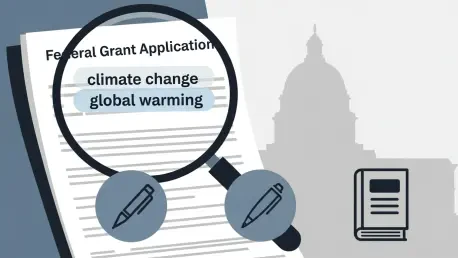

The systematic erasure of historically standard scientific terminology from federal grant applications has emerged as a high-stakes survival strategy designed to insulate vital environmental research from the volatile shifts of political administrations. This phenomenon, colloquially termed “climate hushing,” involves the deliberate scrubbing of phrases like “global warming” and “carbon sequestration” from official documents and research proposals. As researchers face the prospect of immediate funding termination, the linguistic landscape of American science is being redrawn, not by new discoveries, but by the necessity of administrative alignment. This trend reflects a broader shift where the branding of a project now carries as much weight as its empirical methodology, forcing a generation of scientists to choose between terminological precision and the continued existence of their laboratories.
The Strategic Erasure of Climate Terminology in Federal Research
The practice of semantic policing has transformed from an occasional caution into a formalized institutional protocol across various government agencies. Scientists within the Department of Agriculture and the National Science Foundation increasingly view specific descriptors as political triggers that could invite unwanted scrutiny or budget rescissions. By removing references to the changing climate and replacing them with more generic terms such as “weather variability,” these professionals are attempting to create a linguistic firewall. This shift is not merely a change in preference but a calculated move to protect long-term data collection efforts that might otherwise be labeled as ideologically driven.
This erasure extends beyond internal memos and permeates the very fabric of scientific communication between the government and the public. When federal agencies omit standard scientific terms, they fundamentally alter the accessibility of public records and the clarity of scientific progress. However, researchers argue that this trade-off is preferable to the alternative: the complete shuttering of programs that monitor vital agricultural trends or oceanic health. The resulting “hushed” lexicon serves as a temporary shelter, allowing the underlying work to persist while the external labels are sanitized to meet the requirements of the prevailing political climate.
Navigating a New Political Reality for American Science
The current era of American research is defined by a precarious balance between scientific autonomy and state-directed objectives. As administrative directives tighten control over environmental messaging, the scientific community has had to adapt to a reality where funding is often tied to the perceived political neutrality of a project’s title. This environment has fostered a culture of “word hunting,” where administrative staff and political appointees scan grant abstracts for forbidden phrases. Consequently, the act of writing a grant has become an exercise in creative circumvention, where the objective remains the same but the description is unrecognizable to the uninitiated.
Protecting the livelihoods of thousands of federal employees and the continuity of multi-decade studies requires a pragmatic, if uncomfortable, surrender of traditional academic nomenclature. In many cases, the threat of budget cuts is not a theoretical concern but a direct consequence of failing to align with specific linguistic benchmarks. This shift suggests that the relationship between state policy and science has entered a new phase, one where the state exerts influence not by denying the existence of research, but by controlling the vocabulary used to define it. For those within the system, this adaptation is seen as a necessary compromise to ensure that the infrastructure of American science does not collapse under the weight of ideological polarization.
Research Methodology, Findings, and Implications
Methodology
The investigation into these linguistic shifts utilized a comprehensive analysis of National Science Foundation grant databases, comparing the terminology used in successful applications from the current cycle starting in 2026 to those of previous years. By tracking the frequency of specific keywords and phrases in thousands of project abstracts, the study documented the statistical decline of previously standard environmental terms. This quantitative data was supplemented by a series of qualitative interviews with senior federal scientists and university-based principal investigators who receive significant federal support. These conversations provided context for the data, revealing the internal pressures and specific directives that led to the observed semantic changes.
In addition to the database analysis, the research involved a review of internal agency memos and contract templates obtained through various administrative channels. These documents often contained explicit lists of “prohibited” or “discouraged” words, along with suggested neutral alternatives. The methodology also considered the administrative tracking codes used by agencies to categorize research themes, identifying how these codes were modified or deleted to remove references to climate-centric initiatives. By combining these different data streams, the study provided a holistic view of how semantic policing operates from the top down and how it is received and implemented from the bottom up.
Findings
The study uncovered a dramatic and systemic reduction in the use of climate-specific language, most notably at the National Science Foundation, where the mention of “climate change” in grant titles fell by over 75 percent within a single funding cycle. At the Department of Agriculture, a list of more than 100 restricted phrases was identified, leading to the near-total disappearance of terms like “greenhouse gases” in official contracts. Instead, researchers were encouraged to use phrases such as “atmospheric components” or “soil health enhancement.” This shift was not limited to environmental agencies; even programs focusing on infrastructure and technology were found to have scrubbed their documentation of any reference to climate adaptation.
Furthermore, the research identified a pattern of “word hunting” where projects with administrative codes containing climate-related prefixes were disproportionately targeted for cancellation or review. This occurred even when the underlying research was purely technical or unrelated to policy advocacy. For instance, studies on specialized plant growth systems were halted simply because they were tagged with climate-tracking markers from previous cycles. The findings also indicated that terms related to social equity and diversity had similarly vanished from the federal lexicon, suggesting a broader effort to rebrand American science as a purely technical endeavor, devoid of social or environmental context.
Implications
These findings suggest that the branding of science has become a primary factor in its institutional survival, potentially undermining the clarity and transparency of public research. The move toward permanent linguistic fixtures like “coastal resilience” instead of “climate adaptation” may allow projects to continue, but it risks obscuring the true nature of the challenges being studied. When researchers are forced to use vague descriptors, the resulting data can become harder for future scientists to search and synthesize, leading to a fragmentation of knowledge across federal repositories. This creates a functional barrier to meta-analysis and long-term scientific collaboration.
The theoretical implication of these shifts is a narrowing of the scientific discourse, where certain topics become “unsearchable” or invisible to the public and the international community. Societally, the erasure of terms related to environmental justice and climate risk reflects a withdrawal of federal support for addressing the specific needs of vulnerable populations. By sanitizing the language used to describe these risks, the government may be limiting the ability of local communities to access information necessary for disaster preparedness and resource management. This trend raises fundamental questions about the future of the state’s role as a provider of objective, accessible scientific information.
Reflection and Future Directions
Reflection
The process of documenting these semantic shifts revealed the profound psychological and professional toll that self-censorship took on the scientific workforce. Researchers frequently described a pervasive culture of fear, where the simple inclusion of a forbidden word was seen as a career-ending mistake. This climate of apprehension necessitated a high degree of anonymity for many sources, illustrating the sensitivity of the topic within the current federal landscape. While the research successfully captured the immediate linguistic response to political pressure, the necessity of protecting source identities limited the ability to detail specific internal debates that occurred before these policies were implemented.
The study also highlighted a tension between the immediate success of “rebranding” and the long-term integrity of the scientific record. While scientists were able to secure funding by using “neutral” language, the cost was a loss of terminological precision that could have lasting effects on how the work is perceived and utilized. The research could have been strengthened by a more detailed comparison of how different agencies implemented these changes, as some departments appeared more aggressive in their policing than others. Despite these challenges, the study provided a clear map of the tactical maneuvers employed by the scientific community to maintain its functional existence under intense administrative scrutiny.
Future Directions
Future investigations should focus on the impact of these linguistic substitutes on the discoverability of scientific data in federal archives and public databases. If “climate change” is no longer a searchable term in government repositories, there is a significant risk that decades of critical data will become functionally lost to future researchers who may not know the substituted terminology. Studies are needed to determine if new metadata strategies or private indexing services can bridge this gap. Additionally, the effectiveness of alternative funding models, such as private-public partnerships or international consortia, warrants exploration to see if they can offer a more stable environment for researchers.
Another critical area for future study involves the international perception of American science in light of these domestic linguistic restrictions. It is essential to understand whether the global standing of U.S. research institutions is diminished when their output is perceived as being filtered through a political lens. Researchers should also examine whether this “hushing” phenomenon is occurring in other nations with similar political shifts, which would suggest a global trend of scientific retreat from public discourse. Understanding these dynamics will be vital for developing strategies to protect the independence and transparency of global environmental research in an increasingly polarized world.
Preserving Scientific Continuity Through Semantic Adaptation
The trend of climate hushing represented a sophisticated, if desperate, survival mechanism that federal scientists utilized to shield their work from administrative volatility. By adopting a “neutral” vocabulary, these researchers were able to ensure the continuation of critical data collection and the financial security of their staff. This rebranding allowed scientific projects to bypass ideological hurdles, focusing on the mechanical aspects of environmental change while avoiding the politically charged labels that would have invited funding cuts. The study demonstrated that the scientific community possessed a remarkable ability to adapt its communication strategies to match the priorities of its sponsors, even at the cost of traditional academic clarity.
In the end, the linguistic shift was a pragmatic response to an environment where the survival of a project depended more on its title than its empirical merit. Scientists successfully navigated the moral dilemma of self-censorship, choosing to keep their research alive rather than risk total termination over a choice of words. This strategic adaptation preserved the underlying work, ensuring that data continued to flow even as the terminology was silenced. However, the long-term consequences for the transparency and accessibility of American science remained a concern for many observers. The findings underscored the persistent tension between the objective pursuit of knowledge and the administrative realities of state-funded research, leaving a legacy of survival through silence.