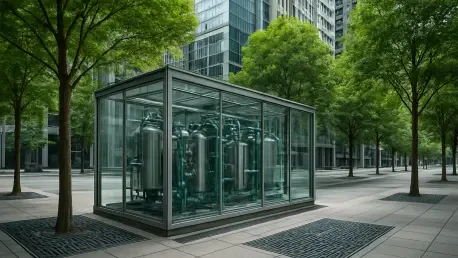

European cities must overcome the logistical complexity of retrofitting medieval layouts with modern absorbent technologies to ensure long-term resilience. The continent currently finds itself at a precarious crossroads where historic charm and modern economic density collide with the increasingly erratic patterns of a changing climate. As urban centers continue to expand, the saturation of traditional drainage networks has moved from a seasonal concern to a persistent existential threat. The 2024 European Climate Risk Assessment remains a vital benchmark, having categorized extreme precipitation as a primary danger to public health, essential infrastructure, and the stability of regional economies. Today, the challenge is not merely about holding back the water but fundamentally rethinking how metropolitan landscapes interact with every raindrop that falls. This necessitates a shift from the rigid engineering mindsets of the past toward a more fluid, integrated approach that balances human necessity with the natural hydrological cycle. Without a rapid transformation in how cities manage runoff and soil permeability, the cultural and financial hubs of Europe risk becoming increasingly uninhabitable during high-moisture events that are now occurring with startling regularity.
The Physical Constraints: Density and Soil Sealing
The inherent architectural density of European cities creates a unique set of vulnerabilities that exacerbate the impact of any flooding event. These metropolitan areas serve as concentrated hubs of human activity, where millions of people, billions of dollars in assets, and critical transportation links are packed into narrow, interconnected geographic footprints. While this density facilitates efficient trade and cultural vitality, it also ensures that a localized downpour can have a disproportionately large ripple effect across an entire region. When a single arterial road or a major subway line is submerged, the resulting paralysis affects the movement of goods, the availability of emergency services, and the daily routines of the entire population. This extreme concentration of value means that the stakes for flood management are higher than ever before, as the margin for error in traditional drainage capacity has almost entirely disappeared under the pressure of modern urban living.
A primary driver of this heightened risk is the pervasive phenomenon of soil sealing, where natural ground is replaced by impermeable surfaces like asphalt, concrete, and roofing. In an undisturbed environment, the earth functions as a biological sponge, absorbing rainfall and allowing it to filter slowly into the groundwater or evaporate naturally. Urban development fundamentally severs this connection, creating a “sealed” landscape where rainwater has nowhere to go but across the surface. This transformed runoff accumulates with incredible speed, gathering force as it rushes toward low-lying districts and subterranean structures. In many heavily built-up European districts, even a moderate storm can trigger significant street-level inundation because the local drainage systems were never intended to handle such a high volume of instantaneous runoff. The degree of soil sealing is now recognized as a direct metric for flood susceptibility, forcing urban planners to look for ways to break up the concrete and restore natural absorption.
Atmospheric Drivers: Climate Change and Infrastructure Limits
The ongoing shift in global temperatures has fundamentally altered the atmospheric physics governing European weather, making historical data an unreliable guide for current infrastructure needs. Scientific consensus has long established that a warmer atmosphere possesses a higher capacity to hold moisture, with roughly a 7% increase for every degree of warming. This physical reality translates into the “super-storms” that have become a recurring feature of the current decade, delivering months of typical rainfall in a matter of hours. These events are often highly localized and intense, striking with little warning and overwhelming even the most robust traditional defense systems. Because our existing urban environments were designed using meteorological assumptions from the late 19th and 20th centuries, they are simply unequipped to manage the sheer volume of water that modern storm systems can dump on a single city block.
Compounding this meteorological pressure is the reality that many European cities continue to rely on combined sewer systems, where domestic wastewater and rainwater share the same network of underground pipes. These systems have rigid design limits that are frequently exceeded during contemporary heavy rain events. When the volume of water surpasses the capacity of these pipes, the system reaches a breaking point, leading to “combined sewer overflows.” This results in the discharge of untreated sewage and industrial runoff directly into public streets, parks, and local waterways. Beyond the immediate physical damage caused by the water, these overflows create a severe secondary public health crisis and long-term environmental degradation. The necessity of separating these flows or providing massive temporary storage has become a central focus for engineers, yet the cost and disruption of digging up historic streets to install new pipes remain a significant barrier to rapid progress.
Surface Water Risks: The Subterranean Vulnerability
While traditional flood planning often focused on the risk of rivers overflowing their banks, the rise of surface water flooding, or “pluvial” flooding, represents a more insidious and less predictable threat. This type of inundation occurs when rain falls so rapidly that it cannot be absorbed by the ground or drained by pipes, regardless of a property’s proximity to a river or coastline. This makes pluvial flooding a “hidden” danger that can strike high-altitude neighborhoods or inland districts that were previously considered safe. Because it depends on localized topography and the state of the drainage grid at a specific moment, mapping and predicting these events is significantly more complex than tracking a rising river. As a result, many residents and business owners are caught unprepared for the sudden arrival of water that flows down streets and pools in unexpected depressions.
The impact of surface water flooding is particularly catastrophic for the subterranean infrastructure that acts as the backbone of modern European cities. Underground parking garages, basement apartments, electrical substations, and subway tunnels are all highly vulnerable to rapid water ingress. When these low-lying spaces are flooded, the disruption is not confined to the immediate area; it often leads to widespread power outages and the total shutdown of public transit networks. This subterranean vulnerability highlights a critical flaw in current urban design, where essential services are often tucked away in the very places most likely to collect water during a storm. Protecting these assets requires more than just better pipes; it demands the installation of flood gates, the raising of ventilation shafts, and a complete reimagining of how we use the space beneath our feet to ensure the city remains operational during and after a storm.
Social Equity: Planning for Disproportionate Impacts
Catastrophic events observed in regions like Valencia demonstrate that floodwaters do not respect municipal boundaries or administrative lines, necessitating a more holistic approach to regional planning. These disasters have shown that managing urban water requires a “catchment-wide” perspective that accounts for how water moves from surrounding hills and rural areas into the city center. When upstream runoff is not managed through reforestation or natural floodplains, the downstream urban areas bear the full brunt of the accumulated volume. This interconnectedness means that a city’s survival depends on its ability to coordinate with neighboring jurisdictions to manage the entire journey of a raindrop. Effective flood resilience is no longer a localized engineering project but a regional diplomatic and logistical effort to ensure that the surrounding landscape supports the city’s drainage needs.
Furthermore, research from cities such as Barcelona has brought the issue of social vulnerability to the forefront of the flood resilience conversation. The impact of a flood is rarely distributed evenly; instead, it often follows the lines of economic and social disparity. High-income neighborhoods typically possess the resources to invest in private flood defenses or to recover quickly through comprehensive insurance and personal savings. In contrast, marginalized communities are frequently found in lower-quality housing, basement units, or districts with neglected infrastructure. For these populations, a single flood event can lead to permanent displacement and financial ruin. True urban resilience therefore requires a commitment to social justice, ensuring that public investments in green infrastructure and flood defenses are prioritized for those who are most at risk and least able to adapt. By focusing on equitable protection, cities can build a more stable and cohesive society that is better equipped to withstand environmental shocks.
The Sponge City Strategy: Naturalizing the Urban Fabric
The transition away from purely “gray” infrastructure toward nature-based “green” solutions is encapsulated in the “Sponge City” paradigm. This strategy aims to transform the urban environment into a landscape that can absorb, store, and slowly release water rather than simply attempting to funnel it away through pipes as quickly as possible. This approach treats rainwater as a valuable resource that can enhance urban biodiversity and cool the city during heatwaves, rather than viewing it as a waste product. Key interventions include the installation of rain gardens, which are strategically placed planted areas designed to catch and filter runoff from streets and sidewalks. By replacing small sections of pavement with these absorbent biological zones, cities can significantly reduce the immediate load on their drainage systems while simultaneously improving the local aesthetic and air quality.
Implementing these green technologies in the context of Europe’s historic centers presents a formidable challenge but also a unique opportunity for creative urban renewal. Retrofitting a medieval square or a densely packed 19th-century street with permeable paving and green roofs requires a delicate balance between preservation and modernization. However, even incremental changes, such as the addition of street trees or the conversion of flat roofs into vegetated spaces, can have a powerful cumulative effect on a city’s overall hydrological health. These nature-based solutions offer a degree of flexibility that traditional concrete walls and pipes cannot match, as they can be scaled and adapted to fit the specific needs of each neighborhood. By weaving these “sponge” elements into the fabric of the city, planners can create a more resilient urban ecosystem that works in harmony with natural processes to manage the volatility of modern weather.
Strategic Future: Policy and Investment Integration
The successful transition toward flood-resilient cities was recognized as a non-negotiable shift in the evolution of urban governance and planning. City leaders and international policymakers concluded that the survival of metropolitan hubs depended entirely on their ability to integrate green infrastructure into the existing gray footprint of the built environment. These stakeholders determined that the financial cost of retrofitting historic districts was significantly lower than the repeated economic paralysis caused by neglected drainage systems and destroyed infrastructure. It became clear that the most successful regions were those that moved away from purely reactive crisis management and instead embraced proactive, nature-based strategies that addressed the root causes of runoff and soil sealing. By prioritizing the safety of the most vulnerable neighborhoods and ensuring that flood defenses were distributed equitably, governments ensured that resilience was not a luxury for the few but a shared public utility.
Furthermore, the integration of regional water management policies allowed for a more coordinated response to environmental threats that crossed administrative boundaries. This comprehensive pivot in methodology fundamentally transformed the way European cities interacted with their local environments, securing a viable pathway for urban life in an increasingly volatile climate. Authorities established that land-use planning must be the primary tool for defense, strictly prohibiting new developments on natural floodplains and mandating the inclusion of absorbent surfaces in all new construction projects. The shift also required a massive reallocation of capital toward subterranean protection and the modernization of combined sewer systems, which was facilitated through innovative green financing and European Union support. This holistic vision ensured that cities were no longer merely surviving the rain but were instead thriving by adapting their structures to the realities of a new environmental era.