
Donald Gainsborough has spent decades at the intersection of legislative strategy and global energy policy. As the leader of Government Curated, he has a front-row seat to the tectonic shifts currently reshaping the world’s power grids and the legislative maneuvers that drive them. In our discussion, we explore the geopolitical fallout of the Strait of Hormuz closure and the intense global competition it has ignited among emerging energy producers. Gainsborough breaks down the rise of Suriname as a pivotal Caribbean energy hub, the strategic fortification of the Eastern Mediterranean through the “3+1” partnership, and the ambitious, though difficult, plans to revive pipeline infrastructure in the Middle East to bypass volatile maritime chokeholds. We also examine how the U.S. Development Finance Corporation is being deployed as a tool of economic statecraft to diversify supply chains and stabilize a market currently burdened by a significant risk premium.
Suriname represents a significant opportunity for offshore gas production near major shipping lanes. How can private investors and the U.S. government collaborate to turn this potential into a stable alternative to traditional Gulf supplies?
The potential in Suriname is not just a theory; it is a tangible opportunity that has already led to high-level diplomatic engagement. During a significant trip to Houston this past March, officials like Assistant Secretary of State Caleb Orr were briefed on the extensive gas discoveries off the Surinamese coast, and those conversations are now being rekindled with a sense of urgency. For private investors, the path forward involves leveraging the expanded authorities of the Development Finance Corporation, which Congress recently bolstered to allow for higher risk tolerance in large-scale energy projects. We are looking at a scenario where American expertise and financing can build the infrastructure needed to tap into these reserves, which are strategically located outside the immediate reach of Middle Eastern instability. The goal is to move beyond the “pitchfest” stage and into physical construction, utilizing Suriname’s proximity to major shipping lanes to ensure that Caribbean gas becomes a cornerstone of Western energy security.
With the Strait of Hormuz closure driving political pressure and market volatility, how is the current administration redefining the concept of energy security and the “risk premium” associated with Middle Eastern molecules?
The closure of the strait has fundamentally altered the math of global energy, creating a “long tail” of risk that will persist even if the waters are eventually reopened. We have seen President Trump’s approval ratings hit record lows as gas prices soared, prompting a military response to escort tankers and get approximately 100 million barrels back into the market. This crisis has forced the White House to shift its focus toward minimizing global reliance on these specific chokeholds by diversifying supply chains and expanding domestic and allied infrastructure. There is now a permanent risk premium attached to any molecule coming out of the Gulf, which makes the “American flag” and U.S. government backing incredibly valuable for new projects elsewhere. The strategy is no longer just about volume; it is about the reliability of the route and the ability to bypass traditional vulnerabilities that have historically held the global economy hostage.
The Eastern Mediterranean is increasingly seen as a vital energy corridor through the “3+1” partnership. What specific milestones, such as the 2028 gas yield or the new East Med Energy Center, should we be watching as indicators of success?
The Eastern Mediterranean is a perfect example of how regional shocks can be bypassed if we create enough diversified options. The partnership between Greece, Cyprus, Israel, and the United States is maturing, as evidenced by the launch of the East Med Energy Center at Rice University in Texas. Cypriot Energy Minister Michael Damianos has indicated that gas projects currently under development by American and European firms could begin yielding significant output by 2028. This timeline is crucial because energy infrastructure takes years to come online, and these milestones serve as a signal to the markets that a more stable, diversified supply is on the horizon. When Energy Secretary Chris Wright meets with his counterparts, the focus is on turning these high-level diplomatic agreements into the actual flow of gas, ensuring the region becomes a primary alternative to more volatile corridors.
Regional players like Syria are pitching ambitious pipeline revivals to bypass maritime chokeholds. What are the practical realities and timelines for restoring infrastructure like the Arab Gas Pipeline in such a complex geopolitical environment?
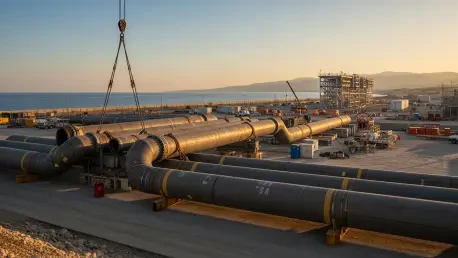
The pitch from Syrian Energy Minister Mohammed al-Bashir highlights a desperate regional need to find land-based alternatives to the Strait of Hormuz, though the hurdles remain significant. The Arab Gas Pipeline, which connects Egypt, Jordan, Lebanon, and Syria, is a primary candidate for revival, but it requires at least 18 months of intensive repair work to fix the extensive damage caused by years of conflict. There is also ongoing talk about reviving the Kirkuk-Baniyas oil pipeline to transport crude directly from Iraq, effectively bypassing the maritime risks altogether. While Syria is telling the world that its doors are open for investment, these projects require a level of political stability and U.S. buy-in that is still being negotiated. If these pipelines can be brought back online, they would provide a critical relief valve for regional energy markets, but the 18-month window for repairs is a reminder that there are no instant fixes to this energy crisis.
What is your forecast for the global energy landscape over the next decade as these new supply chains come online?
The next decade will be defined by a massive shift away from centralized energy chokeholds and toward a fragmented but more resilient network of regional hubs. We will see the Eastern Mediterranean and the Caribbean basin, led by countries like Suriname, emerge as heavyweight players that dilute the geopolitical leverage currently held by those who control the Strait of Hormuz. While the current price spikes are a painful political problem for the White House, they are also the catalyst for a decade-long investment cycle in American-backed energy infrastructure that will eventually lower the global “risk premium.” By 2030, the success of the Development Finance Corporation’s higher risk tolerance and the fruition of projects in Cyprus and South America will likely result in a more balanced market where no single geographical point can trigger a global economic meltdown. The transition will be slow and capital-intensive, but the movement toward energy dominance through diversification is now irreversible.