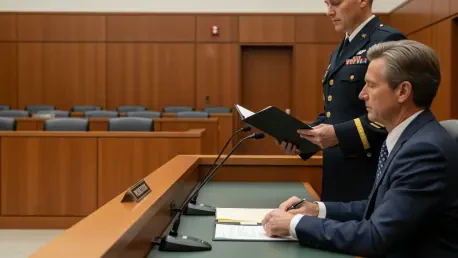

The stark image of a military uniform within the civilian halls of justice is becoming an increasingly common sight, quietly signaling a fundamental shift in the relationship between the Pentagon and domestic law enforcement. A novel and expanding U.S. government initiative has placed dozens of active-duty military lawyers into the role of temporary federal prosecutors in major American cities, a move that is stirring significant debate and raising profound legal alarms among constitutional scholars and former military officials. This unprecedented program blurs long-standing lines, prompting a critical examination of its legality, practicality, and the potential consequences for the American legal system.
When Justice Wears a Uniform: A New Frontline for Military Lawyers
At the heart of this development is a program detailing Judge Advocate Generals (JAGs) to serve as Special Assistant United States Attorneys. This deployment is not a theoretical exercise but an active operation. In cities like Minneapolis, Minnesota, the Department of Justice has requested approximately 40 military lawyers to provide what it terms “crucial legal support” aimed at restoring order. This effort is part of a broader government strategy that has seen similar deployments across the country.
The scale of these assignments marks a dramatic departure from past practice. For example, 20 JAGs were assigned to prosecute violent crime in Memphis, Tennessee, working alongside a surge of federal agents and National Guard troops. Another contingent of 20 military lawyers has been detailed to federal prosecutors’ offices in Washington, D.C., where National Guard presence has also been notable. This coordinated effort represents a new frontline for military lawyers, placing them directly into the complexities of civilian criminal justice.
A Law Enforcement Surge or a Troubling Precedent
Officially, the government frames this initiative as a “whole-government approach” designed to bolster civilian law enforcement agencies struggling to combat rising rates of violent crime. The rationale is to leverage existing federal resources, including the legal expertise within the military, to support overwhelmed prosecutors’ offices and bring more cases to trial. By integrating military legal personnel, the administration aims to create a “law-enforcement surge” that can have an immediate impact on public safety in targeted urban areas.
However, this justification is met with deep skepticism from numerous legal experts who view the program not as a supportive measure but as a troubling precedent. The central concern revolves around a significant and controversial expansion of military involvement in domestic civilian affairs. Critics argue that this move erodes the foundational principle separating military functions from civilian law enforcement, a division historically seen as a safeguard against potential overreach and the militarization of domestic policy.
Analyzing the Key Points of Contention
The current scale of these deployments is without modern precedent. Historically, any use of JAGs in civilian courts was limited to a “handful of cases” that typically had a clear and direct connection to the military. The deployment of dozens of JAGs to work on purely civilian criminal cases represents a qualitative shift in policy, moving beyond targeted assistance to a more systemic integration into the civilian justice system.
This policy shift required reversing a long-standing Department of Justice position. A 1983 DOJ memo explicitly barred the practice, arguing that JAG officers could not constitutionally serve as civil government officers. However, legislative changes to the Uniform Code of Military Justice (UCMJ) in 1986 created the statutory authority that now permits this arrangement. This has sparked a fierce debate over the interpretation of the Posse Comitatus Act, a federal law that generally prohibits using the military for domestic law enforcement. While a subsequent legal analysis found no violation, that conclusion is far from universally accepted.
Beyond the legal debate, the program presents significant practical and ethical dilemmas. The JAG Corps is widely described as an “already overworked” force, and diverting experienced lawyers from their primary duties places a considerable strain on military legal readiness. Furthermore, these military lawyers often lack experience in federal civilian prosecution, facing a “steep learning curve” in a new and complex legal environment. A more profound ethical issue is the potential erosion of prosecutorial independence, as JAGs operate within a military chain of command, which could make it more difficult for them to challenge or refuse questionable prosecutorial directives compared to their civilian counterparts.
Expert Voices a Chorus of Concern
Prominent legal scholars have been vocal in their critiques. Steve Vladeck, a professor at Georgetown University Law, questions the logic of diverting military legal talent away from their core military justice responsibilities. He also points to a more fundamental question about the Justice Department’s capacity, asking why it appears unable to handle its own caseload without resorting to borrowing personnel from the Pentagon.
Steven Lepper, a retired Air Force Judge Advocate General, expresses “serious doubts” about the legality of the deployments. He argues that the complete lack of a “military nexus” in the cases these JAGs are prosecuting fundamentally challenges compliance with the spirit, if not the letter, of the Posse Comitatus Act. Lepper’s concern is rooted in the principle that the military’s role should be distinct from domestic policing and prosecution.
Adding to this chorus of concern, Eric Carpenter, a retired Army lawyer and current law professor, highlights the significant practical challenges. He warns that the program is overstretching an already thin legal corps within the military. Carpenter also emphasizes the skills gap, noting that deployed JAGs will likely be forced to “figure it out as they go,” a situation that is far from ideal in the high-stakes world of federal prosecution.
Unanswered Questions and the Path Forward
Despite the program’s expansion, the Department of Justice has remained reticent, providing few specifics on its full scope, the total number of JAGs involved, or their precise duties. This lack of transparency has made it difficult for legal watchdogs and congressional overseers to fully assess the initiative’s impact and legality, leaving many critical questions unanswered.
The deployment of military prosecutors into civilian courtrooms raised fundamental questions about the future of American jurisprudence. The long-term implications for the separation of military and civilian legal functions were unclear, and the safeguards needed to ensure prosecutorial independence and accountability remained a subject of intense debate. As this policy continued, it was evident that a clear and public deliberation was necessary to navigate the complex legal and ethical territory it had opened.