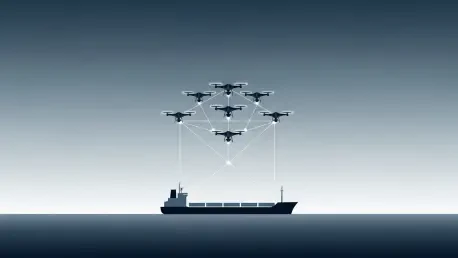

The recent surge in coordinated unmanned aerial vehicle activity across the European continent marks a significant escalation in the use of non-traditional maritime assets for gray zone operations. Between 2026 and 2028, the International Institute of Strategic Studies observed a dramatic expansion of Russian hybrid warfare capabilities that utilize the so-called shadow fleet—a decentralized assembly of aging merchant vessels—to bypass conventional border security. These ships, which have historically operated on the periphery of global commerce to evade international trade sanctions, now function as mobile, clandestine launch pads for sophisticated surveillance equipment. By stationing these platforms in international waters, the Kremlin has successfully monitored sensitive military installations and civilian infrastructure throughout the United Kingdom, France, and Germany. This shift toward a maritime-based aerial strategy allows for a persistent presence near NATO territory while maintaining a level of plausible deniability that complicates the diplomatic response.
Maritime Platforms: Tactical Evasion and Global Reach
The operational success of this campaign hinges on the calculated movements of specific shadow fleet vessels, such as the Arctica and the Vezhen, which serve as mobile motherships for drone deployments. These ships frequently engage in deceptive practices, such as disabling their automatic identification systems (AIS) to obscure their precise locations and intended destinations. By operating under the guise of routine commercial transit or idling in international waters, these vessels can deploy unmanned systems to conduct intelligence, surveillance, and reconnaissance missions without establishing a permanent land-based footprint. This method allows for a high degree of tactical flexibility, as the ships can retreat into deeper waters or alter their course once a mission is completed. The use of commercial vessels for military purposes exploits the legal and jurisdictional complexities of international maritime law, creating a buffer that prevents immediate kinetic retaliation or clear-cut attribution during the initial stages of an incursion.
Evidence from recent incursions suggests a highly synchronized relationship between the positioning of shadow fleet ships and significant political or diplomatic developments within Europe. For example, during a high-profile visit by the Ukrainian president to Dublin, the vessel Vezhen was detected loitering near the Irish coast while military-grade drones conducted unauthorized flights over strategic naval assets for several hours. Similar patterns emerged near the Danish coastline, where the Arctica’s presence coincided with a swarm of drone sightings over major logistics hubs and commercial ports. These events are not isolated technical glitches but represent a deliberate attempt to use maritime-launched drones as a form of non-verbal communication. By projecting power in such a visible yet unofficial manner, the Kremlin exerts psychological pressure on European governments, signaling its ability to disrupt national security and diplomatic protocols at will. The coordination between ship arrivals and drone activity provides a clear link to Moscow’s strategic objectives.
Strategic Impacts: Economic Strain and Nuclear Security
The escalation reached a critical point in early 2026 when a series of sustained drone incursions forced major European aviation hubs to halt all flight operations for extended periods. Airports in Copenhagen and several key cities in Germany faced significant logistical backlogs after unidentified aerial systems were spotted within protected civilian airspace. These incidents highlighted a core tenet of gray zone warfare: inflicting maximum economic and psychological damage while staying just below the threshold of an overt military attack that would trigger a collective NATO response under Article 5. By paralyzing essential transport networks and causing widespread travel chaos, the campaign demonstrates the vulnerability of civilian infrastructure to low-cost, high-impact technology. These disruptions serve as a powerful tool for attrition, forcing European states to divert resources toward emergency response and security upgrades while grappling with the financial consequences of shuttered trade routes and grounded commercial airline fleets.
Beyond civilian infrastructure, the drone campaign has increasingly focused on the most sensitive components of Western defense, including nuclear storage facilities and submarine bases. Surveillance flights have been recorded over the Dutch Volkel Air Base and the French Ile Longue facility, both of which are critical to the European nuclear deterrent strategy. These missions are widely viewed by intelligence experts as stress tests designed to map the radar coverage signatures and response times of NATO’s high-alert military units. By observing how Western forces react to these unconventional threats, Russian intelligence can identify gaps in sensor integration and command-and-control hierarchies. This data is invaluable for refining future offensive strategies and understanding the limitations of existing air defense umbrellas. The systematic nature of these flights suggests a long-term intelligence-gathering effort aimed at compromising the secrecy of defense manufacturing sites and the operational readiness of strategic naval assets across the continent.
Technical Hurdles: Detection Gaps and Bureaucratic Friction
Defending against these low and slow aerial threats has proven to be a significant challenge for European security forces, as traditional air defense systems are optimized for high-speed missiles and aircraft. Drones often possess a small radar cross-section and can easily blend into natural radar clutter or civilian air traffic, making them difficult to track with precision. This technical vulnerability is often exacerbated by bureaucratic friction within national governments, where the responsibilities for drone management are split between local law enforcement, national aviation authorities, and military branches. During an active incursion, the time required to establish a clear chain of command and authorize an interception can provide the drone operators with ample opportunity to complete their mission and return to their maritime launch site. This delay in decision-making remains a critical weakness that Russian operators have consistently exploited to maintain the initiative during high-stakes surveillance operations throughout the year.
Military commanders face a complex set of ethical and logistical dilemmas when deciding whether to engage unidentified drones over densely populated areas. The risk of falling debris causing civilian casualties or property damage often leads to a more cautious approach, allowing the unmanned systems to remain airborne longer than would be tolerated in a purely military theater. This hesitation provides a tactical advantage to the shadow fleet operators, who can gather high-quality imagery and electronic signals with minimal risk of losing their equipment to kinetic fire. Furthermore, the difficulty of definitive attribution persists because the drones are often designed using commercially available components that are hard to trace back to a specific military unit. Unless a launching vessel is caught in the act or a drone is captured intact with its flight data recorders accessible, proving the origin of the flight remains a legal and diplomatic hurdle. This ambiguity protects the perpetrators from immediate international sanctions and allows the campaign to continue.
Defensive Evolution: Legislative Reform and Technology Integration
In direct response to these persistent maritime threats, nations such as Sweden, Denmark, and the Netherlands significantly overhauled their internal security policies to address the changing landscape of aerial incursions. By the middle of 2026, several governments implemented modernized legislative frameworks that clarified the rules of engagement for neutralizing unidentified drones near critical infrastructure sites. These nations also accelerated the procurement and deployment of advanced counter-drone technologies, including directed-energy weapons, high-frequency signal jammers, and automated detection networks. This transition toward a more proactive defense posture reflected a growing recognition that the shadow fleet’s activities represented a permanent shift in regional security dynamics. Western intelligence agencies prioritized the integration of multi-layered surveillance systems that combined satellite imagery with coastal radar to better monitor suspicious merchant vessels. These initiatives focused on bridging the communication gap between units.
To bolster long-term resilience, European defense ministries established dedicated joint task forces that streamlined information sharing between maritime surveillance agencies and domestic air security commands. These organizations prioritized the development of non-kinetic interception methods that minimized the risk to civilian populations while ensuring that unauthorized aerial systems were effectively neutralized. Furthermore, the implementation of more stringent vessel registration and tracking requirements aimed to peel back the layer of anonymity provided by the shadow fleet. Intelligence officials recognized that maritime-launched drone campaigns required a fundamental reevaluation of what constitutes a sovereign border in the age of unmanned technology. By investing in resilient sensor networks and fostering cross-border cooperation, the target nations moved toward a unified defense strategy that reduced the strategic utility of gray zone interference. These comprehensive measures ensured that future provocations were met with rapid detection and decisive action, reinforcing the security of Europe’s critical assets.