
High above the clouds, where thousands of commercial flights crisscross the nation daily, a complex and demanding ballet is directed by a small group of highly skilled professionals, but a political stalemate on the ground now threatens the stability of this critical workforce. A proposed $140 million pay raise for the nation’s air traffic controllers, a measure designed to bolster a strained system, has been grounded by a partial government shutdown, leaving the future of aviation safety under a cloud of uncertainty.
When Political Gridlock Grounds a Paycheck and Puts Skies at Risk
The nation’s air traffic control system operates on precision and vigilance, yet its workforce is now experiencing the disruptive turbulence of a political battle far removed from their control towers. While the Federal Aviation Administration (FAA) itself remains funded, a crucial 3.8% pay increase for its controllers is trapped within a stalled appropriations bill for the Department of Homeland Security (DHS). This procedural entanglement has turned a vital workforce initiative into collateral damage in a broader legislative war.
The delay does more than just affect paychecks; it sends a demoralizing message to a profession already grappling with immense pressure and staffing shortages. The pay raise was not merely a cost-of-living adjustment but a strategic tool intended to attract new talent and retain experienced controllers. With this incentive now in limbo, questions arise about the long-term health of the air traffic control system and its ability to manage the world’s busiest airspace safely and efficiently.
A Legislative Layover Holding FAA Funding Hostage
The reason for this unusual predicament lies in the complex architecture of government funding. The provision for the controllers’ pay increase was bundled into the DHS portion of a larger appropriations package that passed the House. However, that bill has hit an immovable object in the Senate. A political standoff over immigration enforcement reform, prompted by several fatal shootings involving DHS employees, led Democrats to withdraw support, effectively freezing the entire DHS budget.
As a result, the $140 million earmarked for the FAA’s workforce cannot be accessed. The Senate is currently in recess, ensuring the shutdown will persist for at least another week and leaving the pay raise indefinitely postponed. This situation highlights how unrelated policy disputes can have significant and unforeseen consequences, ensnaring essential government functions in a web of political maneuvering.
The Crisis Brewing in America’s Control Towers
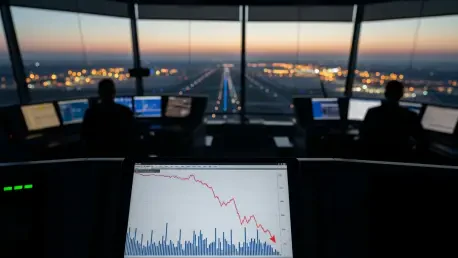
The funding delay exacerbates an already precarious situation within the nation’s control towers. According to the FAA’s own workforce plan, the system is facing a critical shortage of personnel. From a current force of just 10,730 controllers, a staggering 6,872 are projected to be lost between 2026 and 2028 due to retirements and attrition. The proposed 3.8% pay increase is a cornerstone of the strategy to counteract this trend by making the demanding career more attractive to new recruits and encouraging veteran controllers to stay.
This staffing crisis is not an abstract problem but a matter of public safety. The catastrophic mid-air collision between an Army Black Hawk helicopter and a commercial airliner in January 2025, which resulted in 67 fatalities, brought the issue into sharp focus. That incident served as a sobering reminder of the razor-thin margins for error in aviation and reignited a national conversation about the urgent need for a fully staffed and well-supported air traffic control workforce.
A View from the Capitol on the Collateral Damage
The political tactic of leveraging essential funding bills to force debate on unrelated issues has drawn sharp criticism from legislative leaders. House Appropriations Committee Chairman Tom Cole condemned the practice, pointing to the stalled controller pay raise as a prime example of its negative consequences. He argued that such strategies create unnecessary disruption and harm government employees and the public services they provide.
This perspective from the Capitol underscores the frustration felt by those who see essential operational needs being sidelined by partisan disputes. The shutdown of DHS has created a ripple effect, and the controllers’ pay situation is just one of several detrimental outcomes. The impasse serves as a stark illustration of how political gridlock can impede the fundamental workings of government, with real-world implications for national infrastructure and safety.
The Flight Path Forward to Unlocking Stalled Funds
The immediate path to resolving this issue is straightforward but politically challenging. The Senate must break its logjam and approve the DHS appropriations package. Only then will the $140 million for the air traffic controller pay raise be released, allowing the FAA to move forward with its workforce stabilization plan. This requires a political compromise on the immigration enforcement reforms that are currently holding up the bill.
However, even with the funding unlocked, the pay raise is not automatic. The legislation includes a critical prerequisite: the FAA Administrator must first certify that the agency has implemented operational efficiencies in staffing and scheduling. This condition was designed to ensure that any new investment is paired with meaningful reforms to address the root causes of the workforce shortfall and measurably improve aviation safety, tying the financial incentive directly to tangible progress.
The political impasse that stalled a critical pay raise for air traffic controllers ultimately highlighted the fragility of essential government services in the face of partisan conflict. While the debate over homeland security policy continued, the professionals tasked with safeguarding the skies were caught in the crossfire, a situation that underscored the urgent need for a more stable and predictable funding process. The resolution, when it came, was not just about releasing funds; it was a reaffirmation that the safety and stability of the nation’s aviation system must transcend political disputes.