
Donald Gainsborough stands at the intersection of policy and practice as the head of Government Curated, where he has spent years deciphering the complex machinery of federal appropriations and national security. His deep understanding of the inner workings of the Department of Homeland Security (DHS) makes him a critical voice as the nation navigates a high-stakes funding lapse. With the United States recently entering a military conflict with Iran and the FBI issuing stark warnings about domestic terrorism, Gainsborough’s insights offer a sobering look at how budgetary gridlock impacts the very agencies tasked with keeping the country safe. In this discussion, we explore the cascading effects of the current shutdown, the human cost for essential workers, and the political hurdles preventing a resolution.
With the recent military engagement against Iran and FBI warnings of domestic threats, how does a DHS funding lapse specifically undermine national security?
The immediate danger of a DHS shutdown during a hot war is that it creates a perception of internal fragility that our adversaries are keen to exploit. While about 92% of the workforce remains on the job because they are classified as essential, the lack of certain appropriations means that the department is operating with one hand tied behind its back. We are seeing a situation where the FBI has explicitly warned of an elevated threat of terrorist activity domestically, yet the very agencies responsible for countering these threats are mired in financial uncertainty. Even though law enforcement personnel at ICE and CBP are still receiving paychecks through the One Big Beautiful Bill Act, the administrative and support structures that facilitate intelligence sharing are beginning to fray. When you combine this with the fact that training is being curtailed, you see a measurable degradation in the department’s ability to respond to a rapidly escalating international conflict.
DHS personnel have faced multiple shutdowns recently, including a record-setting 43-day period last fall. Since TSA and FEMA workers are seeing partial pay while others remain fully funded, what is the impact on morale, and what specific steps are needed to prevent widespread staffing shortages at airports?
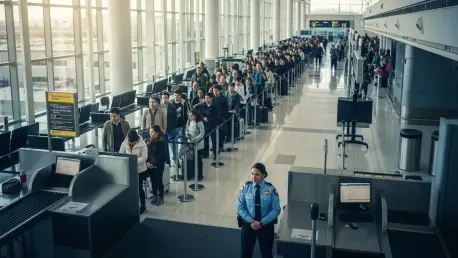
The morale within DHS is currently at a breaking point because these public servants feel like they are being used as pawns in a perpetual political game. Imagine the frustration of a TSA officer or a FEMA responder who is still paying off high-interest loans taken out during the 43-day shutdown last fall, only to be told their paycheck will be partial or delayed again. This “roller coaster” effect, as the AFGE president rightly called it, creates a sense of profound instability that leads to high turnover and increased absenteeism. Historically, we have seen that when TSA employees start calling out from work because they cannot afford gas or childcare, airport security lines swell and the entire national aviation system begins to choke. To prevent a total collapse, Congress needs to move beyond piecemeal funding and pass a comprehensive appropriations bill that guarantees back pay and restores the financial dignity of every single employee, regardless of their agency.
FEMA is currently struggling with payments for long-term recovery efforts, and the Coast Guard has grounded certain aircraft. How do these disruptions affect community resilience, and what metrics are being used to track the degradation of disaster response readiness during this ongoing funding lapse?
The grounding of Coast Guard aircraft is a chilling visual of how a funding lapse directly translates into a loss of life-saving capabilities. When training is curtailed and maintenance schedules are deferred, we aren’t just looking at a line item on a budget; we are looking at a search-and-rescue mission that might not happen in time. FEMA’s struggle to fulfill payments for long-term recovery means that communities still rebuilding from previous disasters are left in a state of suspended animation, unable to secure the contracts needed for reconstruction. We track this degradation by monitoring the “readiness gap”—the difference between the required operational tempo and the actual capacity of the fleet and personnel. Currently, with the Coast Guard paying uniformed personnel but delaying civilian pay, the administrative friction alone is slowing down the deployment of resources to vulnerable coastal regions.
The fatal shooting of Alex Pretti in Minnesota significantly altered the negotiation landscape. How are current policy reform demands stalling the appropriations process, and what specific compromises are needed between the White House and Congress to balance border enforcement with these new oversight concerns?
The tragedy involving Alex Pretti, a Veterans Affairs nurse, acted as a catalyst that completely derailed what was looking like a bipartisan path toward funding. It shifted the debate from simple numbers to fundamental questions of department oversight and the use of force during immigration enforcement. Democrats are now demanding significant policy shifts to ensure that such an incident never happens again, while the House leadership argues that withholding funds during a time of war is irresponsible. For a compromise to work, the White House must provide a transparent framework for these requested reforms that satisfies the need for accountability without stripping the department of its enforcement teeth. Last week’s new set of proposals from the White House is a start, but both sides must be willing to decouple long-term policy debates from the immediate necessity of funding the front lines of national defense.
Most DHS employees are classified as essential and must work without immediate pay. How does this financial strain affect the recruitment of new law enforcement officers, and what long-term damage does this uncertainty do to the department’s institutional knowledge and planning?
Recruiting for law enforcement is already a difficult task, but asking a young recruit to sign up for a job where their paycheck might vanish due to a congressional stalemate is an almost impossible sell. The department is seeing a brain drain where seasoned veterans—the people who hold the institutional knowledge of 20 years of post-9/11 security—are opting for early retirement or moving to the private sector for stability. Long-term planning is effectively dead during these periods because you cannot sign multi-year contracts for technology upgrades or infrastructure projects when you don’t know if you’ll have a budget next month. This leads to a “hollowed-out” department where the Secret Service has to pause vital reforms and the TSA warns of massive delays, creating a vulnerability gap that takes years to close even after the funding is restored.
What is your forecast for the Homeland Security Department’s funding and operational stability over the next year?
My forecast for the next year is one of continued turbulence, as DHS has unfortunately become the primary battlefield for broader arguments over immigration and executive power. While I expect the House to pass a bill this week to end the current three-week shutdown, the Senate’s reaction will likely be lukewarm until the policy reforms sparked by the Minnesota shooting are addressed. We are likely to see a series of short-term fixes rather than a stable, long-term appropriation, which means the department will remain in a reactive posture rather than a proactive one. Until there is a fundamental shift in how Congress handles the intersection of border policy and essential funding, DHS employees and the American public should prepare for more of these “roller coaster” cycles that threaten our operational readiness during an already dangerous era of global conflict.