
The physical footprint of the digital world is no longer a silent grid of server racks tucked away in suburban office parks; it has transformed into a high-stakes industrial titan capable of consuming the energy output of entire cities. As generative artificial intelligence transitions from a novelty into a foundational layer of the global economy, the infrastructure supporting it has undergone a radical metamorphosis. This review examines the shift toward hyperscale environments, where the traditional boundaries of computing, power distribution, and thermal management are being pushed to their absolute physical limits. Understanding this evolution is essential, as the transition from standard cloud storage to high-density compute environments represents the most significant architectural pivot in the history of information technology.
Evolution and Fundamentals of AI-Ready Data Centers
The core principle of the AI-ready data center is the move from general-purpose processing to accelerated, parallelized computing. In the previous decade, data centers were designed primarily for “cold” storage and transactional processing—tasks that are relatively light on energy and heat. Modern AI infrastructure, however, is built to support the training and inference of Large Language Models, which require thousands of specialized chips to work in perfect synchronization. This shift has necessitated a complete redesign of the facility’s skeleton, moving away from low-density racks toward hyper-integrated clusters where every square foot must handle ten times the power load of its predecessors.
This evolution is not merely about adding more servers but about changing the context of how data moves. In a traditional cloud setup, latency was acceptable for most business applications. For AI, the interconnectivity between GPUs is the primary bottleneck. Consequently, the fundamental components now include high-bandwidth fabric networks that allow thousands of processors to act as a single, massive supercomputer. This architectural shift marks the end of the data center as a passive warehouse and its birth as an active, high-performance engine that serves as the bedrock for national competitiveness and industrial intelligence.
Core Architectural Components and Power Dynamics
Hyperscale Computing and Hardware Integration
At the heart of the modern AI facility lies the hyperscale server cluster, a specialized assembly of hardware designed specifically for the rigors of neural network training. Unlike standard servers, these units are packed with high-end GPUs and Tensor Processing Units that require massive amounts of “east-west” traffic—data moving between servers rather than just to and from the internet. This level of integration allows for the processing of quadrillions of parameters in real-time, making it possible for AI models to understand context and generate human-like reasoning. The performance of these clusters is measured not just in clock speed, but in the efficiency of their interconnects, which must prevent any single node from slowing down the entire collective.
The significance of these clusters extends beyond mere speed; they represent a consolidation of digital power. By concentrating such massive compute capability into a single physical location, tech giants can achieve economies of scale that were previously impossible. However, this density creates a unique vulnerability. If the hardware integration is not perfectly tuned, the system risks “thermal throttling,” where the chips automatically slow down to prevent melting, thereby wasting millions of dollars in electricity and compute time. This makes the physical layout and the quality of the silicon integration just as important as the code running on top of them.
High-Density Power and Cooling Systems
The move toward high-density compute has shattered traditional assumptions about facility maintenance, specifically regarding power and cooling. A standard server rack might have required 10 to 15 kilowatts of power; an AI-ready rack now demands upwards of 100 kilowatts. This surge has forced a move away from traditional air cooling, which is simply incapable of stripping away the heat generated by modern AI chips. In its place, liquid cooling—ranging from direct-to-chip cold plates to full immersion systems—has become the new industry standard. These systems use water or specialized dielectric fluids to carry heat away more efficiently, allowing the hardware to run at peak performance for longer durations.
The real-world usage of these systems highlights a growing tension between technological needs and environmental resources. The energy demand of a single hyperscale campus can rival that of a medium-sized metropolitan area, leading to a scramble for stable, high-capacity power sources. Furthermore, the water consumption required for evaporative cooling in some designs has turned data centers into heavy industrial water users. This has sparked a technical race to develop “closed-loop” systems that recycle water and heat, potentially even using the excess thermal energy to provide heating for nearby residential or commercial districts, thereby turning a waste product into a community asset.
Emerging Trends and Industrial Shifts
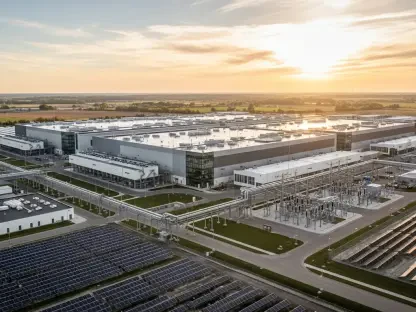
The industry is currently witnessing a pivot toward “hyperscale” campuses, which are essentially massive clusters of buildings designed to act as a single unit. This trend is driven by the need for proximity; the closer the servers are to one another, the faster the AI can learn. We are also seeing the rise of modular data center designs, where pre-manufactured compute blocks are shipped to a site and plugged into the grid like Lego bricks. This modularity allows companies to scale up their capacity in months rather than years, a necessity in a market where the demand for AI compute is doubling every few months.
Perhaps the most significant shift is in the behavior of the tech giants themselves. Major players are no longer just buying server space; they are actively securing massive energy reserves for future capacity. This has led to “behind-the-meter” deals where data center operators partner directly with nuclear or natural gas plants to ensure they have a dedicated power supply that is immune to the fluctuations of the public grid. This proactive approach to energy procurement signals a transition in the tech industry from being a consumer of utilities to being a major stakeholder in the global energy infrastructure.
Real-World Applications and Regional Implementation
Pennsylvania has become a prime example of where these theoretical advancements meet the reality of the ground. The state’s history as an energy powerhouse, combined with its robust transmission infrastructure, has made it a magnet for the latest generation of digital intelligence hubs. Strategic expansions in regions like Luzerne and Bucks counties are not just about building sheds full of computers; they are about integrating these facilities into a regional energy strategy that leverages nuclear and natural gas assets. These deployments serve as a blueprint for how high-tech investment can revitalize industrial heartlands, providing a new tax base and high-skilled employment opportunities.
Beyond the local economic impact, these implementations represent a collaboration between technology firms and energy providers that was unheard of a decade ago. For instance, the integration of data centers with nuclear power facilities creates a symbiotic relationship where the center provides a constant, predictable load for the plant, and the plant provides carbon-free, 24/7 power for the AI. This synergy is being deployed to power next-generation applications in medicine, climate modeling, and autonomous logistics, proving that the physical location of the data center is as critical to its success as the software it runs.
Critical Challenges and Public Resistance
The rapid expansion of AI infrastructure faces significant headwinds, primarily in the form of grid saturation and public pushback. Many regional power grids are reaching their limits, unable to accommodate the massive, concentrated load of a new hyperscale campus without risking brownouts for residential customers. This has led to a regulatory bottleneck, where zoning disputes and permitting delays have become the norm. Local communities are increasingly vocal about the “hidden” costs of these facilities, such as the constant low-frequency hum of cooling fans and the potential for rising utility rates as the grid is upgraded to meet industrial demand.
To mitigate these limitations, the industry has begun investing heavily in mitigation technologies and community-focused initiatives. Noise reduction shrouds for cooling towers, the adoption of “water-neutral” cooling designs, and the funding of local renewable energy projects are becoming standard parts of the development process. Furthermore, some developers are experimenting with “grid-interactive” data centers that can temporarily lower their power consumption or switch to onsite battery storage during peak demand, acting as a buffer for the public grid rather than a drain on it. These efforts are crucial for maintaining the social license to operate in densely populated areas.
Future Outlook and Global Competitiveness
The trajectory of data center infrastructure is inextricably linked to the global race for AI dominance. Superpowers are increasingly viewing compute capacity as a metric of national strength, similar to oil reserves or manufacturing output. Future developments will likely focus on even more extreme levels of efficiency, perhaps through the integration of photonic computing or neuromorphic chips that mimic the human brain’s energy efficiency. As the physical limits of silicon are reached, the next breakthrough may come from how these facilities are built and powered, rather than just the chips inside them.
In the long term, the evolution of these facilities will have profound implications for national security and societal structure. The ability to process massive amounts of data locally, rather than relying on distant cloud nodes, will be a key differentiator for economic resilience. We can expect to see a move toward “sovereign AI” clouds, where nations build their own highly secured infrastructure to protect sensitive data and maintain a competitive edge. This global shift will likely turn data center hubs into the new geopolitical centers of gravity, where the control of energy and compute becomes the ultimate form of influence.
Summary and Strategic Assessment
The review of AI data center infrastructure revealed a technology at a critical crossroads, where the relentless demand for compute power collided with the physical realities of energy and community tolerance. The transition from traditional storage to high-density, liquid-cooled hyperscale environments was found to be the primary driver of this industrial shift. It was observed that while the economic investment in these facilities was unprecedented, the success of the technology depended heavily on its ability to integrate with local power grids and natural resources. The collaboration between tech giants and energy providers in regions like Pennsylvania demonstrated a viable path forward for large-scale digital intelligence.
Ultimately, the verdict on this infrastructure was that it remains the most vital, yet most vulnerable, component of the AI revolution. The industry was forced to move beyond mere hardware optimization toward a more holistic approach that included energy procurement, environmental stewardship, and community engagement. Moving forward, the most successful implementations will likely be those that prioritize modularity and energy independence. This strategic assessment suggests that the future of AI will not be decided solely in software laboratories, but in the massive, humming campuses that must find a way to coexist with the physical world they are designed to analyze.