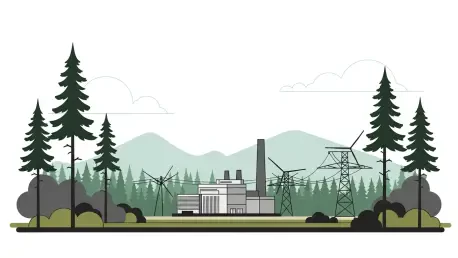

The quiet, pine-scented air of the North Woods is increasingly vibrating with the hum of high-performance computing as the global thirst for artificial intelligence transforms Maine into an unlikely tech frontier. For decades, the state’s industrial identity was defined by the rhythmic churning of paper mills and the seasonal harvest of its coastal waters, yet the current digital gold rush has brought a new kind of heavy industry to the doorstep of rural communities. This shift creates a volatile market dynamic where the allure of multi-billion-dollar infrastructure investments clashes directly with the preservation of a landscape that defines the state’s soul. As 2026 unfolds, the “Pine Tree State” finds itself at a pivotal junction, attempting to determine if it can host the backbone of the modern internet without breaking the very systems—social, environmental, and electrical—that sustain its residents.
From Paper Mills to Server Farms: Maine’s Changing Landscape
The historical backbone of Maine’s economy was built on the pulp and paper industry, which established a legacy of high-power industrial sites scattered across the rural interior. As many of these mills shuttered over the last decade, they left behind “brownfield” sites—pockets of land already cleared and, more importantly, already connected to the high-voltage transmission lines of the electrical grid. For data center developers, these sites represent a shortcut through the bureaucratic thicket of modern zoning and utility interconnection. What used to power massive rollers for newsprint is now being repurposed to fuel the heat-intensive processing units required for large language models and cloud storage.
However, the transition from timber to technology is far from a seamless evolution. While a traditional paper mill operated on a predictable industrial cycle, a modern hyperscale data center demands a constant, unrelenting flow of electricity and, in many cases, massive volumes of water for cooling. This shift in scale is causing a fundamental rift in the state’s economic planning. Residents who once welcomed the mill as a source of stable middle-class jobs now view data centers with skepticism, noting that while a mill employed hundreds of locals, a server farm might only require a skeleton crew of specialized technicians after the initial construction phase is complete.
The Friction of Local Development
Community Pushback: The Demand for Transparency
The current market for data center expansion in Maine is hitting a wall of grassroots resistance characterized by a demand for radical transparency. In Wiscasset, a coastal town known for its historic charm, a proposed $5 billion facility recently saw its progress grind to a halt after a decisive local vote. The opposition was not rooted in a general dislike of technology, but rather in a profound sense of uncertainty regarding the project’s long-term environmental footprint and its impact on the local water table. When developers remain vague about their utility requirements or refuse to disclose the specific nature of their data processing, they inadvertently trigger a protective reflex among residents who value their natural resources over speculative tax revenue.
A similar scenario played out in Lewiston, where a proposed $300 million AI facility was rejected by the city council almost as quickly as it was announced. The speed of this rejection highlights a growing trend in the Maine market: the window for developers to build trust is narrowing. Community organizers have become increasingly sophisticated, using digital tools to mobilize and demand detailed impact studies before a single shovel hits the ground. This heightened scrutiny suggests that the era of “quiet” industrial development is over, and any firm wishing to enter the Maine market must be prepared for an exhaustive public auditing of their sustainability claims.
The Legislative Response: The Moratorium Debate
The escalating tension in local town halls has migrated to the statehouse, manifesting as a fierce debate over Legislative Document (LD) 307. What began as a proposal for a coordination council has morphed into a call for a statewide moratorium on large-scale data center permitting. Under the current proposal, any project exceeding a 20-megawatt power load would be paused until mid-2028. This legislative “time-out” is designed to allow state regulators to study how these massive energy users will interact with an electric grid that is already under significant stress.
The debate over the moratorium has created a fascinating political divide. Proponents argue that a pause is a matter of basic consumer protection, ensuring that the state does not overextend its resources for the benefit of out-of-state tech giants. Conversely, some lawmakers from more urbanized districts argue that a blanket moratorium is a blunt instrument that could stifle innovation in areas where the infrastructure is actually capable of supporting growth. This conflict illustrates the difficulty of creating a unified industrial policy in a state where the needs of a southern coastal city are vastly different from those of a remote northern township.
Energy Security: The Burden on Ratepayers
At the heart of the resistance lies a deep-seated concern regarding energy democracy and the stability of the New England electric grid. Maine currently operates within a regional energy market that is plagued by high electricity prices and a reliance on aging transmission infrastructure. There is a palpable fear that the arrival of 24/7 high-demand data centers will force expensive grid upgrades, the costs of which could be passed on to residential ratepayers. If a family’s monthly utility bill increases to subsidize the cooling of a server farm owned by a multi-billion-dollar corporation, the perceived economic benefit of the data center vanishes instantly.
Furthermore, the regional grid operator, ISO New England, has frequently warned about the challenges of balancing supply and demand during extreme weather events. Adding massive, inflexible loads to this system complicates the transition to renewable energy. While Maine has set ambitious goals for wind and solar production, the intermittent nature of these sources often clashes with the “always-on” requirement of data centers. This misalignment forces a difficult conversation about who gets priority access to the grid during periods of peak demand: the local hospital and residential neighborhood, or the data center processing global AI queries.
Emerging Models for Sustainable Growth
Despite the current friction, the Maine market is beginning to witness the emergence of more sustainable development models that could bridge the gap between growth and preservation. In Limestone, at the former Loring Air Force Base, developers are experimenting with immersion cooling technology that uses specialized non-conductive liquids instead of water. By eliminating the need for massive evaporative cooling towers, these projects significantly reduce their impact on local water supplies. These “innovation-first” facilities represent a shift toward a more surgical approach to infrastructure, where the goal is to integrate with the environment rather than dominate it.
Moreover, the regulatory landscape is shifting toward a “tiered” permitting system. In this model, projects that bring their own renewable energy generation or contribute directly to grid modernization are given a faster path to approval. This encourages developers to become active participants in Maine’s energy transition rather than mere consumers of its limited resources. By pairing data center development with the build-out of battery storage and microgrids, the industry has the potential to actually enhance local energy security, provided the regulatory framework remains strict and the incentives are correctly aligned.
Navigating the Path Forward: Strategies for Balance
For stakeholders navigating this complex landscape, several strategic takeaways have become clear. First, early-stage community engagement is no longer optional; it is the primary determinant of a project’s success. Developers who lead with data and offer specific guarantees regarding noise mitigation and water usage are finding a much smoother path than those who rely on high-level economic promises. Second, the repurposing of brownfield sites must be paired with genuine investment in the surrounding community’s infrastructure. This means that a data center project should ideally result in better internet access for local schools or upgraded substations that improve reliability for nearby homes.
Policymakers are also recognizing that a “one-size-fits-all” approach to data centers is insufficient for Maine’s diverse geography. Future regulations will likely distinguish between hyperscale facilities that strain the grid and smaller, specialized edge computing nodes that can be integrated into existing business parks. By requiring a “net-positive” impact on the grid—where developers must fund more renewable energy than they consume—the state can ensure that the digital frontier contributes to a greener future. This strategy moves the conversation away from a binary choice between technology and nature, focusing instead on a collaborative model of industrial modernization.
Forging a Sustainable Digital Identity
The tension surrounding Maine’s data center expansion highlighted a fundamental shift in how rural regions interacted with the global digital economy. As the legislative session concluded, it became evident that the state’s primary strength lay not in its willingness to provide cheap land, but in its ability to demand high standards for sustainability. The move toward a more regulated, transparent permitting process proved that rural preservation and high-tech growth did not have to be mutually exclusive, provided that the local community remained the primary stakeholder in every negotiation.
Moving forward, Maine established a blueprint for other states by tying industrial approval directly to grid resilience and resource protection. The resulting “Maine Model” incentivized developers to invest in immersion cooling and site-specific renewable energy, ensuring that the state’s digital identity was built on innovation rather than extraction. By prioritizing the long-term affordability of utilities for its citizens, the state successfully navigated the complexities of the digital frontier, ultimately proving that even the most advanced technology must answer to the values of the land it occupies.