
The rapid proliferation of unmanned aircraft systems has introduced a complex and evolving security challenge, transforming open skies from simple thoroughfares into potential vectors for disruption and criminal activity. Counter-Drone (C-UAS) technology represents a significant advancement in the national security and public safety sectors. This review will explore the evolution of these systems, their key features, performance metrics, and the impact they have had on various applications. The purpose of this review is to provide a thorough understanding of the technology, its current capabilities, and its potential future development in response to the escalating threat posed by unmanned aircraft systems.
The Genesis of Counter-Drone Technology
The emergence of C-UAS solutions is a direct response to the widespread availability of consumer and commercial drones, which have created novel security vulnerabilities across public and private sectors. Once considered a niche hobbyist tool, these devices are now exploited for nefarious purposes, ranging from drug smuggling by cartels across the U.S.-Mexico border to the delivery of contraband into correctional facilities. This growing threat landscape has necessitated the development of sophisticated C-UAS solutions to protect critical infrastructure and ensure public safety, highlighting its relevance in the broader technological and security landscape.
The scale of this issue is underscored by staggering statistics from both civilian and commercial domains. The Federal Aviation Administration consistently receives over one hundred reports each month of drones operating dangerously close to airports, posing a direct threat to commercial aviation. Similarly, the National Football League has detected approximately 2,300 unauthorized drone flights near its stadiums, creating significant security concerns during mass gatherings. These incidents demonstrate that the threat is not merely theoretical but a persistent and frequent challenge that demands a robust technological defense.
Core Methodologies in Drone Mitigation
Detection, Tracking, and Identification Systems
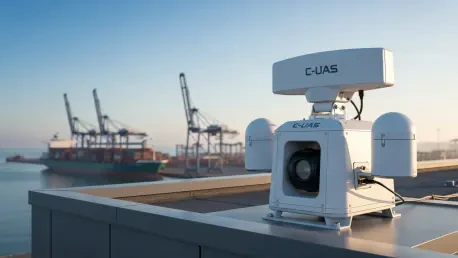
The foundational layer of any effective C-UAS strategy involves the detection, tracking, and identification of potential aerial threats. These systems serve as the critical first line of defense, employing a multi-sensor approach to monitor airspace. Technologies such as radio frequency (RF) analysis scan for communication links between a drone and its operator, while advanced radar systems can detect the physical presence of small, low-flying objects. These are often augmented by electro-optical (EO) and infrared (IR) cameras that provide visual confirmation and tracking capabilities.
The performance of these detection systems is measured by several key metrics, including their detection range, accuracy, and, most importantly, their ability to correctly classify threats. In congested airspace, such as the areas surrounding major airports or crowded NFL stadiums, the capacity to differentiate between a malicious drone and non-threatening aircraft like birds or hobbyist planes is paramount. This capability minimizes false alarms and allows security personnel to focus resources on credible incursions, ensuring a swift and appropriate response without causing unnecessary disruption.
Interdiction and Neutralization Techniques
Once a hostile drone has been detected and identified, the next step involves its interdiction and neutralization. This active phase of C-UAS employs a variety of countermeasures designed to disable or defeat the threat. Among the most common are electronic warfare techniques, including RF jamming, which severs the communication and control links, and GPS spoofing, which feeds the drone false coordinates to misdirect its flight path. These methods are favored in many environments for their non-destructive nature.
In situations where electronic countermeasures are insufficient or a physical stop is required, kinetic solutions come into play. These can range from high-tech options like launching nets to entangle a drone’s propellers to directed-energy weapons and specialized projectiles designed for physical neutralization. The selection of an interdiction method is heavily influenced by the operational environment; protecting a large-scale public event like the FIFA World Cup requires balancing tactical effectiveness with the imperative to avoid collateral damage to crowds and infrastructure below.
Evolving Trends and Strategic Investments
A defining trend in the C-UAS field is the shift toward centralized, government-led strategic investment and oversight. The recent establishment of the Department of Homeland Security’s Program Executive Office for Unmanned Aircraft Systems marks a pivotal moment, consolidating federal efforts to counter drone threats under a single, dedicated entity. This move signals a departure from fragmented, agency-specific approaches and embraces a more unified national strategy for airspace security.
This strategic pivot is backed by substantial financial commitment, as evidenced by an immediate $115 million investment to secure major upcoming national events. This funding is specifically directed toward protecting the massive crowds and numerous venues associated with the U.S. 250th-anniversary celebrations and the FIFA World Cup. Such proactive, large-scale investment highlights a focus on acquiring and deploying standardized, advanced technologies capable of providing a comprehensive security umbrella over vast areas and protecting the public from a diverse range of aerial threats.
Real-World Applications and Deployments
The practical application of C-UAS technology is rapidly expanding beyond military contexts into critical civilian sectors. A primary use case is the protection of major public events, where the high concentration of people creates a vulnerable and attractive target. The coordinated effort to secure the FIFA World Cup and U.S. 250th-anniversary celebrations exemplifies this, deploying layered defenses to safeguard attendees, athletes, and dignitaries from unauthorized drone activity.
Beyond event security, C-UAS systems are being deployed to address persistent criminal threats. They are becoming an indispensable tool for securing national borders, where they help interdict drug-smuggling drones operated by cartels. Similarly, these technologies are used to prevent contraband deliveries into prisons, cutting off a key channel for illegal goods. Furthermore, they are crucial for protecting critical infrastructure, including airports, power plants, and professional sports stadiums, from disruptions and potential attacks orchestrated via unauthorized unmanned aircraft.
Challenges and the Regulatory Landscape
One of the most significant challenges facing the widespread adoption of C-UAS technology is navigating a complex and often restrictive legal environment. Federal law has historically limited the authority to interfere with aircraft, including drones. However, the recent extension of counter-drone authorities for the DHS and the Department of Justice until 2031, as part of the National Defense Authorization Act, provides a much-needed clear legal framework for federal agencies to take decisive action against credible threats.
Another hurdle is ensuring that state and local law enforcement agencies are adequately equipped and authorized to deploy these systems. To address this, new federal initiatives are providing substantial financial support to bolster local anti-drone capabilities. A new grant program has been established to make $500 million available to state and local governments from 2026 through 2027. This funding is designed to facilitate the acquisition and deployment of C-UAS technology, empowering local partners to protect their communities and integrate their efforts into the broader national security architecture.
Future Outlook and Long-Term Impact
The future of C-UAS technology is oriented toward achieving comprehensive air domain superiority through greater integration, automation, and intelligence. The characterization of drones by DHS Secretary Kristi Noem as “the new frontier of American air superiority” underscores a long-term vision of securing domestic airspace against all forms of aerial threats, not just isolated incidents. This perspective drives development toward networked systems that can provide persistent, wide-area surveillance and protection.
Future advancements will likely be centered on the integration of artificial intelligence and machine learning to enable real-time, autonomous threat assessment and response. This will allow C-UAS platforms to more rapidly identify anomalous behavior and distinguish between hostile and benign drones with minimal human intervention. Concurrently, research is focused on developing more sophisticated and low-collateral interdiction methods, ensuring that neutralization techniques are as precise and safe as possible. The long-term impact will be a more layered and resilient security posture for the nation’s critical infrastructure and public spaces.
Conclusion and Overall Assessment
This review highlights that counter-drone technology has become an indispensable component of modern security strategy. The coordinated federal response, demonstrated by the new DHS office and substantial legislative support, underscores the gravity of the threat. With a clear focus on protecting public events, securing borders, and safeguarding critical infrastructure, C-UAS systems are evolving rapidly. The overall assessment is that continued investment and innovation in this sector are critical to maintaining security and public safety in an era of increasing drone proliferation.