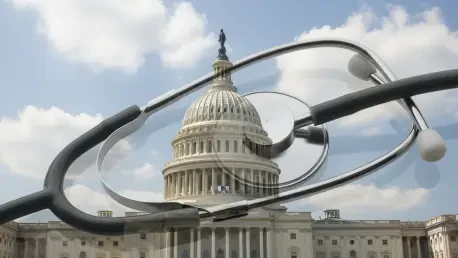

A single, seemingly offhand comment from a former president has thrown the Republican party’s congressional leadership into a frantic scramble, creating a high-stakes political crisis that places the health insurance coverage of over 20 million Americans in jeopardy. As a critical year-end deadline approaches, an abrupt pivot on extending Affordable Care Act (ACA) subsidies has exposed deep, ideological fractures within the GOP, pitting a leadership determined to align with Donald Trump against a growing rebellion of rank-and-file members who fear a self-inflicted political catastrophe. The ensuing chaos reveals a party at war with itself over one of the most sensitive issues for American voters, with no clear path forward.
A Single Sentence Ignites a Political Firestorm
The current legislative turmoil was ignited by former President Donald Trump’s recent refusal to endorse an extension of the enhanced ACA tax credits. In a statement that has since ricocheted through the halls of Congress, Trump articulated a vague but powerful directive: “I want to give the money to the people, not to the insurance companies.” This populist-infused remark was immediately interpreted by Republican leadership not as a policy suggestion, but as a clear command to dismantle the existing subsidy structure, which has become a cornerstone of the individual health insurance market.
In a swift and decisive reaction to Trump’s cue, Senate Republicans abandoned their previous strategies and began preparing a new proposal, co-authored by Senators Bill Cassidy and Mike Crapo. Their plan would allow the subsidies to expire as scheduled, pivoting instead to a conservative framework centered on expanding Health Savings Accounts (HSAs). This move was designed to present a proactive alternative to the Democrats’ push for a three-year extension, allowing the GOP to frame the debate on its own terms. This Senate action, in turn, placed immense pressure on House Speaker Mike Johnson, who had promised his conference a vote on a new health plan before the end of the year, a promise that apparently caught even his own leadership team by surprise.
The Ticking Clock Understanding the High Stakes Subsidy Debate
The legislative battle is unfolding against a rapidly approaching deadline with profound real-world consequences. The enhanced tax credits, which were expanded to make ACA marketplace plans more affordable for a wider range of incomes, are set to expire on December 31. If Congress fails to act, millions of families will face a sudden and severe financial shock. On average, households stand to lose more than $1,000 in annual premium support, an increase that would make coverage unaffordable for many and could drive them out of the insurance market altogether, potentially destabilizing it further.
Beyond the immediate financial impact on families, the political stakes for the Republican party are immense. Allowing healthcare costs to skyrocket for millions of their own constituents just as the 2024 election cycle intensifies is a scenario that many in the party view as politically toxic. The GOP is desperate to avoid a repeat of past healthcare battles where they were blamed for threatening coverage without offering a viable alternative. The pressure is particularly acute for members in competitive districts and those from states with high ACA enrollment, who know that a vote to end the subsidies could be used against them with devastating effect.
A Party Divided The Factions Fault Lines and Competing Plans
The pressure from the impending deadline has laid bare the deep divisions within the Republican conference, where at least three distinct factions are now pulling the party in different directions. At the top, the Trump-Leadership axis, composed of Speaker Johnson and his Senate counterparts, is pushing to follow the former president’s lead. They aim to let the subsidies expire and replace them with a system that champions HSAs and potentially provides funding for cost-sharing reductions, another type of ACA subsidy. This approach satisfies the party’s conservative base and demonstrates loyalty to Trump, but it lacks broad support within the conference.
In direct opposition to the leadership’s hardline stance is a growing rebellion among the party’s moderate and electorally vulnerable members. This group views the abrupt termination of subsidies as a “political disaster” waiting to happen, arguing that the party cannot afford to be seen as responsible for stripping financial assistance from working families. They contend that while the ACA is flawed, causing a massive premium spike without a workable replacement is both poor policy and political malpractice. This anxiety has created a significant internal revolt, threatening the leadership’s ability to impose its will on the conference.
This internal conflict is reflected in a battlefield of competing legislative proposals, highlighting the party’s lack of a unified vision. The leadership’s plan to let subsidies expire and expand HSAs stands in stark contrast to a compromise bill from Representative Brian Fitzpatrick, which would extend the tax credits for two years while incorporating conservative reforms like income caps and eligibility restrictions. A third, more cautious option has also been floated: a short-term extension of funding to January 30, designed to buy more time for a comprehensive deal, though many see this as a logistical nightmare for consumers trying to enroll in year-long health plans.
Voices from the Fray Firsthand Accounts of the Internal Chaos
The internal disarray is not merely a matter of policy disagreement; it is a full-blown crisis of confidence, with key members publicly rebuking their own leadership. Representative Brian Fitzpatrick (R-Pa.), a leading voice for the moderate faction, has been particularly blunt in his criticism. He has warned party leaders against digging “themselves into an ideological corner” while ignoring the real-world consequences for their constituents. “We can’t live in this fantasy land,” Fitzpatrick stated, arguing that simply letting the subsidies expire is “not acceptable” and that the leadership’s approach fails to solve any underlying problems.
This confusion permeates the highest levels of the party. When Speaker Johnson announced his intention to hold a vote on a new health plan, the news came as a shock to some of the very people involved in the discussions. One senior Republican, when asked about the plan, responded with a surprised, “What health care plan?” further illustrating the lack of coordination. The situation is exacerbated by conflicting signals from the Trump administration itself. One senior House Republican noted that the White House’s position “depends on who you ask,” revealing that even the source of the initial directive is not providing clear guidance, leaving congressional leaders to navigate a chaotic and leaderless policy debate.
Navigating the Legislative Minefield Key Pressure Points to Watch
This healthcare impasse has become the first major leadership test for Speaker Mike Johnson, whose attempts to “bulldoze internal dissent and march in lockstep with Trump” have met with significant resistance. By siding with the hardline faction demanding the subsidies expire, Johnson is risking an open revolt from the very moderate members whose votes are essential to maintaining his narrow majority. His ability to unify a deeply fractured conference on such a contentious issue, under an intense time crunch, will be a defining moment of his speakership and could determine the party’s legislative success for the remainder of the session.
Frustration with the leadership’s direction has grown so intense that a parliamentary “nuclear option” is now on the table: the discharge petition. This procedural tool would allow a bipartisan majority of House members to force a floor vote on a specific bill, bypassing the Speaker’s control over the legislative agenda entirely. A sufficient number of disgruntled Republicans have indicated they may be willing to sign such a petition to bring up a bill extending the subsidies, representing the ultimate threat to Johnson’s authority and a clear signal that the rank-and-file will not be easily controlled.
Faced with internal rebellion and a ticking clock, the GOP leadership is scrambling to pass “something” before the holiday recess. The goal is to hold a vote on a Republican-led bill, even one that has no chance of passing the Democratic-controlled Senate. Such a move would be largely symbolic, designed to demonstrate action and project an image of a party engaged in solving problems. However, without a consensus plan, even this effort risks backfiring, potentially highlighting the party’s dysfunction rather than its legislative prowess on a major policy crisis.
The crisis over healthcare subsidies ultimately revealed a party caught between its past and its future. The episode underscored the profound and lingering influence of a single political figure over the party’s legislative priorities, often at the expense of pragmatic policymaking. It was a stark reminder of the deep ideological rifts that continued to prevent the formation of a coherent Republican vision for healthcare. The frantic, last-minute negotiations and internal power struggles left the party on a precarious footing, having narrowly averted one political crisis only to face the broader challenge of proving it could govern effectively as the next election loomed.