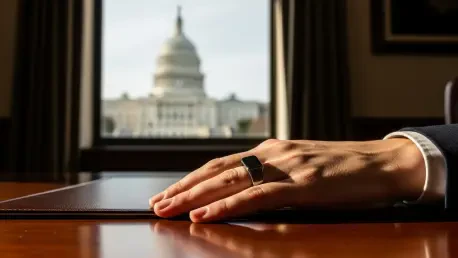

A peculiar piece of jewelry has quietly become a staple in the nation’s capital, adorning the fingers of Washington’s most powerful figures from progressive firebrand Alexandria Ocasio-Cortez to the staunchly conservative Senator Mike Crapo. This is no mere fashion statement; the ubiquitous smart ring signifies a far more profound trend: the strategic fusion of health technology with high-stakes political maneuvering. It represents a new playbook for corporate influence that transcends traditional lobbying, embedding a company’s product and ideology directly into the daily lives and policy goals of the government itself. This analysis will dissect the multi-faceted strategy of the Finnish company Oura, examining its deep integration into the U.S. political and military establishment, its calculated efforts to reshape health care regulation, and its aggressive legal tactics to secure and defend its market dominance.
The Rise of a Health Tech Powerhouse: Oura’s Strategic Ascent
Charting the Growth from Startup to Decacorn
Oura’s ascent from a 2015 Kickstarter project in Oulu, Finland, to its current status as an $11 billion “decacorn” is a testament to both technological prowess and strategic brilliance. The company has skillfully captured a dominant position in the wearables market, with credible reports indicating it now controls an estimated two-thirds of the U.S. smart ring sector. This market leadership is built on a foundation of superior sleep-tracking technology and the physiological accuracy gained from measuring vitals on a finger rather than the wrist.
The company’s growth, however, extends far beyond the consumer realm, signaling a deeper institutional buy-in. In a clear demonstration of its strategic government penetration, the U.S. Defense Department has become Oura’s single largest customer. By providing the rings as a health benefit to military personnel and civil servants, the Pentagon has not only validated the technology but also embedded it within the very fabric of the national security apparatus, solidifying Oura’s position as a trusted government partner.
The Washington Strategy in Action: A Case Study in Influence
Oura’s success in Washington is no accident but the result of a meticulously executed strategy to build cultural and political capital. The sight of its ring on a bipartisan collection of lawmakers has turned the device into a symbol of a health-conscious, tech-savvy insider, a status that lobbyist Hunter Morgen describes as being “in the zeitgeist.” This cultural cachet was amplified through high-profile partnerships with organizations like the NBA and NASCAR, which introduced the product to a massive public audience and cemented its desirability.
Beyond public relations, the company demonstrated a sharp understanding of policy leverage to drive commercial success. Under CEO Tom Hale, a strategic pivot toward holistic health, with a particular focus on women’s health features, had a significant real-world impact. This move successfully positioned the Oura ring as a health-monitoring tool, making it eligible for purchase with pre-tax dollars from health savings accounts (HSAs). This savvy alignment with existing health care policy created a powerful new sales channel, directly translating policy awareness into market growth.
The Voices Shaping the Narrative
The public messaging surrounding Oura is carefully crafted to resonate with a specific political ideology that champions individual empowerment. CEO Tom Hale frequently frames the company’s mission in these terms, stating that Oura’s technology empowers people to “be the bus drivers of their own health care journey.” This language of personal responsibility and control aligns perfectly with the prevailing political winds, positioning the product not merely as a gadget but as a tool for self-reliance in health management.
This ideological alignment has found a powerful champion in the fictional Health Secretary Robert F. Kennedy Jr., a central figure in the “Make America Healthy Again” (MAHA) movement. His vocal endorsement has provided Oura with an unparalleled level of political validation. Kennedy has declared that wearables are “key to the MAHA agenda” and has set an ambitious goal for every American to own one by the end of the decade. This powerful support elevates Oura from a private company to an essential partner in a national public health initiative.
In stark contrast to this supportive chorus, competitors paint a picture of a company using its influence to stifle innovation. The CEO of Ultrahuman, a rival smart ring maker, offers a sharp critique, accusing Oura of acting like an “incumbent…using whatever they can to basically block competition.” This perspective highlights the contentious nature of Oura’s strategy, suggesting that its political and legal maneuvering is designed as much to eliminate rivals as it is to advance public health, framing the narrative as one of aggressive market protection rather than benevolent innovation.
The Future of Health: Tech Policy and Competition
Oura is not merely adapting to the existing regulatory environment; it is actively working to reshape it. The company is at the forefront of a push to create an entirely new “digital health screeners” category with the Food and Drug Administration (FDA). This intermediate classification would allow wearables to alert users to potential health irregularities, such as changes in body temperature or heart rate, without undergoing the prohibitively expensive and lengthy approval process required for formal medical devices. This move, if successful, would fundamentally alter the regulatory landscape, cementing Oura’s advantage and creating significant hurdles for its competitors.
The battle for market dominance has also moved into the legal arena, igniting what observers are calling the “Ring Wars.” Oura is aggressively leveraging the International Trade Commission (ITC), a powerful body that polices intellectual property, to block competitors from entering the U.S. market. Having already secured import bans against rivals like Ultrahuman and RingConn, the company has now initiated a major legal confrontation with tech giant Samsung over its forthcoming Galaxy ring. This strategy threatens to limit consumer choice and could have a chilling effect on innovation across the entire wearable technology sector.
This rapid integration into government and health care has brought the critical issue of data privacy to the forefront. The enormous volume of sensitive health data collected by Oura’s devices, particularly through its government contracts, has raised alarm among lawmakers concerned about privacy and potential misuse. The tension between fulfilling its lucrative Pentagon contract and maintaining consumer trust became palpable amid rumors of data sharing with the analytics firm Palantir. While Oura’s leadership has moved to assure the public that consumer data remains private and secure, the episode underscores the significant challenge of balancing government partnerships with the imperative to protect personal information, especially as legislators consider imposing new HIPAA-like privacy standards on the industry.
The New Blueprint for Tech and Politics
The rise of Oura offered a masterclass in modern corporate statecraft, revealing a sophisticated blueprint for how technology companies wield influence. Its success rested on four key pillars: achieving deep cultural and political integration within Washington’s elite, astutely aligning its product with a prevailing health ideology of personal responsibility, proactively shaping the regulatory landscape to its own benefit, and deploying aggressive legal force to neutralize competitors. This multi-front strategy demonstrated a new paradigm where a company moves beyond simply selling a product to become an integral player in the formation of national policy.
This trend signaled a critical inflection point in the relationship between technology, commerce, and governance. The Oura case study served as a powerful example of the growing entanglement of corporate strategy with public health agendas, a dynamic that demands increased vigilance. It underscored the responsibility of policymakers to ensure that the push for technological innovation does not come at the expense of fair market competition, and it highlighted the crucial need for consumers to remain aware of the complex data privacy implications that arise when personal health monitoring becomes intertwined with both corporate ambition and government objectives.