
In the turbulent world of U.S. politics, few figures command as much attention as Donald Trump. A recent, wide-ranging interview with POLITICO has provided a fresh and unfiltered look into the president’s thinking on the most pressing issues of our time. To help us unpack these revelations, we’re joined by Donald Gainsborough, a leading mind in policy and legislation from Government Curated. We’ll explore the president’s stark litmus test for the next Federal Reserve chair, his glowing self-assessment of the economy amidst public anxiety, and his ambiguous plans for healthcare. We will also delve into his tactical shifts on trade tariffs, his transactional and dismissive view of European alliances, his hands-off approach to congressional oversight, and his blunt message for Ukraine’s future.
You’ve established an immediate interest rate cut as a litmus test for the next Fed chair. Could you walk me through the specific economic metrics that justify this urgency and explain how you’d manage the relationship with a central bank that has traditionally prized its independence?
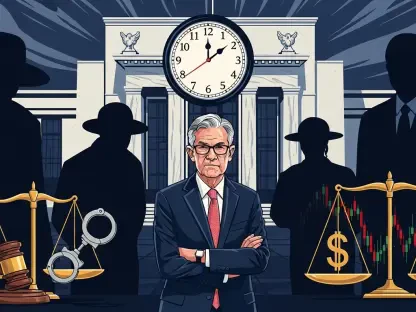
The president’s statement represents perhaps the most overt challenge to the Federal Reserve’s independence we’ve seen in the modern era. By explicitly stating that support for immediate rate cuts is a “litmus test,” he’s not just pressuring the institution; he’s attempting to fold it into the political wing of the White House. This move completely erodes the foundational principle that the central bank should make decisions based on economic data, free from partisan influence. He’s made it personal, berating the current chair, Jerome Powell, as “not a smart person” who simply “doesn’t like Trump.” This isn’t about managing a relationship; it’s about demanding fealty. The expectation is that the next chair, widely believed to be Kevin Hassett, will act not as an independent steward of the economy, but as an instrument of the president’s political will, regardless of what the long-term economic data on inflation or employment might suggest.
You graded the economy an “A-plus-plus-plus-plus-plus,” but a poll found many of your own voters are struggling with costs. What key performance indicators are you looking at to justify that grade, and what’s your step-by-step plan to address the affordability concerns you’ve called a “hoax”?
That “A-plus-plus-plus-plus-plus” grade is a fascinating piece of political messaging because it exists in a reality completely detached from the daily experience of a significant portion of the electorate, including his own base. The POLITICO poll you mentioned is devastatingly clear: 37 percent of his 2020 voters say the cost of living is the worst they can ever remember. Yet, the president dismisses this widespread anxiety as a “hoax” fabricated by Democrats. He justifies his grade not by looking at household budgets, but through a macro lens of his own making, citing trillions in foreign investment from his diplomatic trips—capital that he admits will take years to manifest as actual jobs. Meanwhile, hard data, like the recent ADP report showing a loss of 32,000 private sector jobs, including 18,000 in manufacturing, is completely ignored. There is no step-by-step plan to address affordability because, in his narrative, the problem doesn’t exist; it’s a political illusion he must simply talk his way out of.
When asked about extending health care subsidies, you focused on wanting to pay money directly to the people instead. Can you elaborate on the specific legislative steps needed to enact this direct-payment system and provide a timeline for how you’d transition away from the current subsidy model?
The president’s pivot to wanting to pay money directly into health savings accounts is a masterclass in populist appeal that creates a legislative nightmare for his own party. The soundbite, “No money for the insurance companies, I want to pay the money directly to the people,” resonates powerfully with a base that is deeply distrustful of large corporations. However, when pressed for specifics, he offers none. He declined to take a position on the immediate issue of extending the enhanced Obamacare subsidies, which are set to expire, a move that would cause premiums to spike for millions. This leaves Hill Republicans completely adrift. They are struggling to find a unified plan, and the president is offering them a broad, appealing concept with no legislative framework or timeline. He’s essentially endorsing a destination without providing a map, complicating their reality right as they face a critical vote to stave off massive premium increases.
You mentioned being open to more tariff carveouts on goods like coffee to lower prices for Americans, while raising duties elsewhere. Could you describe the process for determining which products get this relief and provide an example of a sector where you might increase tariffs to compensate?
This is a clear example of the president trying to have his cake and eat it too. He recognizes that rising grocery prices are a political vulnerability, so he’s floating the idea of expanding tariff exemptions on consumer staples, pointing to coffee as something he’s “done that already with.” He dismisses these as “very small carveouts” to signal that he isn’t retreating from his signature economic policy. The process here isn’t based on some rigorous economic analysis; it’s driven by political necessity. He’s looking for visible, consumer-facing products where a price drop would be noticed and appreciated. Crucially, he stressed that any relief would be offset by raising duties elsewhere, preserving his strategy of using trade penalties as a weapon. He didn’t name a specific sector to target, but the message is that this is a tactical shuffle, not a strategic withdrawal, designed to blunt inflationary pain at home while keeping his tariff arsenal fully loaded for geopolitical leverage.
You characterized Europe as “decaying” and “weak,” suggesting that alliances are now conditional. What specific changes in immigration or defense policy would a traditional ally need to make to secure its relationship with the U.S., and can you share an anecdote that illustrates this new, more transactional approach?
The president’s view of Europe is deeply ideological and profoundly personal. When he calls the continent “decaying” and “weak” due to lax immigration and political correctness, he is signaling that the old guarantees of American partnership are over. The relationship is no longer based on shared democratic values but on his personal approval. He made this explicit when asked if European nations would cease to be allies, responding with a chilling, “Well, it depends.” The anecdote he shared about NATO Secretary General Mark Rutte calling him “daddy” perfectly captures this dynamic. It’s a story he tells with pride, but for our allies, it’s a belittling flourish that illustrates his desire for dominance over partnership. To secure the relationship, an ally would likely need to adopt his nationalist-populist worldview, perhaps by emulating figures he admires like Hungary’s Viktor Orbán, and align their policies with his, rather than relying on the sanctity of a 75-year-old treaty.
Regarding the controversial military strike, you said Defense Secretary Hegseth can testify “if he wants.” What’s your framework for when a cabinet secretary should or shouldn’t comply with congressional oversight, and how does your personal review of the operation’s footage influence that decision?
The framework is simple: loyalty to the president outweighs any obligation to a co-equal branch of government. The statement, “I don’t care if he does. He can, if he wants,” is a profound dismissal of Congress’s constitutional oversight role. The president is essentially communicating that his Pentagon chief’s compliance is optional, a personal choice, not a legal or constitutional duty. His comment that he reviewed the footage and that “it looked like they were trying to turn back over the boat” is a strategic intervention. He is adopting a specific, exculpatory narrative—the same one pushed by allies like Senator Tom Cotton—to provide political cover for the strike. At the same time, by saying, “I don’t get involved in that,” he masterfully distances himself from the final, lethal decision, creating a split screen where he is both the supportive boss and a detached commander-in-chief.
Given the president’s blunt assessment that Ukraine is “losing” and his pressure for an election under martial law, what is your forecast for Kyiv’s political and military future in the face of these shifting American expectations?
My forecast for Ukraine is unfortunately quite bleak under this framework. The president is systematically dismantling the pillars of Ukrainian resistance and sovereignty. By publicly declaring that Ukraine should hold an election despite martial law, he is echoing a key Russian talking point designed to delegitimize President Zelenskyy. He even directly states that Ukraine’s claim to democracy is at risk, which is an extraordinary statement to make about a country fighting an existential war against an authoritarian invader. His blunt assessment that Kyiv is “losing” and that Zelenskyy will have to “start accepting things” is not just an opinion; it’s a signal to the world that the United States is preparing to accept major Ukrainian concessions. When he hedges on whether the U.S. would walk away, saying the idea isn’t “exactly correct, but not exactly wrong,” he is essentially putting a price on American support. The forecast is for immense pressure on Kyiv to negotiate from a position of weakness, likely leading to a settlement that involves a permanent loss of territory and a compromised future.