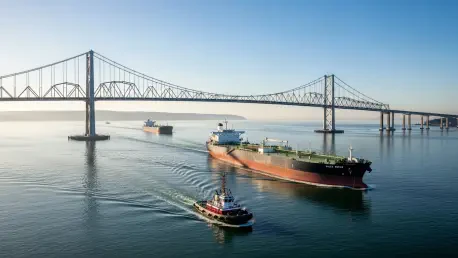

The terrifying structural failure of a major transit artery often begins with a single mechanical glitch aboard a massive vessel whose weight dwarfs the engineering safeguards of a bygone era, leaving the nation’s supply chains hanging by a metaphorical thread. This chilling reality became a central focus for maritime safety experts following the catastrophic destruction of the Francis Scott Key Bridge, an event that stripped away the illusion of permanence regarding American infrastructure. The collapse did more than just sever a vital highway; it exposed a systemic misalignment between the gargantuan scale of modern global commerce and the static, aging concrete that supports the nation’s most critical waterway crossings. As the dust settled and investigations commenced, the focus shifted toward a broader, more unsettling question: how many other bridges across the United States are currently operating on borrowed time?
Engineers and policymakers now face a daunting landscape where the protection of maritime infrastructure requires a radical departure from traditional maintenance schedules. The core challenge lies in the fact that many of the country’s iconic spans were designed in the mid-20th century, a period when the largest container ships were a fraction of the size of the neo-Panamax giants that dominate the seas in 2026. This massive discrepancy in kinetic energy means that a collision today is not merely an accident but a catastrophic event that current pier protections are often wholly unable to absorb. Protecting these spans is no longer just about repairing rust or reinforcing steel; it is about re-engineering the relationship between the built environment and the relentless growth of maritime logistics.
The Vulnerability of American Maritime Infrastructure
The central theme emerging from recent structural audits is the profound fragility of the maritime gateway system, particularly regarding bridges that serve as the backbone of the American East and Gulf Coasts. The Francis Scott Key Bridge collapse served as a grim proof of concept for structural engineers, illustrating that even a well-maintained bridge can be instantly liquidated by a concentrated kinetic force. This disaster highlighted a glaring vulnerability in “fracture-critical” designs, where the failure of a single primary component can lead to a total progressive collapse of the entire structure. While these designs were standard during the original construction boom of the Interstate Highway System, they are fundamentally ill-equipped to handle the erratic movement of modern cargo vessels.
Furthermore, the engineering challenges of protecting these aging spans are compounded by the geographic reality of their locations. Many of these bridges sit at the narrowest points of high-traffic shipping channels, where current and wind can easily push a vessel off its intended path. Because these structures were often built before the implementation of modern vessel-collision-modeling techniques, their support piers are frequently located in or dangerously close to the primary navigation channels. This proximity creates a razor-thin margin for error, where a momentary loss of steering or power on a ship can translate into a national economic crisis within seconds.
Background of the Post-Baltimore Infrastructure Crisis
The immediate aftermath of the Dali collision in Baltimore triggered an exhaustive investigation by the National Transportation Safety Board (NTSB), which sought to move beyond the specific mechanics of the crash and look at the broader safety ecosystem. This investigation revealed that a single loose wire on the vessel caused the power failure that ultimately doomed the bridge, but the structural failure was attributed to a lack of adequate pier protection. The NTSB’s inquiry quickly evolved into a national mandate for state transportation departments to re-evaluate their own waterway crossings against modern safety metrics. This research is vital because bridge failures do more than just halt traffic; they paralyze port operations, drive up the cost of consumer goods, and require billions of dollars in emergency federal spending.
The current crisis is largely defined by the disconnect between 20th-century engineering and 21st-century ship dimensions. In the decades following the completion of the major coastal bridge projects, the volume of cargo passing through American ports has increased exponentially, leading to the development of ships that carry over 10,000 containers at a time. These vessels possess such immense mass that even a low-speed impact can deliver a blow that existing bridge fenders were never intended to survive. Consequently, the research conducted over the past few years has emphasized that the “safe” bridges of the past are effectively obsolete in the face of modern maritime trade demands, necessitating a complete overhaul of how the nation assesses structural risk.
Research Methodology, Findings, and Implications
Methodology
The research methodology employed by federal safety officials and engineering firms involved a multi-tiered risk assessment framework designed to identify which bridges posed the greatest threat to public safety and economic stability. At the direction of the NTSB, owners of 68 major highway bridges were tasked with performing rigorous vulnerability studies based on the American Association of State Highway and Transportation Officials (AASHTO) safety standards. These standards utilize sophisticated probability modeling to calculate the likelihood of a vessel strike and the subsequent chance of a structural collapse. The methodology accounted for variables such as local water depth, current speed, the frequency of large-vessel transits, and the specific structural redundancy of each bridge span.
In addition to mathematical modeling, the assessment process included physical inspections of existing protective measures, such as fenders and dolphins, to determine if they met the kinetic energy absorption requirements of the present day. Researchers also conducted simulations of “worst-case” scenarios, modeling the impact of the largest ships currently calling at nearby ports to see how each bridge’s support piers would behave under extreme stress. This data-driven approach allowed officials to move away from anecdotal safety claims and toward a standardized ranking of bridge vulnerability across the entire national inventory.
Findings
The most alarming outcome of the research was the identification of the “dirty dozen,” a group of 12 high-risk bridges that significantly exceed modern “acceptable risk” thresholds for vessel collisions. Among these are the Chesapeake Bay Bridge in Maryland, both spans of which are deemed highly vulnerable due to their length and the volume of massive ships heading toward the Port of Baltimore. Similarly, the Walt Whitman and Benjamin Franklin bridges, which connect Philadelphia to New Jersey across the Delaware River, were found to have inadequate pier protections for the size of modern tankers. These findings suggest that the risk of a Baltimore-style disaster is not localized to any one city but is a pervasive threat throughout the I-95 corridor and beyond.
Other notable bridges identified in the findings include the Crescent City Connection in New Orleans and the Coronado Bridge in San Diego, both of which face high collision probabilities due to the heavy naval and commercial traffic in their respective waterways. The research concluded that these structures operate in a zone where the mathematical probability of a catastrophic strike is statistically significant over a 50-year lifespan. The overarching discovery was that the current safety infrastructure on these bridges is largely performative, capable of handling minor bumps from tugs or small barges but completely useless against the momentum of a fully loaded container ship.
Implications
The practical implications of these findings are staggering, primarily due to a multi-billion-dollar funding gap that prevents immediate remediation. Replacing even a single major bridge like the Chesapeake Bay Bridge is estimated to cost upward of $15 billion, a figure that far exceeds the annual capital budgets of most state transportation departments. Consequently, many states are forced to consider stop-gap measures, such as retrofitting pier protection systems with massive concrete “dolphins” or energy-absorbing fender systems. While these retrofits are cheaper than total bridge replacement, they still carry price tags in the hundreds of millions of dollars and require years of environmental permitting and construction.
Moreover, the research has sparked a intense debate regarding new maritime regulations, specifically the potential mandate for tug-boat assistance for all large vessels passing under vulnerable bridges. Such a requirement would shift some of the safety burden—and cost—onto the shipping industry, which has historically resisted such measures due to the increased operational time and expense. However, the findings suggest that physical engineering alone may not be enough to secure these spans; a “layered” safety approach that combines structural reinforcement with strict operational controls in the water may be the only feasible path forward in the current fiscal environment.
Reflection and Future Directions
Reflection
The study’s findings reflect a troubling “regulatory loophole” that has historically exempted older bridges from retroactive safety assessments. Because federal law did not mandate that bridges built before the 1990s meet modern collision-resistance standards, many of the nation’s most traveled spans were allowed to fall behind the curve of maritime evolution. This oversight was not due to a lack of engineering knowledge, but rather a result of financial inertia; the cost of acknowledging these risks was simply too high for previous administrations to face. This has created a situation where the public relies on infrastructure that is technically “safe” by outdated rules but functionally dangerous by modern standards.
This reflection also reveals a deeper tension between economic growth and infrastructure resilience. The desire to accommodate larger ships to remain competitive in global trade has directly increased the risk profile of the bridges that span those same shipping channels. The Baltimore disaster effectively ended the era of “wilful ignorance” regarding this trade-off, forcing a reckoning with the fact that the pursuit of maritime efficiency has outpaced the nation’s willingness to invest in the structures that make that trade possible. The current predicament is the logical conclusion of decades of deferred maintenance and a lack of proactive federal oversight in maritime safety zones.
Future Directions
Looking ahead, future research must prioritize the development of more cost-effective kinetic energy absorption materials that can be easily applied to existing piers without requiring massive underwater construction. Exploring the use of high-strength composites or modular “sacrificial” structures could provide states with a way to mitigate collision risks at a fraction of the cost of traditional concrete dolphins. Additionally, there is a clear need for advanced real-time monitoring systems that use artificial intelligence to predict potential collisions based on a ship’s trajectory and speed, allowing for immediate emergency alerts to be sent to motorists on the bridge above.
Furthermore, the reauthorization of federal highway laws should include provisions that mandate periodic vulnerability modeling for all bridges over navigable waterways, regardless of their age. By integrating these assessments into the National Bridge Inventory, the federal government can create a more transparent and prioritized funding pipeline for high-risk structures. Future research should also investigate the environmental impact of large-scale pier protection projects, as the construction of massive barriers in sensitive waterways can disrupt local ecosystems and sedimentation patterns. Balancing the urgent need for structural safety with environmental stewardship will be a defining challenge for the next generation of civil engineers.
Conclusion: Securing the Future of National Waterway Crossings
The comprehensive analysis of the nation’s bridge inventory after the Baltimore disaster revealed a precarious state of maritime infrastructure that demanded immediate and sustained intervention. It was found that the “dirty dozen” high-risk bridges represented only the most visible portion of a much larger systemic failure to reconcile the increasing mass of global shipping with the static nature of mid-century engineering. The research underscored that the prevailing “wait-and-see” approach to infrastructure safety was no longer a viable strategy, as the economic and human costs of a single collapse far outweighed the investment required for proactive protection. Through the application of AASHTO standards, engineers successfully identified the most critical points of failure, but the path toward actual remediation remained hindered by significant financial and regulatory hurdles.
The investigation ultimately shifted the national conversation from a reactive focus on accident cleanup to a proactive mandate for structural resilience and maritime regulation. It was concluded that a combination of physical pier reinforcements and stricter waterway management, such as mandatory tugboat escorts for large vessels, offered the most realistic chance of preventing future catastrophes. While the multi-billion-dollar price tag for these upgrades presented a daunting challenge for policymakers, the findings made it clear that the cost of inaction would be significantly higher. By identifying the regulatory loopholes that allowed these vulnerabilities to persist, the study provided a roadmap for legislative reform that sought to prioritize the safety of the nation’s waterway crossings in an era of unprecedented maritime growth. The lessons learned from the Baltimore disaster served as a definitive warning that the integrity of the American transportation network depended on the ability to anticipate and mitigate the kinetic realities of modern trade.