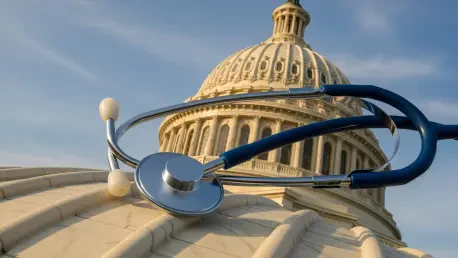

A new fault line has emerged within the Republican party’s approach to healthcare, threatening to shatter decades of free-market orthodoxy with a populist vision aimed directly at the industry’s corporate giants. As the nation grapples with persistent concerns over medical costs and access, a proposed ideological pivot away from established conservative principles has ignited a fierce debate about the future of American healthcare. This potential transformation, embodied in a plan that favors direct government intervention over market-based solutions, signals a significant departure from the party’s long-held platform and sets the stage for a contentious political and legislative battle.
The Republican Healthcare Battlefield: A Landscape of Shifting Alliances
For years, the Republican healthcare agenda was defined by a singular, unwavering mantr”repeal and replace.” This approach, rooted in free-market conservatism, championed policies designed to reduce government regulation and promote competition among private insurers and providers. The goal was to dismantle the Affordable Care Act (ACA) and substitute it with a system that empowered consumers through mechanisms like health savings accounts and the sale of insurance across state lines. This philosophy prioritized individual choice and market dynamics as the primary tools for controlling costs and improving care.
However, the political ground has shifted dramatically. Rising ACA premiums in certain markets and pervasive voter frustration over high deductibles, prescription drug prices, and surprise medical bills have created immense pressure for a new strategy. The abstract appeal of free-market principles has been overshadowed by the tangible economic pain felt by many households, pushing Republican leaders to seek more direct and immediate solutions. This environment has made the party’s traditional hands-off approach increasingly difficult to defend, especially when voters are demanding decisive action on kitchen-table economic issues.
This evolving landscape has exposed deep divisions among key Republican stakeholders. The party’s populist base, a crucial component of its electoral coalition, is increasingly receptive to government intervention if it means lower costs and accountability for large corporations. This puts them at odds with free-market conservatives and influential think tanks that view such policies as a betrayal of core principles. Meanwhile, corporate allies in the pharmaceutical and insurance industries, once reliable partners in policy debates, now find themselves the primary targets of this new populist offensive, creating a complex and unpredictable web of shifting alliances.
The Populist Wave: Charting the New GOP Trajectory
From Repeal and Replace to Reset and Redefine
The proposed “Great Healthcare Plan” represents a fundamental ideological pivot, moving the Republican party away from its established orthodoxy toward a more interventionist and populist strategy. This new vision consciously jettisons prior free-market proposals in favor of direct government action aimed at curbing the power of corporate healthcare entities. Republican lobbyist Ryan Ellis described the initiative as a “massive redefinition of the relationship between the United States government and the health care system,” designed to “reset the vision” for the party and its approach to one of the nation’s most pressing domestic issues.
This strategic shift is underscored by what the plan omits as much as by what it includes. Gone are the familiar calls for allowing small businesses to form associations to increase their bargaining power with insurers, a central plank of a recent House Republican bill. Instead, the focus is squarely on leveraging government power to force down prices. Lauren Stewart of Americans for Prosperity, a conservative group that historically opposed Obamacare, identified the proposal as creating a “fundamental line in the sand,” distinguishing this new direction from the “Paul Ryan Republican conference” whose focus was narrowly fixed on repeal. She characterized the new trajectory as more innovative, open, and forward-looking.
The political drivers behind this strategic reorientation are clear: to put the Republican party “on offense” in the healthcare debate. For too long, the party has been cast in a defensive role, reacting to Democratic initiatives without offering a compelling, proactive vision of its own. By targeting widely unpopular industries like pharmaceuticals and insurance, the plan aims to channel public anger over high costs into a potent political weapon, reframing the GOP as the party fighting for the consumer against entrenched corporate interests.
Gauging the Political Shockwaves and Electoral Stakes
The plan’s potential to resonate with voters in the upcoming elections is significant, as it directly addresses one of the most persistent sources of economic anxiety for American families. With healthcare costs consistently ranking as a top concern in national polls, a platform promising aggressive action to lower drug prices and insurance premiums could prove highly effective. The proposal is crafted to appeal to a broad cross-section of the electorate, including independents and disaffected Democrats who feel let down by the current system’s inability to control expenses.
Data on voter sentiment reveals a deep-seated frustration with the healthcare status quo, creating fertile ground for a populist message. The plan’s emphasis on price transparency and holding insurers accountable for claim denials and wait times taps directly into the common experience of navigating a confusing and often adversarial system. By framing the problem as one of corporate greed rather than a need for more government spending, the platform seeks to align with the GOP’s traditional fiscal conservatism while simultaneously delivering a populist blow against powerful industries.
However, this new platform carries substantial political risks. While it may energize the populist base, it could alienate free-market conservatives and major corporate donors who are central to the party’s traditional power structure. The aggressive, interventionist policies risk being labeled as a form of “big government” conservatism, a charge that could dampen enthusiasm among libertarian-leaning voters. The electoral stakes are therefore incredibly high, as the party must navigate the delicate balance between winning over new converts and retaining its long-standing ideological core.
An Ideological Civil War: The Hurdles Facing Trump’s Vision
The proposal has ignited a multi-front opposition, drawing staunch criticism from both the pharmaceutical industry and conservative free-market advocates. PhRMA, the leading trade group for drug manufacturers, has condemned the plan’s price-control measures, arguing they would “threaten access to breakthrough treatments and undermine critical investments” in research and development. This sentiment is echoed by conservative organizations like the National Taxpayers Union, which warned that while such policies might lower costs in the short term, restricting the pipeline of innovative drugs would ultimately leave patients sicker and increase long-term medical expenditures.
Further complicating the political calculus is deep concern from social conservatives, who have expressed alarm over the plan’s conspicuous omission of anti-abortion provisions. For decades, a core tenet of the Republican platform has been to ensure that no taxpayer money is used to fund abortions. The failure to include such protections in a major healthcare initiative has been called “indefensible” by groups like Americans United for Life, signaling a potential fracture with a critical and highly motivated segment of the party’s base. This oversight could prove to be a significant roadblock, as these groups wield considerable influence in Congress.
Beyond the ideological and stakeholder opposition, the plan faces serious questions about its legislative feasibility. Policy analysts have expressed skepticism about its prospects in a deeply divided Congress. Chris Meekins, a former Trump health official, dismissed the proposal as a “retread of previously advocated positions” with “no legislative path forward,” noting that Democrats have already rejected similar bills. This assessment stands in stark contrast to the administration’s expectation of bipartisan support, highlighting the immense challenge of building a coalition capable of passing such transformative—and controversial—legislation.
Deconstructing the Plan: A Pillar-by-Pillar Policy Analysis
A deep dive into the plan reveals its most radical component: the codification of a “most-favored-nation” (MFN) drug pricing model. This policy represents a dramatic departure from traditional GOP trade and pricing policies by mandating that the prices the U.S. pays for drugs align with the lower prices paid in foreign countries with socialized medical systems. This strategy, which began in the first term with the use of tariff threats to secure voluntary agreements from major drugmakers, would be made permanent through legislation. To support this effort, a new website, TrumpRx.gov, is planned to direct consumers to these discount programs, directly challenging the pharmaceutical industry’s pricing autonomy.
In a major policy reversal, the plan also advocates for using taxpayer money to fund Cost-Sharing Reduction (CSR) payments to insurers. During his first term, Trump derided these payments as “bailouts” and unilaterally halted them, an action that destabilized insurance markets. The new embrace of CSR funding is a pragmatic attempt to correct a market distortion known as “silver loading,” where insurers inflated premiums on specific plans to recoup their losses, which in turn drove up federal subsidy costs. By formally funding CSRs, the plan aims to lower premiums for individuals who do not qualify for subsidies. However, a Congressional Budget Office estimate for a similar proposal projected that while premiums could fall, the number of uninsured Americans might rise.
Building on a signature initiative from his first term, the plan calls for strengthening price transparency mandates for both insurers and providers. Acknowledging that the implementation of existing rules has been “shaky,” with low hospital compliance and overly complex data, this new proposal aims to make the information more accessible and useful. It would compel insurance companies to publish rate and coverage comparisons “upfront on their websites in plain English.” Furthermore, the plan mandates that insurers publicly disclose key performance metrics not currently required, including claim rejection rates, average wait times for care, and medical loss ratios, empowering consumers with unprecedented insight into insurer operations.
The Future of Conservative Healthcare: A Fork in the Road
The introduction of this populist, interventionist plan signals a potential long-term realignment of the Republican Party’s healthcare platform. For the first time in a generation, a prominent GOP vision is prioritizing direct government action over free-market mechanisms to control costs. This creates a critical juncture for the conservative movement, forcing a debate over whether this model will become the new standard for the party or if it represents a temporary deviation driven by electoral pressures. The outcome of this internal struggle will likely define conservative health policy for years to come.
This new trajectory places the party at a fork in the road. One path leads toward a permanent embrace of a more populist, state-driven approach to healthcare, fundamentally altering the GOP’s relationship with private industry and its own ideological foundations. The other path involves a eventual return to free-market principles, potentially under different leadership that seeks to re-establish the party’s traditional identity. The tension between these two futures will be a central theme in conservative politics, with the success or failure of this plan serving as a key test case.
The plan is also poised to act as a significant market disruptor, forcing a strategic reassessment within the healthcare industry. While pharmaceutical companies face direct threats to their pricing models, the insurance industry may find new opportunities. As noted by Karen Ignagni, a former head of the insurance trade group AHIP, the plan’s aggressive stance on drug pricing provides political cover for insurers to also address the high prices charged by hospitals and providers, which they identify as a primary driver of rising premiums. This could trigger a new round of consolidation, competition, and conflict across the entire healthcare ecosystem as each sector jockeys for position in a reshaped landscape.
The Final Verdict: Revolution or Political Rhetoric?
The proposed plan represented a genuine attempt to redefine the fundamental relationship between the government and the American healthcare system. Its core tenets challenged decades of conservative economic theory by championing state intervention as a tool to discipline powerful corporate actors, a move that promised to reshape one-sixth of the U.S. economy. The vision was not merely an adjustment of existing policy but a full-scale reimagining of the Republican party’s role in a sector long dominated by market-driven rhetoric.
Ultimately, the debate over the plan centered on whether it was a lasting ideological revolution or a pragmatic, election-year gambit. Its populist appeal was undeniable, tapping into a deep well of public frustration with rising costs and a lack of transparency. Yet, this appeal was counterbalanced by formidable legislative barriers and intense opposition from a unique coalition of free-market purists, corporate interests, and social conservatives. The proposal’s success hinged on its ability to forge a new political consensus in a deeply polarized environment.
The final assessment of the plan’s prospects weighed its potential to energize a frustrated electorate against the significant political and structural hurdles it faced. It was a high-stakes effort that forced a necessary and overdue conversation within the Republican party about its identity and priorities in the 21st century. Whether it marked the dawn of a new era in conservative health policy or a footnote in a longer political saga depended entirely on the capacity to translate its bold rhetoric into a viable legislative reality.