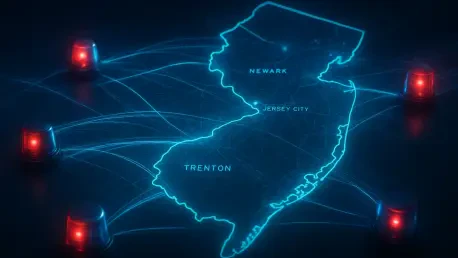

As a prominent political savant and a leading voice in policy legislation, Donald Gainsborough has dedicated his career to navigating the complex intersection of government authority and emerging technology. Currently at the helm of Government Curated, he has become a pivotal figure in advising how public institutions can adopt innovation without sacrificing the constitutional rights of the citizenry. With New Jersey serving as a high-stakes laboratory for artificial intelligence in law enforcement—ranging from AI-drafted police reports in small towns like Mount Holly to expansive surveillance networks in Trenton—Gainsborough’s insights provide a necessary bridge between technical capability and ethical governance. His expertise is particularly relevant now, as the state grapples with a lack of unified strategy and the high financial risks of unproven digital tools.
The following discussion explores the rapid proliferation of algorithmic tools within the New Jersey justice system, examining the tension between administrative efficiency and the potential for systemic bias. The dialogue covers the struggles of medium-sized police departments facing exorbitant subscription costs for investigative software, the legal challenges surrounding AI-generated evidence in the Supreme Court, and the revolutionary shift in how public defenders manage decades of legal precedents. Through these themes, the conversation highlights the urgent need for transparency and state-level guardrails to ensure that the pursuit of safety does not dismantle the foundations of privacy and due process.
In cases like the 1991 Himebaugh disappearance, AI tools were initially seen as a beacon of hope for cold cases. Why did this specific attempt struggle to deliver results, and what does it reveal about the current limitations of AI in deep-dive investigative work?
The case of Mark Himebaugh is a heartbreaking reminder that technology is not always the silver bullet we hope it will be, especially when dealing with the heavy silence of a decades-old mystery. In Middle Township, the police department partnered with an AI company called Terawe to sift through the fragments of that November day in 1991, hoping an algorithm could see patterns in the brush fire and the quiet streets that human eyes had missed for over thirty years. However, as the local leadership discovered, the tool functioned more like a high-powered search engine with a curated database rather than a sentient detective capable of generating new leads. It lacked the intuitive leap required to solve a disappearance that has haunted a community of 20,000 residents for a generation. When the free trial concluded, the department was faced with a staggering $30,000 monthly fee to continue, which would have swallowed nearly one-tenth of the entire budget for their 55-officer force. This illustrates a sobering reality: many AI tools currently being marketed to law enforcement are expensive “black boxes” that offer administrative organization but struggle with the “messy human endeavor” of actual crime-solving.
The city of Trenton has seen a dramatic shift in its crime statistics, with reports indicating a fivefold drop in murders since 2020 due to AI surveillance. How do we reconcile this success with the growing anxiety over personal privacy and the “testing ground” nature of these technologies?
Reconciling public safety with personal liberty is the defining challenge of our current era, and Trenton serves as the epicenter of this debate. Mayor Reed Gusciora has been very vocal about his stance, choosing the cold eye of a camera over the very real heat of a gunshot, and the data showing a fivefold reduction in homicides since 2020 is a powerful argument in his favor. Yet, we must look at the “web” of surveillance that has been spun to achieve those numbers, where AI-powered cameras track the movement of every pedestrian and motorist navigating the capital city. The anxiety stems from the fact that these neighborhoods have become expensive testing grounds for a multi-billion-dollar industry that is evolving faster than our ability to regulate it. While the immediate drop in violence provides a sense of relief, the long-term cost is a pervasive sense of being watched, where your presence at a community event or critical infrastructure is logged and stored indefinitely. Taxpayers are often left holding the bill for these systems, yet we are still waiting for definitive proof that these tools reduce crime more effectively than traditional community policing over the long term.
Across New Jersey, from Mount Holly to Eastampton, officers are using AI to draft incident reports. From a legislative and evidentiary perspective, what are the risks when an algorithm, rather than an officer’s personal observation, forms the basis of a legal narrative?
The shift toward using software like Code Four to analyze body camera footage and draft incident reports is a double-edged sword that cuts right to the heart of constitutional law. On one hand, it frees up officers from the drudgery of paperwork, but on the other, it risks sanitizing the “human element” that is critical to establishing reasonable suspicion. When an officer pulls a car over, their brain processes a thousand sensory details—the twitch of a hand, the smell of the interior, the tone of a voice—and they prioritize certain facts based on their immediate training and instinct. If an AI “looks at everything all at once” and drafts a report based on a holistic analysis of video, it might inadvertently include justifications or suspicious behaviors that the officer didn’t actually perceive in the moment. This creates a legal fiction where a witness might testify to “personal knowledge” that was actually synthesized by a machine, potentially manufacturing a narrative that didn’t exist in the officer’s mind during the encounter. We are going to be litigating these AI-generated conclusions for years because they fundamentally flout the doctrine that evidence must stem from direct human observation.
There is a notable absence of statewide strategy or regulation regarding AI in policing, leaving many departments in a state of “legislative limbo.” What are the practical consequences for a police chief who wants to innovate but fears a sudden shift in Attorney General guidelines?
The current policy vacuum in New Jersey is creating a climate of hesitation and financial risk that is completely unsustainable for local law enforcement. Police chiefs are in an impossible position; they see the potential of these tools to modernize their agencies, but they are terrified of signing a two-year contract only to have the Attorney General issue a directive six months later that bans the technology. This isn’t just a theoretical fear—we’ve seen the state’s top legal office solicit comments on facial recognition as far back as 2022 and then offer no concrete guidance, leaving local departments to navigate a legal minefield on their own. This inaction discourages meaningful innovation and leads to a fragmented landscape where the rules of engagement change the moment you cross a township line. Furthermore, without statewide guardrails, we see incidents like the one in Passaic County, where $13 million was spent on technology from a company whose owner was later embroiled in federal charges involving banned equipment. Radical transparency is the only cure for this uncertainty, yet policymakers have been “tiptoeing” around the issue while the industry continues to move at light speed.
The financial burden of AI is significant, with some tools costing upwards of $30,000 a month. How can medium-sized agencies justify these costs when there is no definitive proof yet that they solve more investigations or reduce crime better than traditional methods?
The justification of these costs is becoming increasingly difficult as the initial luster of AI begins to fade into a reality of high subscription fees and questionable returns. For a medium-sized agency, spending hundreds of thousands of dollars a year on a tool like Terawe or Packetalk is a massive gamble that can divert resources away from hiring more officers or investing in proven community outreach programs. There is a growing concern that law enforcement agencies are being treated as “early adopters” in a commercial marketplace rather than public institutions making evidence-based decisions. Critics like the ACLU are right to point out that no one has actually proven that these expensive tools are the primary reason for crime reduction, especially when many departments are still struggling with basic data integrity. When you consider that a 55-officer force might be asked to devote ten percent of its budget to a single software license, the math simply doesn’t add up for the average New Jersey taxpayer. We need to move away from the “shiny object” syndrome and demand that these multi-billion-dollar companies provide rigorous, independent proof of efficacy before they are allowed to drain municipal coffers.
The use of facial recognition has already led to high-profile legal battles in the state Supreme Court. What specific deficiencies in this technology are being exposed, and how should the “trust but verify” principle be applied in a courtroom setting?
The state Supreme Court has become the primary battleground for exposing the “black box” nature of facial recognition, and the rulings we’ve seen are a clear signal that the era of blind trust is over. Defense attorneys have successfully argued that the technology is prone to errors that can lead to wrongful arrests, forcing a conversation about the need for full disclosure on how these algorithms actually function. The “trust but verify” guidance issued to the judiciary is a necessary step, acknowledging that AI can fabricate case citations, misstate legal holdings, and even “hallucinate” facts. In the context of facial recognition, this means that a “match” produced by a computer cannot be treated as an infallible truth; it must be treated as a lead that requires independent, human verification. We’ve seen cases where the Office of the Public Defender had to fight all the way to the top court just to gain transparency into the deficiencies of the tools being used to incarcerate their clients. If we don’t have the “radical transparency” that experts are calling for, we risk a system where the algorithm becomes the judge, jury, and executioner, hidden behind a proprietary software agreement.
Public defenders are now utilizing AI-powered databases to sift through years of legal research in seconds. How is this “arms race” of technology between the prosecution and defense reshaping the concept of a fair trial?
The introduction of the Princeton-developed database for public defenders is a fascinating example of AI being used as a “blessing” rather than a “curse.” By allowing attorneys to access years of motions, briefs, and institutional knowledge in seconds—a task that used to take an entire afternoon of manual searching—it levels the playing field in a system that is often heavily tilted toward the prosecution’s vast resources. However, this creates a new kind of “technological arms race” where the quality of justice may eventually depend on the quality of the software your lawyer can access. We see the judiciary developing their own tools, like NJ Courts AI Access, to summarize documents and assist judges, which further complicates the human element of the law. The danger is that as both sides become more reliant on these “super-user” tools, the actual human advocacy and the nuances of a specific case might be buried under a mountain of AI-generated filings. As the Chief Justice noted, a simple two-count complaint can now be expanded into fifteen counts with the press of a button, creating an administrative burden that threatens to clog the very system it was designed to streamline.
What is your forecast for the integration of AI in the New Jersey criminal justice system over the next few years?
My forecast is that we are entering a period of “aggressive litigation and forced transparency” that will define the next decade of American jurisprudence. In the coming years, I expect to see a wave of challenges to AI-drafted reports and surveillance data that will force the Attorney General’s office to finally abandon its “tiptoeing” approach and implement rigorous, statewide governance. We will likely see a thinning of the herd among AI vendors, as smaller departments realize they cannot sustain $30,000-a-month subscriptions for tools that offer more “search engine” utility than “crime-solving” power. The courts will become the ultimate gatekeepers, and the “trust but verify” mantra will evolve into a strict legal standard where any AI involvement in an investigation must be fully disclosed during discovery. Ultimately, I believe we will move toward a model where AI is strictly an administrative assistant—handling the summaries and the data organization—while the “messy human endeavor” of determining intent, suspicion, and guilt remains firmly in the hands of human beings. We are at a crossroads where we must decide if technology serves the law, or if the law is being reshaped to fit the needs of the technology, and the outcome of that struggle will determine the future of civil rights in this state.