
The digital ghost of a political opponent can now dance on command, deliver a scripted speech in a cloned voice, or even transform into a monster, all thanks to the powerful and unregulated tools of artificial intelligence. As Texas voters navigate the heated 2026 primary season, they are witnessing the frontline of a new political battleground, one where synthetic media is no longer a futuristic concept but a readily deployed weapon in campaign arsenals. This roundup examines the emerging tactics, the potential fallout for public trust, and what it means for the future of democratic discourse when reality itself becomes a campaign variable.
The Lone Star State’s Unregulated Digital Frontier
The 2026 Texas primary has become a crucial testing ground for the strategic deployment of AI-driven political attacks. Candidates are increasingly turning to generative AI to create content that can mock opponents, dramatize policy criticisms, and capture the attention of a perpetually scrolling electorate. This surge in synthetic media is occurring in a legislative vacuum, creating a high-stakes environment where the rules of engagement are still being written in real-time.
A significant factor contributing to this landscape was the failure of a legislative bill that would have mandated clear disclosures on political advertising using AI or substantially altered imagery. After passing the Texas House, the bill stalled in the Senate and never became law, effectively creating a “free-for-all” environment. Consequently, campaigns are now at liberty to experiment with a wide spectrum of AI tools, from overtly cartoonish animations to highly realistic deepfakes, all without a unified standard for transparency. This unregulated frontier is forcing voters to become digital detectives, tasked with discerning authentic discourse from calculated deception.
From Digital Jest to Deceptive Warfare: Unpacking the AI Campaign Toolkit
The rapid democratization of artificial intelligence has equipped political campaigns with an unprecedented toolkit for influencing public opinion. What once required Hollywood-level production budgets can now be achieved with off-the-shelf software, enabling strategists to craft everything from lighthearted parodies to sophisticated fabrications. This section dissects the primary ways AI is being used in Texas political advertising, exploring the distinct methods and the unique risks each one presents to an already fragile information ecosystem.
Parody as a Political Weapon: When AI-Powered Satire Enters the Ring
Several campaigns are leaning into overtly artificial videos, using AI-powered animation and satire to land political punches. For instance, an ad from Attorney General Ken Paxton depicted his primary opponent, Senator John Cornyn, in an AI-generated dance with Democratic Representative Jasmine Crockett to frame him as too bipartisan. Similarly, state House candidate Kat Wall used synthetic voice clones and deepfake visuals of world leaders like Vladimir Putin and Xi Jinping to mock her opponent’s voting record. These ads use exaggerated, clearly non-realistic visuals to create memorable, often humorous attacks.
While presented as parody, experts in media literacy warn that such content carries significant risks. In the fast-paced environment of a social media feed, voters scrolling quickly may miss the satirical context or the subtle cues indicating the content is fabricated. A disclaimer buried at the end of a video, as seen in some of these ads, often proves ineffective. The primary goal of these ads is to generate a viral, emotionally charged reaction, and that initial impact can easily overshadow any subsequent clarification, leaving a lasting negative impression that is untethered from its satirical intent.
The Uncanny Valley of Political Persuasion: Sophisticated Fakes Without a Safety Net
Beyond obvious satire, the 2026 primary is also seeing the deployment of more advanced and subtle AI manipulations. One ad targeting Representative Wesley Hunt as a “show dog” utilized a more sophisticated deepfake, seamlessly integrating his likeness into a fabricated scene without any disclosure of AI use. Another ad from Representative Jasmine Crockett’s campaign, which presented her as a warrior for Texans, concluded with an image of her standing before a massive, AI-generated crowd of supporters. These examples represent a move toward high-realism fakes that aim for plausibility rather than parody.
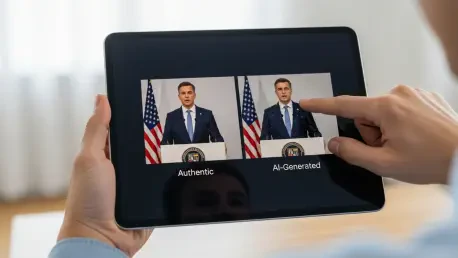
The technical markers of this manipulation—such as blurred backgrounds, unnaturally folded flags, inconsistent movements, and an overly polished visual quality—can be difficult for the average viewer to spot. Without clear and prominent disclaimers, these sophisticated fakes blur the line between legitimate political commentary and malicious digital disinformation. The danger lies in their ability to create a false impression of support or to place a candidate in a compromising, entirely fabricated situation, undermining voter trust in all forms of visual media.
Monstrous Metaphors: How AI Is Resurrecting Political Caricature
A growing trend involves using AI image generators to transform political rivals into literal monsters, reviving a classic form of political caricature for the digital age. In this election cycle, Senator John Cornyn’s campaign has released a series of images depicting opponents as ghoulish figures. State Representative James Talarico was morphed into “Taxula,” a vampire clutching a tax bill, while former Representative Beto O’Rourke became “Franken-Beto,” a stitched-together monster powered by unpopular policies. Another graphic portrayed former Representative Colin Allred as a witch brewing a “Bidenomics” cauldron.
This strategy weaponizes familiar attack ad tropes by using grotesque and instantly recognizable imagery to create a strong negative association in the voter’s mind. While political cartoons have a long history of exaggerating features to make a point, AI accelerates and amplifies this tactic. The hyper-realistic textures and cinematic quality of AI-generated images create a modern form of caricature that is both more visceral and more easily shareable than its hand-drawn predecessors, raising questions about whether this is simply an evolution of an old technique or a fundamentally new and more potent form of political attack.
The Erosion of Reality: Voter Skepticism in the Age of Synthetic Media
The proliferation of synthetic media in political campaigns is predicted to have a significant long-term psychological impact on the electorate. As voters are increasingly exposed to a mix of real, manipulated, and entirely fabricated content, some experts believe they will become desensitized to factual information altogether. This creates a fertile ground for cynicism, where the effort required to distinguish truth from fiction becomes so taxing that voters may disengage from the news entirely.
This phenomenon fuels what is known as the “liar’s dividend,” where the mere possibility of a deepfake can be used to deny the authenticity of real, unflattering videos or audio recordings. A candidate caught in a genuine scandal can simply claim the evidence is an AI-generated fabrication, exploiting the public’s generalized skepticism to evade accountability. This challenges the foundational assumption that viewers can reliably parse fact from fiction, a task that becomes exponentially harder as AI tools improve in realism and accessibility, threatening the very concept of shared reality in political discourse.
Navigating the New Normal: A Voter’s Guide to Spotting Digital Deception
The tactics observed in the Texas primary—from satirical animations and monstrous caricatures to subtle visual manipulations—underscore a new reality for voters. To navigate this complex landscape, developing strong media literacy skills is no longer optional but essential. This involves a multi-pronged approach to consuming political content, moving from passive acceptance to active, critical engagement with the information presented.
Actionable strategies include fundamentally questioning the source of all campaign content, especially media that appears on social feeds without clear attribution. Voters should be wary of content designed to provoke a strong emotional reaction, as outrage and fear are common tools of disinformation. Before accepting a claim or sharing a video, it is crucial to seek verification from multiple trusted, independent journalistic outlets. Adopting a “think before you share” mentality can disrupt the viral spread of misleading information, empowering individuals to act as a firewall against deception rather than as unwitting carriers.
Beyond 2026: The Future of Truth in Texas Politics
The evidence from the campaign trail made it clear that AI-generated content was no longer a novelty but had become a permanent and powerful fixture in the political arsenal. Its integration into campaign strategies signaled a fundamental shift in how political narratives were constructed and disseminated, moving beyond traditional advertising into a realm of synthetic reality. This new era of political communication demanded an urgent response.
The widespread use of this technology highlighted the critical need for a comprehensive framework to manage its impact on democratic discourse. Whether through thoughtful regulation, proactive platform policies that enforce transparency, or robust public education initiatives, a system of checks and balances was essential to prevent the complete erosion of public trust. Ultimately, in an age where seeing is no longer believing, the last line of defense was an informed and critically aware electorate, prepared to question, verify, and hold campaigns accountable for the reality they chose to present.