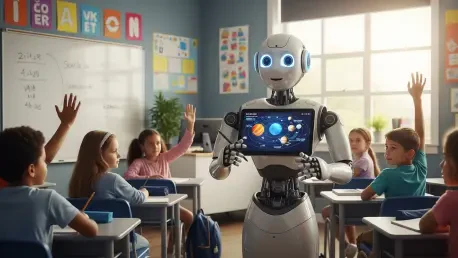

An English teacher in East Stroudsburg captures the dizzying acceleration of technological change with an observation so sharp it borders on a warning: what qualified as proactive AI integration in the classroom just one year ago is now merely a reactive scramble to keep pace. This single sentiment encapsulates the profound and sudden paradigm shift facing educators across Pennsylvania, a state where the future of education is no longer a distant concept to be debated but an immediate reality unfolding in real-time. As generative artificial intelligence transitions from a niche tech-world fascination to a ubiquitous tool in the hands of students, the commonwealth’s 500 school districts find themselves at a critical juncture, grappling with a technological upheaval as transformative and disruptive as the forced pivot to remote learning, yet with far deeper implications for the very nature of teaching and learning itself. The question is no longer if AI will reshape the classroom, but how schools will navigate its arrival and whether they are prepared for the revolution already underway.
The New Reality From Proactive to Reactive in a Single School Year
The velocity of AI’s entry into the educational mainstream has left many institutions breathless. Luke Orlando, the middle-school English teacher from East Stroudsburg, articulates the sentiment shared by many on the front lines: “Last year, if you were teaching about AI in your classroom, you were proactive. This year, if you’re using AI in your classroom, you’re reactive. That’s how fast the paradigm is shifting.” This rapid compression of the innovation cycle means that curricula, policies, and pedagogical strategies developed with foresight have become outdated almost as soon as they are implemented. The ground is perpetually shifting beneath educators’ feet, forcing a constant state of adaptation in a profession that traditionally values stability and long-term planning.
This environment creates a dynamic where districts and individual teachers are simultaneously innovators and first responders. The challenge is not simply to adopt a new piece of software but to fundamentally rethink assignments, assessments, and the development of core skills in a world where a machine can generate a passable essay in seconds. The technological whiplash is palpable, pushing schools to move beyond theoretical discussions and into the messy, practical work of managing a powerful and unpredictable new variable within the complex ecosystem of the classroom. For Pennsylvania’s educators, the era of observing AI from a distance has definitively ended; the age of grappling with its daily presence has begun.
An Inevitable Tide Why Ignoring AI Is No Longer an Option
Across the commonwealth, from university computer science departments to state education union headquarters, a firm consensus has emerged: artificial intelligence is not a passing trend but a foundational component of modern life that the education system must address head-on. The debate has moved past whether AI should be in schools to how it should be managed responsibly. David Touretzky, a computer science professor at Carnegie Mellon University and a key figure in the AI4K12 initiative, dismisses any lingering skepticism about teaching AI to young children by pointing to a simple truth. “We’re not introducing AI to kindergartners,” he states plainly. “By the time these kids get to kindergarten, they’ve already spent two years talking to Alexa.” His point reframes the educational imperative—it is not about introducing a new technology but about providing literacy for a technology that is already deeply integrated into students’ lives.
This sense of urgency is amplified by a collective desire to avoid repeating the mistakes of the past. Christopher Clayton, a spokesperson for the Pennsylvania State Education Association (PSEA), draws a direct and cautionary parallel to the rise of social media. “With social media, we ignored it. We by and large did not bring that into school,” he explains, acknowledging the passive, hands-off approach that left schools unprepared for its profound impact on student well-being and social dynamics. “Are we going to have this happen again with AI?” The question is rhetorical, signaling a statewide resolve among educators to be intentional and proactive this time. This commitment is further underscored by Pennsylvania’s growing stature as an AI hub, where state investment and academic-corporate partnerships are creating an economic and social landscape that makes AI literacy a prerequisite for future success, placing immense pressure on its public schools to prepare the next generation.
The Duality of the Digital Tool AI’s Promise and Peril in the Classroom
For students, the promise of AI is that of a tireless, personalized tutor and a creative brainstorming partner. For many, like Mount Pleasant junior Lucas Poole, generative AI provides a crucial first step in overcoming writer’s block by helping generate outlines and initial ideas for assignments. Beyond ideation, it serves as a bespoke study aid; Poole uses it to create tailored practice problems in chemistry to “fill in the gaps” in his understanding, a level of customization that a standard textbook cannot offer. For teachers, the potential benefits are equally compelling, centered on reclaiming their most valuable resource: time. Administrative burdens like drafting lesson plans, creating assessments, and writing parent communications can be significantly streamlined by platforms like MagicSchool, a tool adopted by numerous Pennsylvania districts that offers a suite of over 80 specialized functions.
This technological assistance allows educators to dedicate more energy to direct, meaningful student interaction. Luke Orlando’s classroom provides a powerful example of AI enabling differentiated instruction. He created “Skipper,” a custom chatbot avatar designed to help his middle-school English students with the fundamentals of writing, such as grammar and organization. This allows him to “differentiate for the students who need more personalized assistance from a human,” effectively multiplying his presence in the classroom. The success of one particularly shy student, who used the chatbot as their primary guide to craft an A-grade paper, illustrates how AI can empower independent learning and cater to diverse student needs in ways previously unimaginable.
However, this wave of innovation brings with it a significant undertow of concern, with academic dishonesty at its crest. The widespread availability of free and sophisticated tools like ChatGPT has triggered “considerable handwringing” among educators who fear an entire generation may be tempted to outsource its thinking. The fear is not unfounded and has created a tense “cat-and-mouse game” in classrooms, where teachers struggle to verify the authenticity of student work. The tools designed to detect AI-generated text have proven to be notoriously unreliable, creating high-stakes situations for students like Susan Babick, a senior at Mount Pleasant. She recounts a “really scary” experience of being falsely accused of cheating when a teacher’s AI-detection programs yielded conflicting and inconclusive results on her legitimately written essay.
Beyond the immediate crisis of cheating lies a deeper, more existential fear about the “erosion of cognitive ability,” a term used by the PSEA’s Christopher Clayton. The central anxiety is that an over-reliance on AI to generate text, solve problems, and synthesize information will cause students’ own critical thinking, analytical, and writing skills to atrophy. Educators worry that if students are not consistently challenged to perform these foundational cognitive tasks, they may never develop the intellectual resilience and creativity necessary for navigating complex challenges. This concern extends beyond academic skills to the very fabric of the educational experience, questioning what is lost when the struggle of learning is outsourced to a machine.
A Fractured Frontier How 500 Districts Are Forging Their Own AI Policies
In the face of this technological tidal wave, Pennsylvania offers no unified, statewide framework for AI in education, a reality it shares with more than 20 other states. This policy vacuum is a direct result of the commonwealth’s deeply ingrained tradition of “local control,” which entrusts individual districts with the autonomy to set their own course. The consequence, as Christopher Clayton notes, is that “we’re going to have 500 different places that we’re at across the state.” This has created a fragmented and diverse landscape of innovation and caution, where each of the state’s 500 school districts is effectively a laboratory, experimenting with its own unique approach to AI integration, regulation, and instruction.
Responding to this lack of central guidance, the PSEA, which represents 177,000 education professionals, has stepped into the breach. Following a pivotal meeting, the association convened a task force that produced the “Artificial Intelligence Task Force Impact Report,” a comprehensive document offering crucial recommendations on everything from data security and academic integrity to teacher training and legal considerations. This report serves as a vital navigational aid for districts charting their own paths. Case studies from across the state reveal the varied strategies taking shape. In the Mechanicsburg Area School District, administrators developed a principles-based rubric on a 0-3 scale, empowering teachers to evaluate AI’s role in any given task, focusing on enrichment rather than rigid restriction.
In contrast, the Mount Pleasant Area School District has championed a model of proactive instruction over prohibition. Educators there, like Kevin Svidron and David Greene, have chosen to explicitly teach students how to leverage AI as a tool for deeper learning, believing that fostering a culture of academic integrity begins with empowering students with knowledge, not limiting them with bans. Meanwhile, the state’s largest district, the School District of Philadelphia, has prioritized cybersecurity and student privacy above all else. In partnership with the University of Pennsylvania’s Graduate School of Education, Philadelphia has implemented Google’s Gemini AI within a “walled garden”—a closed, secure digital environment that prevents student data from being fed back into the wider large language model, thereby safeguarding their personal information. These distinct approaches highlight the ongoing, real-time effort to find a tenable balance between innovation and responsibility.
The Human Element Confronting the Philosophical and Ethical Quandaries of AI
Beneath the practical challenges of policy and implementation lies a deeper set of philosophical and ethical questions about the soul of education in an age of intelligent machines. A primary concern voiced by experts is the pervasive influence of “Big Tech.” Christopher Clayton expresses “big worries around corporate indoctrination,” warning that if educators are not vigilant, “Big Tech will make sure this happens to us, not with us.” The near-total integration of platforms like Google Classroom and the widespread use of Chromebooks in districts like Philadelphia illustrate how a single corporation can shape the educational ecosystem, raising critical questions about whether technology is serving pedagogy or pedagogy is being reshaped to fit the technology.
This leads to a more nuanced understanding of what AI literacy truly entails. Mike Soskil, a Wayne County STEM teacher and PSEA task force member, argues forcefully that genuine literacy extends far beyond knowing how to operate an AI tool. For him, it is more critical that students “understand what their role is when they interact with it, what data is being collected and how it’s being used.” He urges a curriculum that teaches students to critically examine the “implicit biases that are built into AI models” and to question the “profit motives of companies that are putting AI in front of you.” This perspective reframes AI education not as technical training, but as an essential exercise in modern civics and critical thinking.
This critical lens culminates in the most fundamental debate of all: the distinction between learning and education. As Soskil powerfully articulates, “AI, especially generative AI, can be a great tool for learning—but it doesn’t necessarily mean that it’s a great tool for education.” He posits that learning can be the acquisition of facts and processes, a task at which AI excels. Education, however, is a uniquely human endeavor involving critical thought, the making of cross-curricular connections, and ethical problem-solving. The fear shared by educators like Soskil and his colleague Marilyn Pryle is that the current push for AI is driven by a quest for efficiency that risks stripping away these vital humanistic components, distracting from the core mission of getting students “to be more intrinsically connected to their own learning.”
Forging a Path Forward Actionable Frameworks for an AI Integrated Future
The statewide navigation of artificial intelligence in Pennsylvania’s schools ultimately revealed not a single, monolithic solution, but a collection of powerful guiding principles that had been forged in the classrooms of its most adaptable districts. These emergent frameworks provided a blueprint for responsible and effective integration, offering wisdom born from direct experience rather than top-down mandates. This collective journey underscored that the path forward was not about finding a universal policy, but about embracing a shared set of values to guide local decisions.
First and foremost, the most successful districts demonstrated the wisdom of creating flexible principles instead of brittle, prescriptive rules. The model pioneered in places like the Mechanicsburg Area School District showed that developing a thoughtful rubric focused on how AI could meaningfully enrich teaching and learning offered a far more sustainable approach than attempting to police every new application that appeared. This strategy acknowledged the fluid nature of technology and empowered educators to make professional judgments rather than merely enforce a static list of prohibitions.
A second foundational strategy that emerged was the intentional shift from a culture of prohibition to one of proactive instruction. Visionary educators in districts like Mount Pleasant recognized that the most potent antidote to academic dishonesty was not a ban, but education. They proved that fostering a lasting culture of integrity was best achieved by explicitly teaching students how to use these powerful new tools ethically, responsibly, and effectively, thereby transforming a potential vector for cheating into an opportunity for deeper analysis and understanding.
The third pillar of this emergent framework centered on the non-negotiable priority of student privacy and data security. The “walled garden” approach implemented by the School District of Philadelphia became a benchmark for responsible adoption. By ensuring that student interactions with AI occurred within a closed and secure digital environment, the district established a critical precedent: innovation must never come at the expense of protecting the personal information of young learners in an increasingly data-centric world.
Ultimately, the most profound lesson learned across the commonwealth was the absolute necessity of maintaining a human-centered approach. The varied experiences of Pennsylvania’s districts affirmed that the ultimate goal of AI integration was not to automate or replace, but to augment and enhance the essential human elements of a true education. It was a firm conclusion that technology’s role was to support the development of critical thinking, foster ethical reasoning, and deepen the meaningful connections between teachers and students. The revolution had made it clear that while machines could facilitate learning, the sacred task of education remained a fundamentally human endeavor.