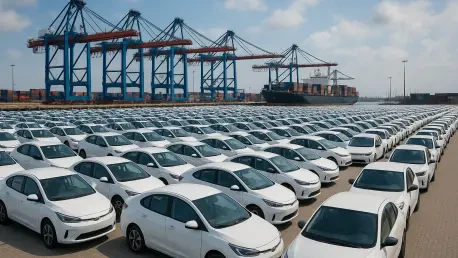

The United States now accounts for only 10.3% of Chinese exports, a sharp decline from 2018 levels as Beijing strategically realigns its trade focus toward the ASEAN region. This shift occurs as China’s economic landscape throughout 2026 presents a striking study in contrasts, defined by a historic expansion in international trade alongside a persistent slowdown in domestic activity. As the nation marches toward a projected $1 trillion trade surplus, the surge is fueled by a strategic pivot toward high-tech exports and a realignment of global partnerships. This fiscal trajectory highlights the resilience of the export sector, which currently serves as the primary engine keeping the broader economy afloat despite internal stagnation and shifting geopolitical dynamics. The scale of this trade performance is reflected in the latest data, showing that overseas sales reached a massive $3.37 trillion in the first nine months of the year, marking a massive 21.3% increase.
Industrial Evolution: High-Tech Dominance and Value Chain Ascent
The primary catalyst for this record-breaking surplus is China’s successful ascent into high-margin manufacturing. Moving away from the low-cost, high-volume production models of previous decades, the country has become a dominant provider of advanced technology, particularly in semiconductors and artificial intelligence infrastructure. This shift has allowed Chinese firms to capture significant value even as lower-end manufacturing migrates to neighboring regions like Vietnam or India, ensuring that the export sector remains robust and highly profitable. Market intelligence indicates that global appetite for high-performance computing components has bolstered these figures significantly, as Chinese manufacturers of automatic data processing equipment see unprecedented demand. This evolution from basic assembly to complex technological innovation has fundamentally altered the nation’s trade profile, providing a sustainable competitive advantage in the 2026 to 2028 period.
This technological evolution is also clearly visible in current import trends, where inbound shipments are increasingly composed of sophisticated components needed for high-end assembly rather than general consumer goods for the local market. By positioning itself at the center of the global AI and data processing supply chain, China has managed to maintain its industrial relevance despite mounting global competition. This specialization has created a necessary buffer against global economic volatility, allowing the nation to leverage its manufacturing prowess in sectors that exhibit high international demand. Furthermore, the integration of advanced automation within domestic factories has kept production costs manageable, allowing exporters to maintain their edge in pricing. While traditional consumer sectors face domestic headwinds, the high-tech industrial base continues to expand its reach, proving that the move toward value-added goods was a well-timed strategic maneuver by central planners.
Market Realignment: The ASEAN Pivot and Regional Integration
Geopolitical tensions have fundamentally reshaped China’s trade map, resulting in a notable shift away from traditional Western markets toward regional partners. While the United States’ share of Chinese exports has nearly halved from its peak in 2018, the Association of Southeast Asian Nations has emerged as the country’s most vital and consistent trading partner. This pivot reflects a strategic effort to diversify export destinations and mitigate the impact of Western trade barriers through deeper regional integration and investment. Exports to ASEAN nations surged by over 52% in September alone, illustrating the depth of this new economic corridor. By establishing stronger ties with emerging economies in the global south, China is securing its supply chains against potential sanctions or tariffs from the West. This diversification is not merely a reaction to external pressure but a proactive reorganization of trade routes that prioritizes regional stability over distant reliance.
Despite these long-term shifts, short-term fluctuations continue to play a role in the surplus figures as global markets react to shifting policy environments. A temporary easing of tensions with Washington led to a significant spike in shipments of consumer goods to the U.S. in late 2026, aided by specific tariff reductions on kitchenware and household electronics. However, the most explosive growth remains concentrated in Asia, with exports to South Korea reaching multi-year highs and bilateral trade with regional neighbors becoming the new bedrock of China’s external economy. This regional strength provides China with a more stable foundation as it navigates an increasingly fragmented global trade environment through the 2026 to 2029 cycle. The growth in regional trade is also supported by advanced logistics networks and digital payment systems that facilitate smoother cross-border transactions, further entrenching China’s dominance within the Asian economic sphere.
Domestic Stagnation: Internal Headwinds and Policy Responses
In sharp contrast to the booming export figures, China’s internal economy faces significant headwinds characterized by a prolonged property market slump and weak consumer confidence. This divergence between international success and domestic fragility has forced international organizations to lower their overall growth projections for the country to roughly 4.5%. Without the record-breaking trade surplus acting as a life support system, the nation would likely struggle to meet its official economic targets for the year. Household spending remains cautious as the real estate crisis continues to impact middle-class wealth, leading to a “savings-first” mentality that suppresses retail growth. While the factories hum with activity for foreign buyers, the domestic malls and housing developments tell a different story of stagnation. This dual-speed economy creates a complex challenge for policymakers who must balance the needs of a thriving global sector with a domestic population facing economic uncertainty.
To combat this internal softness, authorities have introduced a series of stimulus measures, including significant interest rate cuts and expanded liquidity for key industrial sectors. The People’s Bank of China and the Ministry of Finance launched a CNY 700 billion expansion of re-lending quotas specifically aimed at stabilizing the property market and supporting high-tech innovation. These interventions aim to lower financing costs and spark a recovery in household spending, though their long-term effectiveness remains a subject of intense debate among financial analysts. There is a concerted effort to broaden the “Six Networks” infrastructure program to create jobs and stimulate demand for industrial materials within the country. While these fiscal injections have prevented a deeper downturn, they have not yet translated into the robust consumer-led growth that Beijing desires. The reliance on the export engine remains absolute as the internal market slowly undergoes a difficult structural transition.
Strategic Outlook: Navigating Protectionism and Market Shifts
The trajectory of China’s $1 trillion surplus established a clear precedent for how the nation intended to manage its economic influence. It demonstrated that by pivoting toward high-margin technology and regional partners, Beijing successfully insulated its industrial core from the volatility of Western consumer demand. The record-breaking performance in 2026 proved that the global supply chain remained deeply tethered to Chinese manufacturing expertise, regardless of geopolitical rhetoric. However, the reliance on an external surplus to mask internal domestic weakness was a strategy that required careful balancing to avoid overextension. As the trade gap widened, it naturally invited scrutiny and defensive measures from partners who viewed the imbalance as a threat to their own industrial sectors. This period of record growth served as a bridge, allowing the state to fund its technological transition while searching for a long-term solution to the property market crisis that had weighed on the domestic sentiment for several years.
Moving forward, the primary challenge for Chinese leadership will be to convert these massive trade earnings into sustainable internal demand to reduce the economy’s vulnerability to global protectionism. Actionable steps should include deep reforms in the social safety net to encourage household spending and a more aggressive transition toward a consumption-led growth model. Companies must also prepare for more sophisticated trade barriers, such as the recent limits on hybrid vehicle shipments to the European bloc, by localizing production in key markets. The current tech cycle, while lucrative, is subject to rapid shifts; therefore, continued investment in indigenous research and development is essential to maintain the current export edge. By leveraging the current fiscal cushion provided by the surplus, China can afford to take more decisive actions to fix its domestic financial architecture. The success of the next few years will depend on whether the nation can evolve from being the world’s factory to becoming its own most reliable customer.