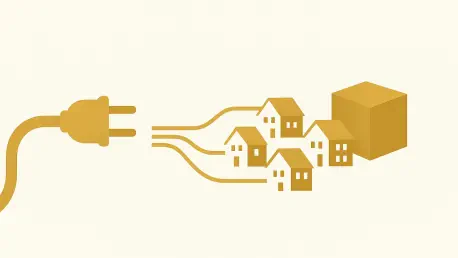

Donald Gainsborough has spent decades navigating the intricate corridors of power, but few issues have proven as polarizing as the collision between artificial intelligence and the local electric grid. As the head of Government Curated, he has a front-row seat to the legislative tug-of-war in Washington. Following the House of Representatives’ recent passage of the Ratepayer Protection Act, Gainsborough joins us to discuss the shifting responsibilities of tech giants, the struggle for community transparency, and why the current “ad hoc” approach to infrastructure might be reaching its breaking point. This conversation delves into the complexities of energy standards, the hidden costs of our digital appetite, and the quest for a national strategy that balances innovation with the financial security of American families.
The Ratepayer Protection Act focuses on making facilities with a peak demand of 100 megawatts or more pay for their own infrastructure. How does this new “large-load standard” fundamentally change the relationship between big tech and local utility commissions?
This legislation marks a paradigm shift because it finally puts a concrete number on what constitutes a “large-load” consumer. By setting that 100-megawatt threshold, we are essentially drawing a line in the sand for non-residential facilities that consume massive amounts of power. In the past, the cost of upgrading transmission lines or building new generation plants was often spread across the entire customer base, but this standard requires these operators to cover the full, incremental cost of those upgrades. It means a technology company can’t just move into a county, plug into the grid, and expect local families to pick up the tab for the multi-million dollar electrical reinforcements required. We are seeing a move toward requiring real financial assurances up front, which protects the integrity of the grid and the wallets of individual ratepayers who have no part in the data center’s profits.
While the bill passed the House with an overwhelming majority, there is still significant public anxiety regarding the impact of these facilities on residential utility bills. Why has this become such a flashpoint for American families?
The anxiety stems from a very simple, visceral concern: the fear of being priced out of your own home because of a neighbor you never asked for. For many Americans, data centers have become the least favorite type of development because the trade-off feels incredibly lopsided. We are seeing communities where proposals for new facilities promise jobs and investment, yet the reality is often a spike in electricity costs and a strain on local resources like water. Rep. Bob Latta hit the nail on the head when he noted that American families should not be the ones subsidizing the operational costs of billion-dollar tech firms. When people see their monthly bills creeping up while massive server farms are being erected just a few miles away, it creates a sense of profound unfairness that no amount of corporate PR can easily smooth over.
Some lawmakers have criticized the current state-by-state or county-by-county approach to data center development as “predatory” and “profit-driven.” What would a more sensible national strategy look like in practice?
The current “ad hoc” approach is essentially a race to the bottom where localities are pitted against each other, often without a full understanding of the long-term infrastructure toll. A sensible national strategy would move away from this fragmented model and toward a framework that prioritizes the needs of the community from the outset. Instead of reacting to developer requests as they arrive, we need a proactive plan that identifies where the grid can actually handle a 100-megawatt load without compromising local service. This involves looking at the “actual score” of resource impact rather than just the potential economic benefits. If we are going to build the infrastructure necessary for the AI era, we have to do it in a way that is logical and sustainable, rather than letting short-term, predatory development dictate our national energy landscape.
Transparency seems to be a major hurdle, with many local officials reportedly signing nondisclosure agreements during development talks. How does this lack of openness affect the way we measure the true impact of data centers on water and power?
The use of NDAs in these agreements is a major red flag because it prevents the public from seeing the true “score” of the project until it is far too late. We often measure the impact of these facilities by their potential or their supposed efficiency, but as Rep. Subramanyam pointed out, that’s like judging a football team by the size of the players rather than their actual record on the field. Without transparency, a community might sign up for a project thinking the impact is manageable, only to find out the actual water and power usage is far higher than forecasted. We need mandatory disclosures on resource consumption and clear, public-facing data on how these facilities are performing in real-time. Accountability can’t exist in a vacuum, and right now, the lack of transparency is leaving many counties flying blind.
Critics from environmental groups argue that this bill is merely a “tiny step” that fails to address the “data center tsunami” affecting our air and water. Is Congress doing enough to protect the environment from the rapid expansion of Big Tech?
There is a legitimate concern that by focusing primarily on ratepayer protection, we are punting the much harder environmental questions to the states. Organizations like the Center for Biological Diversity are right to point out that these facilities don’t just consume power; they have a massive footprint on our water supplies and local air quality. While this bill addresses the financial burden on ratepayers, it doesn’t necessarily implement the rigorous safeguards needed to prevent tech billionaires from profiting while the local environment suffers. The “tsunami” of development is moving much faster than our regulatory framework, and if we don’t address the ecological impact with the same urgency as the financial impact, we risk winning the battle on utility bills while losing the war on environmental stability.
What is your forecast for the future of data center regulation?
I expect we are going to see a significant tightening of the screws as the Senate takes up this debate and the public outcry grows louder. The days of data centers operating as “invisible” infrastructure are over; they are now the most scrutinized developments in the country. We will likely see more states following the lead of those that have already implemented moratoriums, at least until a national standard for transparency and resource usage is firmly in place. My forecast is that by the end of this legislative cycle, we won’t just be talking about who pays for the power, but we will have mandatory federal standards for water recycling and carbon offsets for any facility exceeding that 100-megawatt mark. The era of unchecked growth is being replaced by an era of extreme accountability.