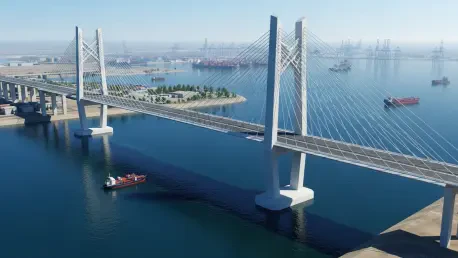

The massive steel arches rising over the Detroit River were originally intended to serve as a monument to international unity, but today they stand as a focal point for the most contentious trade dispute in modern North American history. This $4.7 billion infrastructure undertaking was designed to link Windsor and Detroit, creating a vital economic artery that could bypass the bottlenecks of older crossings. Industry analysts recognize that this project has become a barometer for the health of the world’s most significant bilateral trading relationship. What was once envisioned as a logistical triumph has transformed into a symbol of diplomatic friction and “asymmetric cooperation,” where physical connections of trade are forced to persist despite increasingly fractured political ties.
Foundations of a Project Built on Partnership and Shifting Geopolitics
The project represents a generational investment intended to solidify the Windsor-Detroit corridor as the backbone of continental commerce. By providing a modern, six-lane alternative to the century-old Ambassador Bridge, the new span aims to secure the movement of goods essential for the automotive and manufacturing sectors. However, the shifting geopolitical landscape has complicated these foundational goals. The bridge now functions as a testing ground for how integrated economies handle the sudden imposition of protectionist policies and nationalistic rhetoric.
As cross-border tensions rise, observers suggest that the bridge highlights the vulnerability of shared infrastructure to political volatility. While the technical completion of the span marks a feat of engineering, the underlying diplomatic framework has shifted toward a more guarded and transactional form of interaction. This shift reflects a broader trend where economic necessity must compete with political posturing, forcing both nations to redefine the boundaries of their long-standing partnership in real-time.
The Tangled Web of Tariffs, Tolls, and Political Maneuvering
A Landmark Opening Clouded by Diplomatic Absences and Trade Threats
The formal opening of the bridge, once expected to be a joint celebration of North American cooperation, manifested instead as a solitary Canadian event. The notable absence of high-ranking American officials was viewed by many as a diplomatic snub that underscored the current volatility of the relationship. This lack of participation coincided with aggressive economic rhetoric, including proposals for significant tariffs on Canadian imports, which cast a shadow over the technical achievement of the project.
Local officials in Windsor attempted to maintain a festive atmosphere, yet the tension between community pride and broader trade hostilities was palpable. The event served as a reminder that even the most robust physical infrastructure cannot fully insulate regional economies from the impacts of national-level policy shifts. As threats of economic decoupling became more frequent, the bridge transitioned from a simple transit route into a high-stakes symbol of diplomatic resilience under pressure.
The Battle Over Revenue and the Quest for Investment Recovery
A significant point of contention involves the original 2012 agreement, which dictated that Canada would be fully reimbursed for construction costs before profits were shared. Recent assertions from the United States, however, have introduced claims regarding an immediate 50 percent profit split, sparking a legal and diplomatic debate over the financial terms. Canada has remained firm on its stance that as the sole financier of the project, its multi-billion-dollar investment must be recovered first.
The emergence of ambiguous draft agreements has further complicated the situation, with some language suggesting a revenue split that ignores the prior reimbursement clause. Legal experts note that this strategic ambiguity allows both governments to claim a political victory for their domestic audiences without resolving the core financial dispute. This lack of clarity poses a long-term risk to the financial stability of the bridge and sets a challenging precedent for future joint infrastructure ventures.
Monopolies and Lobbying: The Shadow of the Ambassador Bridge
The influence of private interests has also played a major role in complicating the project’s progress. Lobbying efforts from established transit owners sought to protect existing monopolies, leading to significant delays and legal hurdles throughout the construction phase. These private industry players leveraged domestic political donations to exert pressure on high-level decisions, suggesting that the dispute is not purely about national trade policy but also about protecting entrenched corporate interests.
Challenging the assumption that the conflict is solely a federal matter, these local and private dynamics highlight the complexity of cross-border infrastructure. The intersection of political campaign contributions and infrastructure planning created a scenario where private profit motives were able to influence international relations. This reality suggests that future projects will likely face similar interference from established players who view new competition as a threat to their dominance.
Beyond Concrete: National Identity and the Symbolism of Asymmetric Cooperation
The bridge carries a deep cultural weight, particularly through its naming after a legendary sports figure who remains a hero in both Detroit and Windsor. During the inauguration, the display of Canadian symbols and national colors emphasized a sense of resilience in the face of external economic pressure. This cultural framing was intended to show that while the political climate may be transactional, the historical and social ties between the two nations remain a point of pride.
Analyzing the shift in diplomacy, it is clear that the neighborly collaboration of the past has been replaced by a more cautious and guarded strategy. The bridge represents a physical necessity that persists even when leaders are fundamentally divided on trade and environmental policies. It stands as a testament to the fact that while rhetoric can change overnight, the physical requirements of modern commerce demand a level of cooperation that transcends individual political cycles.
Navigating the New Normal: Strategic Approaches for Cross-Border Stability
The reality of maintaining a daily trade flow exceeding $190 million has forced leaders to prioritize economic stability over immediate financial disagreements. Industry experts argue that the integrated nature of the North American supply chain makes total economic decoupling nearly impossible without devastating consequences for both sides. Consequently, the focus has shifted toward managing vital infrastructure under the constant pressure of protectionist policies and fluctuating tariff threats.
Strategies for safeguarding these supply chains involve creating more resilient logistical pathways that can withstand political volatility. Leaders are increasingly looking toward formalizing long-term operational agreements that are insulated from the whims of election cycles. By focusing on the shared benefits of the automotive and manufacturing sectors, both nations can maintain a level of stability that allows for continued investment, even as the broader diplomatic relationship remains strained.
A Bridge Built for Trade in an Era of Political Uncertainty
The project ultimately served as a physical reminder that economic necessity frequently outweighed the temporary maneuvers of political posturing. While the diplomatic gap appeared wider than in previous decades, the Windsor-Detroit corridor remained the indispensable backbone of North American commerce. The completion of the span provided a crucial redundant route that secured the movement of essential goods, ensuring that regional industries could continue to function despite the broader trade war.
Moving forward, the focus shifted toward establishing clearer frameworks for the management of international assets to prevent similar revenue disputes. The bridge demonstrated that while infrastructure could be used as a political hostage, its operational value was too great for either nation to ignore indefinitely. Leaders learned that the resilience of integrated supply chains provided a natural check against extreme protectionism, ultimately forcing a return to functional cooperation. This era of trade highlighted the need for more robust legal protections for cross-border investments that could survive shifts in national leadership.