
Donald Gainsborough is widely regarded as a political savant whose influence at the helm of Government Curated has shaped countless policy discussions on the world stage. With a career dedicated to the intricacies of global legislation and energy security, he offers a unique perspective on the volatile intersection of military action and market stability. Today, he joins us to provide a deep dive into the escalating hostilities in the Middle East and what they mean for the future of global benchmarks.
Our conversation navigates the sudden resurgence of energy prices and the geopolitical catalysts behind them, from maritime strikes in the Strait of Hormuz to the sudden revocation of critical sanctions waivers by the US Treasury. We explore the fraying diplomatic agreements between Washington and Tehran, the strategic dispute over international waters, and the long-term implications for global shipping routes that keep the world’s economy afloat.
Brent crude recently surged past $76 a barrel, effectively erasing previous price drops. How do these sudden spikes reflect the underlying fragility of the global energy supply chain?
Brent crude’s climb above $76 a barrel for the first time in two weeks is a jarring wake-up call for those who thought the markets were cooling down into a period of sustained relief. We saw a sudden, sharp 3 percent jump on Wednesday, a move that effectively wiped out the modest gains we’d seen as prices recently flirted with pre-war levels. There is a palpable sense of anxiety on trading floors in places like Tokyo and Seoul, especially when you see Brent futures for September hitting $76.48 as early as 06:30 GMT. This isn’t just a numerical adjustment; it’s the sound of a fragile peace shattering, leaving investors to grapple with the reality that the floor beneath them is much thinner than they anticipated. The volatility we are seeing now suggests that the market has found a new, higher base, and the comfort of the previous slide has evaporated into thin air as the threat of broader conflict looms.
The Strait of Hormuz is once again a flashpoint after US strikes on Iranian targets. From a geopolitical standpoint, how do you interpret the escalation following the attacks on commercial shipping?
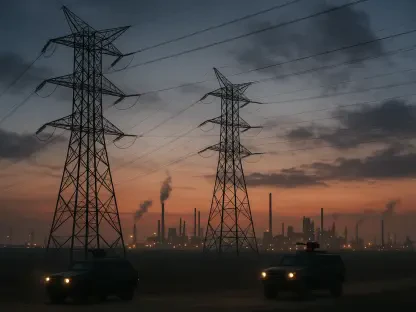
The situation in the Strait of Hormuz has shifted from a tense standoff to a series of powerful strikes aimed at imposing heavy costs on Tehran after a period of relative calm. When three commercial vessels crewed by innocent civilians were targeted, it forced the US Central Command to launch attacks to protect what is arguably the world’s most critical international waterway. You can almost feel the tension radiating from the Persian Gulf as Tehran warns against unauthorized transits, even as they avoid claiming direct responsibility for the maritime chaos. This escalation feels different because it directly challenges the freedom of navigation, turning a strategic chokepoint into a theatre of active hostilities that keeps the entire world on edge. The smoke from these strikes carries a heavy political price, as the disagreement over whether the strait is an international waterway or territorial territory remains a dangerous, unresolved friction point that continues to haunt global trade.
The US Treasury recently revoked a crucial sanctions waiver regarding Iranian oil. What does this pivot away from the June 17 memorandum of understanding signal about the current state of diplomacy?
Revoking that 60-day waiver is a massive signal that the June 17 memorandum of understanding has essentially been torn up by the shifting winds of conflict. While the Treasury Department had originally authorized the sale of Iranian oil until August 21 as part of a broader negotiation, the new order moving that deadline to 12:01 am EDT on July 17 shows how quickly the diplomatic landscape can sour. Iranian officials are already calling this move a blatant violation of their previous agreements, and the sense of betrayal in Tehran is likely to fuel even more decisive actions to safeguard their interests. It feels like the diplomatic safety net has been cut, and the transition from negotiation to financial strangulation happened in the blink of an eye, leaving no room for the “vague” language that once kept the peace. By rescinding authorization for any new transactions after Tuesday, the US has effectively placed a hard ceiling on Iranian economic outreach, signaling that the era of temporary pauses is over.
What is your forecast for the stability of global energy markets?
My forecast for the global energy market is one of persistent, grinding volatility as the Strait of Hormuz remains under a dark cloud of uncertainty and military posturing. We are looking at a harrowing scenario where passage through this vital corridor could drop below 50 percent of pre-war levels for many months to come, creating a structural deficit that no emergency stockpile can easily fix. The strategic disagreement over whether these waters are international or territorial remains a ticking time bomb that will likely trigger periodic flare-ups and keep crude prices elevated well into the fall. Unless there is a fundamental shift in how both nations view traffic management and control of the waterway, we should prepare for a long season of hazardous conditions and market instability. This isn’t just a temporary spike; it’s the beginning of a high-stakes standoff that will test the resilience of global economies and keep energy benchmarks on a razor’s edge for the foreseeable future.