
As the morning sun rises over the historic neighborhoods of Roxbury, Dorchester, and Mattapan, thousands of commuters begin their daily struggle against a transit system that many residents feel has left them stranded in the past while other parts of the city benefit from modern rail connections. This vital corridor along Blue Hill Avenue has become the center of a profound debate that extends far beyond simple civil engineering, touching on the deep-seated issues of racial equity, economic mobility, and the long-term vision for Boston’s urban landscape. Currently, city officials are weighing a well-funded proposal for high-speed, center-running bus lanes against a growing community movement demanding a full-scale extension of the Orange Line subway. The avenue is the primary transit artery for communities located in the gap between the existing Red and Orange Lines, serving roughly 20,000 bus trips every week. Despite this high volume, the current infrastructure forces these riders to endure massive delays due to traffic congestion, with safety being a constant concern as emergency services respond to crashes along the route with alarming frequency. This choice represents a pivotal moment for the city, as leaders must decide whether to pursue a pragmatic, immediate solution that leverages existing federal grants or to commit to a generational project that could redefine the region’s connectivity for the next century. The stakes are particularly high because the current state of Blue Hill Avenue is often described as a systemic failure for the people who rely on it most, creating a transit desert where the lack of reliable options stifles economic growth and limits access to essential services for thousands of families.
The Strategy: Implementing Center-Running Bus Infrastructure
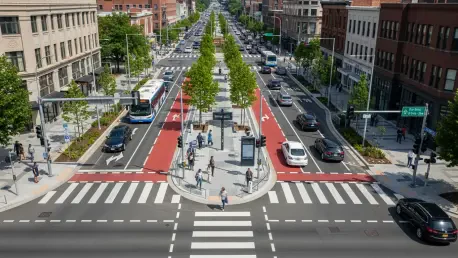
The city’s primary proposal for addressing the transit crisis involves a comprehensive redesign of Blue Hill Avenue centered on the implementation of dedicated, center-running bus lanes. By relocating bus traffic to the middle of the roadway, the Massachusetts Bay Transportation Authority aims to insulate public transit from the unpredictable and often gridlocked nature of general vehicle traffic. This design is not merely a coat of paint on the asphalt; it represents a fundamental shift in how the street functions, incorporating specialized signals that give buses priority at intersections and raised platforms that allow for level boarding, much like a subway station. This plan is backed by a robust financial package totaling $150 million, which includes a significant portion of federal funding that has already been secured. Positioned as a shovel-ready project, the city anticipates that construction could begin as early as 2027, providing a relatively quick turnaround for a community that has spent years pleading for relief. Proponents of this bus-centric model, including many in the current city administration, argue that this is the most responsible way to utilize available resources, as it addresses the immediate suffering of commuters who currently face three-hour daily travel times. They emphasize that the plan improves reliability for ten different bus routes simultaneously, offering a scalable solution that can be realized within a few years rather than a few decades, while also incorporating essential safety upgrades like wider medians and improved crosswalks.
However, the path toward a more efficient bus system is fraught with significant local resistance from a coalition of small business owners and residents who remain deeply skeptical of the trade-offs involved. For many who live and work along Blue Hill Avenue, the proposed loss of travel lanes and hundreds of street parking spaces feels like a direct threat to the economic viability of the neighborhood. Small business owners, who have long served as the backbone of the local economy, fear that removing parking will alienate customers who travel from outside the immediate area, potentially leading to closures in a community that has already struggled with disinvestment. This friction has escalated to the point where a formal petition was submitted to federal authorities requesting a pause on the project’s funding, reflecting a deep-seated divide over how the street’s limited public space should be allocated among different users. Opponents often point out that while the bus lanes might speed up travel for some, they could simultaneously worsen congestion for those who have no choice but to use personal vehicles for work or family obligations. This debate highlights a fundamental tension in urban planning: the struggle to balance the needs of the transit-dependent majority with the concerns of those whose livelihoods depend on the existing automotive infrastructure. The challenge for the city is to prove that the long-term benefits of a faster, safer transit corridor will outweigh the immediate disruption caused by such a drastic reconfiguration of one of the city’s most important commercial and residential thoroughfares.
The Vision: Reviving the Dream of Subway Expansion
In mid-2024, a bold and ambitious counter-proposal gained significant traction within the Boston City Council, calling for the extension of the Orange Line from its current terminus at Ruggles Station deep into Mattapan Square. This vision seeks to replace the bus-focused strategy with a heavy-rail subway system that would travel beneath the surface, effectively bypassing the surface-level congestion of Blue Hill Avenue entirely. Supporters of this plan argue that a subway extension is the only true way to achieve transit equity, as rail service is inherently more reliable, has a higher capacity, and offers a level of permanence that buses simply cannot match. The proposed route would include several strategic underground stops, such as Nubian Square and the Franklin Park Zoo, creating a high-speed link between the city’s historic Black neighborhoods and the broader regional economy. Advocates for this rail expansion frequently point to the history of broken transit promises in the area, specifically citing the demolition of the elevated Orange Line in the late 1980s, which many residents believe was never properly compensated for with equivalent service. For these community leaders, demanding a subway is a way of signaling that their neighborhoods deserve the same gold-standard infrastructure that has recently been extended to wealthier, whiter parts of the metropolitan area. They argue that a bus-only future would lock the community into a second-tier status, whereas a subway would serve as a permanent anchor for transit-oriented development and long-term generational wealth.
Despite the powerful emotional and social appeal of a subway extension, the project faces monumental hurdles regarding its financial and logistical feasibility. Unlike the bus lane proposal, which has secured funding and completed engineering studies, the Orange Line extension currently exists only as a conceptual framework without established capital or technical blueprints. Experts in the field suggest that a project of this magnitude—involving extensive tunneling through complex urban geology—would likely cost billions of dollars and could take upward of twenty years to complete, from the initial environmental review to the first train leaving the station. The Massachusetts Bay Transportation Authority has agreed to evaluate the proposal, but officials have been cautious about making any firm commitments, given the agency’s existing backlog of maintenance and the intense competition for federal transit dollars. This creates a difficult dilemma for the community: whether to hold out for a generational investment that may take decades to materialize or to accept a less transformative bus project that can be built today. Critics of the subway plan worry that focusing on a multi-billion-dollar dream could lead to a state of paralysis, where neither the bus lanes nor the subway get built, leaving commuters to continue suffering in the current, broken system. This debate underscores the broader challenge of urban governance, where the desire for perfect, long-term solutions must be weighed against the urgent, practical needs of the present population.
The DilemmReconciling Immediate Needs With Long-Term Equity
The tension between the bus lane and subway proposals ultimately centers on a conflict of timelines and the definition of what constitutes a dignified transit experience. Transit advocacy groups have expressed growing concern that the push for a subway extension, while well-intentioned, might serve as a distraction that prevents any meaningful progress from happening on the ground in the near term. They fear that if the city abandons the current bus lane project in favor of a rail study that may never lead to construction, the residents of Roxbury and Dorchester will be left with the same dangerous and unreliable service they have endured for the last several generations. These advocates argue that the bus lane project should be viewed not as a final destination, but as a critical first step that provides immediate relief while the city continues to plan for larger rail investments in the future. However, the skepticism toward the bus lanes is rooted in more than just a preference for trains; it is a response to a history of public investments that have often prioritized the convenience of suburban commuters over the needs of urban residents. For many in the community, the quality of a bus—no matter how many dedicated lanes it has—is still perceived as inferior to the speed and comfort of a subway. This perception is fueled by a desire for infrastructure that signals a permanent commitment to the neighborhood’s growth, making the transit debate a microcosm of larger frustrations regarding the distribution of public resources across the city’s diverse demographic enclaves.
There is, however, a significant amount of common ground between the two camps when it comes to the basic infrastructure needs along the Blue Hill Avenue corridor. Both sides of the debate agree that the current state of the street is unacceptable and that immediate improvements are necessary to ensure the safety and dignity of everyone who uses it. There is a broad consensus that the avenue requires better lighting, more frequent trash collection, and a complete overhaul of its pedestrian infrastructure to prevent the frequent accidents that have plagued the area for years. Regardless of whether the city ultimately moves forward with center-running bus lanes or pivots toward a long-term rail study, there is a clear mandate for the administration to prioritize “dignified” transit that treats commuters with respect. This means creating environments where waiting for a bus or a train is safe, comfortable, and efficient, moving away from the neglected bus stops that currently characterize the corridor. By focusing on these shared goals, the city may be able to bridge the divide between those who want immediate action and those who want long-term equity. The challenge lies in creating a phased approach that delivers tangible benefits today without closing the door on the more ambitious rail projects that the community envisions for its future. Success will require a level of transparent communication and genuine community engagement that ensures every resident feels heard, regardless of which transit technology eventually wins the day.
The Consensus: Defining a Path Toward Unified Transit Reform
The deliberations regarding the future of Blue Hill Avenue culminated in a strategic framework that attempted to bridge the gap between immediate transit needs and the long-term aspirations of the community. City officials recognized that the status quo was no longer an option, as the data clearly showed that the current infrastructure hindered economic mobility and compromised public safety. Throughout the public comment period, the administration moved to refine the bus lane proposal, adding more detailed plans for small business support and parking mitigation to address the concerns of local entrepreneurs. At the same time, the inclusion of a formal feasibility study for the Orange Line extension provided a pathway for the rail project to move from a community dream toward a technical reality. This dual-track approach allowed the city to proceed with the $150 million bus lane project, ensuring that commuters would see significant improvements in travel times by the late 2020s, while simultaneously laying the groundwork for a generational rail investment. The council emphasized that the bus lanes were designed to be adaptable, providing a high-capacity transit spine that could eventually be integrated into a larger rail network if funding and engineering permitted. By prioritizing both safety and speed, the city looked to create a model for how urban corridors could be transformed through a combination of pragmatic action and visionary planning.
Looking forward, the success of this unified transit strategy depended on the consistent monitoring of project milestones and a continued commitment to community-led oversight. The city established a dedicated task force to oversee the implementation of the bus lanes, ensuring that the promised safety features and beautification efforts were completed to the highest standards. Furthermore, the commitment to the Orange Line study was backed by a timeline that required regular progress reports to the public, keeping the long-term goal of rail equity at the forefront of the city’s agenda. This process demonstrated that effective urban planning required a balance between technical expertise and the lived experiences of the people who used the system every day. By treating the transit debate as an opportunity for holistic neighborhood improvement rather than a zero-sum conflict, Boston set a precedent for how other major cities could navigate the complexities of transit reform in historically underserved areas. The ultimate goal remained the creation of a seamless, high-quality transportation network that eliminated the disparities between different parts of the city. As the first phases of the redesign moved into the final engineering stages, the focus shifted toward ensuring that the new infrastructure served as a catalyst for local job creation and sustainable urban growth, providing a foundation for a more equitable and connected future for all residents along the Blue Hill Avenue corridor.