


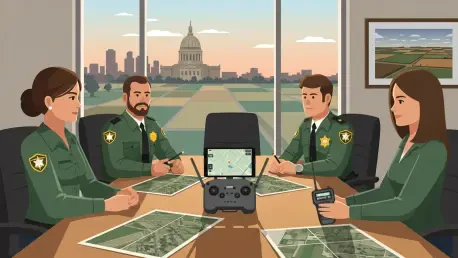

Nightfall used to signal quiet over Indiana’s fields and fencerows, yet low hums and blinking diodes now trace tight grids across pastures and hedgerows, unsettling hunters, spooking livestock, and leaving homeowners unsure who is watching from above and why those machines picked their barns or backyards. What began as a trickle of sightings turned into a steady flow of calls to sheriffs and conservation officers, forcing a practical question that has played out far from big-city skylines: how to discourage bad actors without grounding a tool that is becoming as common on farms as seed monitors and soil maps. A growing consensus has started to form. The state pressed its first-known case against drone-assisted deer hunting, lawmakers codified new protections for livestock and operations under “remote aerial harassment,” and agencies began channeling community frustration into report-and-investigate routines. It is a rough balance, not a tidy truce. Federal airspace rules still preempt broad flight bans, intent remains hard to prove, and anonymous pilots can vanish beyond hedge lines. Yet the contours of a workable framework—ethics for fair chase, consent for farm uses, penalties for harassment—have been taking shape.
Fair Chase on a New Frontier
A Headline-Grabbing Buck and a First-of-Its-Kind Case
In southeastern Indiana, the white-tailed deer that locals dubbed the “Nucor Monarch” moved along familiar edges near a steel facility, gathering myth as a 17-point trophy whose habits seemed knowable but not predictable—until, neighbors said, a drone began tracing his route. Reports landed with Indiana conservation officers, who followed a trail that did not rely on hearsay alone. Drone videos, stills, and flight logs surfaced, revealing repeated flights in the run-up to crossbow season and continuing after the opener. Those dates mattered. State law bars using drones to take or assist in taking deer beginning 14 days before a season and throughout the hunt, a window crafted to protect fair chase and the integrity of the pursuit, not just the letter of trespass.
The investigation yielded the case’s human anchors. Cousins Rodney and Eric Pettit were charged with misdemeanors tied to those flights. Rodney, identified as the pilot and the hunter who harvested the buck, received 60 days’ probation and a one-year suspension of hunting and fishing licenses. Eric, a reserve officer with the Jennings County Sheriff’s Department, entered a pretrial diversion agreement set to dismiss charges if conditions were met. Defense statements cast the conduct as a novice’s mistake, stressing that the deer was not filmed on the day of the kill and that the animal’s patterns were obvious from public roads. Still, the record of pre-season tracking built the state’s case and established a narrative that modern optics and persistent aerial eyes had tipped the scales.
What the Evidence Showed—and How the Law Reads
Enforcement hinged on more than a few grainy clips. Investigators matched timestamps, GPS traces, and media metadata to a calendar that mattered to the statute: the 14-day period before season and the first days of active hunting. The logs showed methodical aerial tailing, the sort of persistent surveillance that converts roaming into a map of habits—beds as dots, trails as lines, feeding as a sequence. In court-suitable terms, that pattern illustrated assistance in taking game, regardless of whether the drone was aloft at the moment the bolt flew. The law’s purpose—preventing technology from collapsing uncertainty into near certainty—framed the interpretation.
The outcomes underscored how prosecutors intend to draw the boundary. Rodney’s probation and license suspension signaled a penalty structure calibrated to both punishment and deterrence, while the diversion for Eric reflected discretion tied to his claimed level of participation. Indiana conservation officer Josh Thomas called the conduct an “unfair chase,” a phrase that resonates in hunting circles where ethics often live alongside rules. Just as critical, the procedural backbone—recovering device data, authenticating logs, linking flights to specific operators—offered a template for future cases. It showed that proving misuse is possible when digital breadcrumbs are preserved, witnesses document timelines, and officers secure physical control of the drone or controller.
Ethics, Enforcement, and a Ripple Effect
After the case became public, Thomas’s district logged a distinct surge in tips about drone-aided scouting and suspected poaching, suggesting the enforcement spotlight drew out activity that had felt unreportable. Hunters who accepted drones for recovery after a lawful harvest increasingly differentiated that practice from pre-harvest tracking. That split lines up with recent legislative adjustments that explicitly allow post-harvest use to locate and retrieve downed game but keep scouting bans intact within the pre-season window and active seasons. The resonance extended beyond deer camps. Landowners recognized that the same persistent overhead presence that narrows a hunter’s uncertainty can also rattle stock and, in the worst case, push skittish animals into fences.
The cultural impact traveled too. The Nucor Monarch’s antlers were placed in a Department of Natural Resources “Turn in Poachers” trailer that visits fairs and sportsmen’s events, turning a trophy into a teaching exhibit. That display functioned as more than a shaming device; it embodied the state’s message that modern aids do not rewrite the calculus of fair chase. Crucially, the case advanced a practical lesson for residents: resist the impulse to take matters into personal hands. Shooting at drones is illegal under federal law and heightens risk. Filing detailed reports—with locations, times, photos, and, when possible, tail numbers or operator sightings—gives officers what they actually need to build a case that clears a courtroom, not just a coffee shop debate.
Protecting Barns, Herds, and Fields
Biosecurity Fears, Barnyard Flyovers, and Rural Anxiety
As avian flu detections circulated, northeastern Indiana farmers began calling in clusters of drone sightings around barns and poultry houses. Descriptions ran from small quadcopters hovering like curious birds to claims of larger craft drifting in groups, sometimes at dusk. In one anecdote relayed among neighbors, an Amish family described a drone spraying something in a barn aisle followed by a child’s temporary breathing issues, a correlation that inflamed nerves even as causation remained unproven. The throughline was not scientific certainty but a sense of exposure in places long assumed private: calving sheds, brooder houses, milking parlors, and feed alleys where a sudden buzzing shadow sets off chain reactions in animals and people alike.
The state’s homeland security office reviewed the flurry. After sorting reports, officials later concluded that most sightings were either unfounded or linked to legitimate activities such as crop-spraying drones operating under contracts or routine agronomic flights timed to weather. That clarification tempered the notion of orchestrated surveillance but did not erase the memory of nights with blinking lights over rooftops. Fear has its own half-life. Biosecurity for concentrated animal operations relies on controlled ingress—from boots to trucks to birds—and drones sit awkwardly in that schema. Even if disease transmission by drone remains speculative, the perception of risk drives behavior: employees barred from fields after work, hand-washing protocols posted by gates, farm families calling sheriffs rather than stepping out under rotors.
A Sharper Legal Tool Against “Remote Aerial Harassment”
Lawmakers took that anxiety and carved it into statute. While a standalone farm drone bill faltered, key language migrated into HB 1249, signed in March and effective July 1, expanding the state’s “remote aerial harassment” provisions to include livestock, crops, and farm operations. The law focuses not on mere overflight but on intent: operating a drone over someone’s property with the aim to harass animals, damage crops, or impede farm work. Violations are Class A misdemeanors, carrying potential penalties up to a year in jail and a $5,000 fine. That design respects federal supremacy over airspace while asserting state police powers over harmful conduct—a familiar partition in drone policy.
Industry groups welcomed the calibration. Indiana Farm Bureau representatives described the update as a way to “attach consequences” to conduct that crosses the line from curiosity into disruption, without ensnaring consent-based agronomy. The statute leaves ample space for authorized uses—spraying, scouting, mapping, stand counts—when the landowner or operator invites the flight. By centering on intent and interference, lawmakers avoided drawing arbitrary altitude boxes likely to conflict with Federal Aviation Administration guidance. Critics might argue that intent invites ambiguity, but the same critique haunts many criminal statutes. Practically, prosecutors now have a charging hook when evidence shows low hovers over cattle yards, repeated buzzing near barns to flush animals, or pattern flights during sensitive operations like loading poultry or farrowing.
How Farmers See the Risk—and the Remedy
Producers across sectors describe drones as both tools and potential threats, often in the same breath. Mixed crop-livestock operators see value in rotorcraft that slip into wet fields to map drown-outs or spot nutrient deficiencies when ground rigs would rut. Poultry growers lean on aerial thermal checks for insulation gaps, and cattlemen appreciate quick looks at a downer cow across a muddy bottom. Yet when a drone hugs rooftops with no owner in sight, adrenaline speaks first. Heifers can stampede when startled. Horses can rear and lacerate legs on panels. In confinement, flighty turkeys will pile and suffocate. The risk is not speculative; animal behavior is predictable when startled by sound and motion above eye line.
The remedy, to farmers’ minds, blends etiquette with enforceability. Clear consent standards—text the neighbor before flying the fenceline, mark company drones with legible identifiers, agree on time windows for sensitive periods—lower friction before lawyers enter. When courtesy fails, the updated harassment statute offers teeth. Producers have also adopted practical countermeasures that stop short of vigilantism: mounting trail cameras near barns to capture overhead activity, training workers to note times and bearings, and storing contact info for local conservation officers alongside emergency vets. Those steps create a record that, when combined with device forensics after a seizure, can bridge the proof gap that too often sinks cases predicated solely on a neighbor’s uneasy memory.
Drawing the Line Without Blurring Progress
Federal Airspace, State Police Powers, and Practical Boundaries
The Federal Aviation Administration sets the baseline: unmanned aircraft registration, pilot certification, operational limits, and the overarching principle that shooting at aircraft—manned or unmanned—is unlawful. That supremacy precludes states from declaring “no-fly zones” over private land at will. Indiana’s lane therefore runs through conduct, not corridors. The wildlife code has long barred using an aircraft to take game; in 2016 that logic expanded specifically to drones. In 2024, lawmakers tweaked the rule to acknowledge a humane reality—after a lawful kill, drones could help locate and recover downed game—without relaxing the ban on pre-season and in-season tracking that erodes uncertainty central to fair chase.
HB 1249 continued that pattern by protecting the work of agriculture rather than claiming the air itself. Practically, the state now delineates acceptable use cases—consent-based crop spraying with Part 107-certified pilots, agronomic scouting coordinated with landowners, post-harvest recovery for ethical game retrieval—against prohibited conduct such as intentional harassment of animals or purposeful interference with planting, harvest, or barn operations. The balance recognizes that a drone’s value often depends on flying low and slow, exactly where privacy sensibilities run highest. By focusing on intent and outcome rather than blanket bans, Indiana avoided direct collisions with federal rules while equipping sheriffs and conservation officers with clearer charging pathways.
Why Enforcement Still Struggles to Get Off the Ground
Even with sharper tools, enforcement remains a craft problem. Drones can be piloted from beyond a hedgerow with line-of-sight lost to a witness in seconds. Identifying an operator requires more than a license plate; it often hinges on recovering the aircraft, the controller, or logs stored in the cloud. Strong cases knit together elements that are not always present: flight logs that tie dates and times to GPS points, onboard video that shows proximity to animals or people, device forensics that link serial numbers to buyers or registered pilots, and human testimony that fills in context. Without that tapestry, prosecutors risk leaning on inference where statutes demand proof of intent.
Technical gaps also surface. Remote ID, designed to broadcast a drone’s registration data in flight, has rolled out unevenly as manufacturers update firmware and pilots retrofit equipment. Rural deputies may not carry receivers or apps to capture those beacons in real time. Training cycles vary between conservation officers and county law enforcement, and few agencies can dedicate specialists to small UAS investigations. In that vacuum, evidence can go stale: cloud logs overwritten, devices wiped, witnesses’ recollections fuzzed by the hum of a dozen similar evenings. The lesson emerging from the Nucor Monarch case is procedural as much as legal—move quickly to secure devices, document scenes with precision, and coordinate with prosecutors early so that charging theories track the evidence, not the other way around.
A Practical Path: Norms, Reporting, and Responsible Ag Tech
A workable balance grew clearer when stakeholders leaned into norms first and penalties second. Farm service companies began standardizing pre-flight notifications to landowners, sharing flight plans during sensitive windows like calving or poultry moves, and labeling company drones with high-contrast IDs visible from a distance. Hunters reinforced community expectations by separating ethical recovery after a lawful harvest from pre-harvest tracking that compresses chance into certainty. Residents learned to replace futility with documentation—recording dates, times, bearings, and any visible markings, and contacting conservation officers or sheriffs rather than confronting operators. Those steps, modest on their own, created a base of facts that investigators could later stitch to device logs and Remote ID hits.
Actionable next steps had also been mapped out in realistic, local terms. Counties could have adopted simple incident intake templates so dispatchers captured the details investigators need; farm groups could have distributed wallet cards listing legal thresholds and reporting lines; extension offices could have hosted briefings where FAA safety teams explained Part 107, airspace classes, and why shooting down drones violates federal law. Manufacturer partnerships could have promoted firmware defaults that store detailed logs and broadcast Remote ID reliably even when pilots toggle optional settings. Importantly, lawmakers could have monitored charging data and case outcomes through the next two seasons, adjusting definitions or penalties based on evidence rather than anecdotes. Taken together, those measures respected the realities on the ground and had steered Indiana toward a steadier middle—protecting privacy, wildlife, and barns while keeping the best of agricultural innovation aloft.







