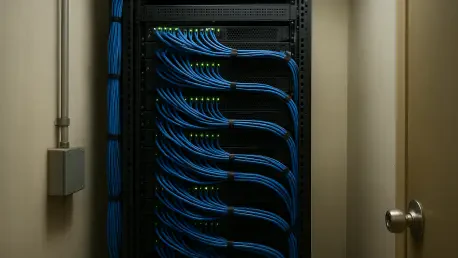

The seamless flow of data across a high school campus often feels as natural as the air students breathe, yet this digital oxygen depends entirely on a complex federal subsidy now caught in a regulatory storm. The quiet hum of servers and the instant loading of educational portals are often taken for granted in schools across the country, yet these functions rest on a decades-old federal pillar currently facing an uncertain future. As the Federal Communications Commission (FCC) re-evaluates the E-Rate program, a fundamental question emerges: has a program designed to bridge the digital divide become so successful that it is now being viewed as an unnecessary expense, or is it the essential “electricity” of 21st-century learning?
The Invisible Utility: Powering the Modern American Classroom
The modern school building is no longer just a collection of bricks and mortar; it is a sophisticated data center where every lesson plan, grade book, and security protocol flows through a network of fiber optics and wireless access points. For the past several decades, this infrastructure has been largely invisible to the public, functioning in the background to ensure that students in rural outposts have the same digital opportunities as those in affluent suburbs. This review of the E-Rate program occurs at a time when the federal government is weighing the necessity of continued investment against the desire for fiscal consolidation.
Educational advocates suggest that the success of the program has created a “success paradox.” Because the digital divide has been significantly narrowed, some policymakers argue that the mission is complete. However, the reality on the ground suggests otherwise. High-speed connectivity is now the primary delivery mechanism for the modern curriculum, and its removal or reduction would be akin to cutting off the power supply to a physics lab or the water to a gymnasium. The debate is no longer about getting schools online, but about keeping them online in an environment where technological demands are perpetually increasing.
From Dial-Up to Fiber Optics: Why E-Rate Matters in 2026
Established in 1996, the E-Rate program was a visionary response to an era when most schools lacked even a single internet connection and the World Wide Web was in its infancy. Today, in 2026, it serves as the financial backbone for broadband and internal networking in nearly every public school and library in the United States. This review comes at a critical juncture where the definition of “educational necessity” is expanding rapidly. Connectivity is no longer just a tool for research; it governs everything from digital gradebooks to campus security systems, making its funding a matter of both academic performance and institutional safety.
The shift from 1996 to the present day has seen a transition from basic dial-up access to multi-gigabit fiber connections that support thousands of devices simultaneously. As instructional models evolve to include more immersive technologies and real-time collaboration, the bandwidth requirements of the average district have grown exponentially. For many institutions, the E-Rate subsidy is the only factor preventing a massive regression in technological capability, as local budgets are rarely equipped to handle the rising costs of high-speed enterprise-grade networking.
Deconstructing the Debate: Connectivity, Safety, and Local Budgets
Leading educational advocates, including the National Education Association, argue that connectivity is no longer a luxury but an ongoing utility that requires permanent federal support. They contend that the program’s success in achieving near-universal access should not be a precursor to its termination, but rather a mandate for its continued maintenance. The argument is that broadband is a permanent infrastructure requirement, much like heating or lighting, and that the federal government must remain a partner in sustaining this foundational service for future generations.
Modern school districts, such as those in Orange County, Virginia, have integrated E-Rate-funded networks into their core safety protocols with significant success. These networks support real-time student information systems, transportation logistics, and sophisticated security camera feeds that are vital for campus protection. A loss in funding could directly impact a school’s ability to respond to emergencies, as many of these safety features rely on the same robust internal networks that provide internet access to classrooms. Consequently, the debate has shifted from purely academic concerns to those involving the physical security of students.
Economic Multipliers: Expert Perspectives on Federal Support
Data from the Schools, Health & Libraries Broadband Coalition highlights a staggering economic reality: every $1 of E-Rate funding removed could result in a $1.60 loss in real Gross Domestic Product. If the program’s $2.6 billion annual budget were eliminated, the national economy could face a $4.2 billion contraction. This economic multiplier effect suggests that federal investment in school connectivity is not just a social good, but a vital component of national economic stability. For state representatives in Ohio and Pennsylvania, the debate is a matter of fiscal survival for their local municipalities.
Without federal subsidies, the costs of maintaining networks would fall entirely on local taxpayers, likely forcing a choice between significant tax hikes or deep cuts to teaching staff and student services. This financial pressure is compounded by the “digital hygiene” movement, where organizations like the Free State Foundation are pushing for a more nuanced approach. They advocate that the FCC link future funding to responsible usage, addressing the social and psychological impact of constant digital access. This would transform E-Rate from a simple funding mechanism into a comprehensive framework for healthy digital habits.
Navigating the Regulatory Shift: Strategies for Stakeholders
As the FCC continues its review, schools and libraries are being encouraged to shift their strategic planning from one-time hardware installations to long-term lifecycle management. This approach ensures that internal networks remain robust even if federal priorities pivot in a different direction. By focusing on maintenance and sustainability rather than just acquisition, stakeholders can create a more resilient technological environment. This transition requires a cultural shift within school boards to view IT infrastructure as a recurring operational expense rather than a series of isolated capital projects.
To address regulatory concerns regarding screen time, educational leaders can proactively develop digital hygiene programs that involve parents and educators in monitoring and managing network usage. Municipalities and school boards can better protect their interests by documenting the specific operational tasks—from bus routing to standardized testing—that would fail without E-Rate support. Providing clear data for public comments and legislative outreach remains the most effective way to demonstrate the program’s value. Proactive planning and clear communication will be essential for navigating the next phase of federal connectivity support.
Educational leaders analyzed the shifting landscape and adopted more resilient local funding models that decreased reliance on federal fluctuations. They integrated digital literacy directly into the curriculum, ensuring that connectivity served as a tool for empowerment rather than a source of distraction. Proactive school districts documented the vital role of internal networks in emergency response protocols, creating a compelling case for the program’s continued existence. Ultimately, the focus shifted toward a balanced approach that maximized technological benefits while mitigating the social risks of a hyper-connected environment. These strategic adjustments ensured that the digital foundations of the American classroom remained secure for the years ahead.