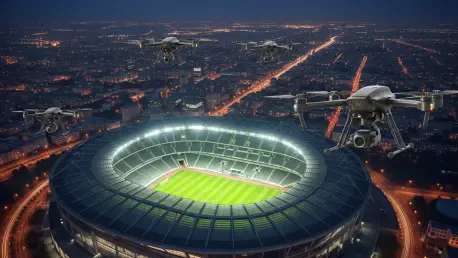

High above the sprawling urban landscapes of eleven host cities, a sophisticated and invisible digital architecture serves as the primary guardian for millions of football fans gathered for the global tournament. While the spectators inside the stadiums remain fixated on the precision of a striker or the agility of a goalkeeper, a silent and high-tech battle for the sky unfolds far beyond the sight of the average ticket holder. The current tournament has presented a security challenge of unprecedented proportions, demanding a departure from the traditional reliance on physical barriers. In this new era of public safety, the standard methods of crowd control and perimeter defense have been augmented by a multi-layered aerial strategy. The arrival of millions of international visitors across diverse jurisdictions has necessitated a transition where unmanned aerial systems act as the primary shield against potential disruptions.
The complexity of securing such a massive event stems from the inherent limitations of ground-based observation. In cities like Los Angeles, New York, and Miami, the movement of people through transit hubs, sprawling fan zones, and hotel districts creates a tapestry of movement that is impossible to monitor through fixed cameras alone. Public safety agencies have recognized that the modern threat profile has shifted into the third dimension, where the air is no longer a neutral space but a potential vector for interference. Consequently, the deployment of drones has become a cornerstone of the security apparatus, providing first responders with a versatile eye-in-the-sky that can navigate urban canyons and stadium rafters with equal ease. This shift represents more than just a technological upgrade; it is a fundamental reimagining of how a city protects its inhabitants during a period of intense global scrutiny.
Traditional security measures, such as metal detectors and concrete bollards, are effectively rendered obsolete when a threat can simply fly over the stadium walls. To counter this, law enforcement and private security firms have integrated autonomous and remotely piloted aircraft into their daily operations, ensuring that the peace is kept from the heavens down to the pitch. By utilizing these systems, agencies can maintain a proactive stance, identifying anomalies in crowd behavior or unauthorized aerial intrusions before they escalate into significant incidents. As the tournament progresses, the efficacy of these unmanned systems continues to prove that in the modern world, safety is a product of technological agility and constant vigilance.
The Invisible Front Line of Modern Stadium Security
The concept of a secure perimeter has undergone a radical transformation as the limitations of physical fencing and ground patrols become increasingly apparent in the face of modern technology. For decades, stadium security was defined by what occurred at the gates, yet the current global tournament has demonstrated that the most significant vulnerabilities often originate from above. High-profile venues are no longer just land-based structures; they are nodes within a complex three-dimensional airspace that must be managed with surgical precision. The invisible front line now consists of a network of sensors and patrol drones that monitor the approach paths of every stadium, ensuring that the sky remains as restricted and safe as the VIP lounges. This change has forced a massive reallocation of resources, with agencies shifting focus from static defense to dynamic, aerial-based intelligence gathering.
Integrating these aerial assets into the existing security framework requires a delicate balance between visibility and discretion. While the presence of police drones can act as a deterrent to petty crime or unauthorized activity, the most critical work often happens through silent, high-altitude surveillance that does not distract the fans. These systems are equipped with thermal imaging and high-resolution zoom lenses, allowing operators to spot a discarded bag in a crowded plaza or a suspicious vehicle near a transit entrance from miles away. This capability has fundamentally changed the response time for emergency services, as the “eye in the sky” can provide a real-time assessment of a situation before a single officer arrives on the scene. By bridging the gap between detection and action, drones have become the most vital tool in the modern security professional’s arsenal.
Moreover, the psychological impact of this invisible front line cannot be understated, as it provides a sense of security to millions of travelers who are far from home. The coordination required to manage the airspace above eleven different cities is a feat of logistical engineering, involving constant communication between local police, federal agencies, and private contractors. This unified front ensures that no matter which city a fan visits, the level of protection remains consistent and robust. The invisible line of defense is not just about stopping threats; it is about creating an environment where the focus remains entirely on the spirit of the game, rather than the logistics of safety.
Why Aerial Surveillance Is the New Standard for Global Events
The sheer density of human movement during a global tournament of this scale makes traditional policing methods statistically insufficient for maintaining total awareness. With millions of fans congregating in outdoor fan zones, occupying every available hotel room, and flooding public transportation, the “secure perimeter” of the past has effectively been erased. Data from the Center for Internet Security suggests that the proliferation of consumer-grade drones has created a scenario where any individual with a few hundred dollars can challenge the integrity of a major event. Whether through simple curiosity or more nefarious intent, unauthorized drones represent a risk that ground-based teams cannot easily mitigate without aerial assistance. This reality has moved aerial surveillance from a luxury to a mandatory standard for any city hosting a high-profile international gathering.
Managing the risk profile of such a large-scale event requires understanding that threats are no longer two-dimensional. In the past, security focused on preventing unauthorized entry through gates or fences, but the modern era demands a rigorous management of the vertical space. A hobbyist drone pilot attempting to capture a unique photograph of the opening ceremony can inadvertently cause a massive security alert, disrupting flight paths or creating a panic among the crowd. By establishing a comprehensive aerial surveillance network, public safety officials can distinguish between a harmless mistake and a deliberate attempt at disruption. This nuance is critical, as it allows security forces to respond with the appropriate level of force or intervention, preventing unnecessary escalations in high-pressure environments.
The evolution of these standards is also driven by the need for better data and situational awareness in real-time. In a congested urban environment, ground-based cameras are often blocked by trees, buildings, or the very crowds they are trying to monitor. Drones provide a “top-down” perspective that reveals the true flow of a crowd, identifying potential crush points or bottlenecks before they become dangerous. This data is fed directly into command centers, where algorithms and human experts analyze the movement of people to optimize the deployment of resources. As global events continue to grow in size and complexity, the ability to view the entire landscape from an elevated vantage point has become the only way to ensure that nothing is missed in the chaos of a celebration.
The Dual Role of Drones: Threat Detection and Tactical Response
To effectively secure a global event of this magnitude, security forces must operate with the understanding that drones represent both the greatest challenge and the most effective solution. This duality requires a sophisticated, layered approach that combines cutting-edge detection technology with a tactical response capability. The first layer of this defense is centered on awareness; before a potential threat can be neutralized, it must be accurately identified. Major cities have invested in complex detection networks that utilize Radio Frequency sensors to pick up the control signals of unauthorized devices long before they reach the stadium. These systems act like a digital early-warning radar, providing the exact location of both the drone and the operator, allowing ground teams to intercept the pilot before any harm can be done.
Beyond detection, the role of drones as tactical first responders has revolutionized how law enforcement handles emergencies in gridlocked cities. The “Drone as First Responder” model allows a police department to launch an aerial unit the moment a call for service is received. In the heavy traffic common during match days, a drone can reach a medical emergency or a report of a disturbance in a fraction of the time it would take a patrol car to navigate the streets. These units provide a live video feed to dispatchers, who can then determine if a full tactical team is necessary or if the situation can be resolved with a smaller footprint. This efficiency not only saves time but also ensures that limited manpower is used where it is most needed, enhancing the overall safety of the entire city.
Finally, the defense against proximity-based cyber attacks has become a critical component of the tactical response strategy. Modern drones can be outfitted with sophisticated equipment designed to exploit Wi-Fi networks or jam essential communication frequencies. From a high-altitude hover, a malicious actor could theoretically interfere with a stadium’s internal systems, such as digital ticketing or the massive LED screens used for broadcasts. To counter this, specialized electronic warfare teams work alongside aerial patrols to monitor the spectrum for any signs of interference. This digital protection is just as vital as physical safety, as a disruption to the global broadcast or the ticketing system could result in massive financial losses and a complete breakdown of order at the venue gates.
Expert Perspectives on the Speed of Technological Innovation
Security experts and government officials agree that the pace at which drone technology evolves is currently outstripping the speed of traditional policy-making. John Cohen, a prominent voice at the Center for Internet Security, has frequently pointed out that the window for adaptation is narrowing, and that agencies must move with “seconds-to-minutes” agility to be effective. This sentiment is echoed by the massive financial commitments seen across the country, such as the seventeen-million-dollar investment in drone programs recently authorized for New York’s regional security. These funds are not just for purchasing hardware; they are for developing the intelligence-driven policing models that allow for proactive rather than reactive responses to aerial threats. Experts argue that if the defense does not innovate as quickly as the potential attackers, the security gap will eventually be exploited.
The transition toward these advanced systems is fueled by a collective understanding that the threats of the current year are vastly different from those of even a few seasons ago. For instance, the use of AI-driven drones that can navigate without GPS signals has become a point of concern for high-level security planners. To address this, current programs emphasize the importance of “dark drone” detection—using radar and optical sensors that do not rely on the drone’s transmission of a signal. Experts suggest that the goal is to create a seamless “sensor fusion” where different technologies work together to provide a single, clear picture of the airspace. This level of sophistication requires constant training and the recruitment of specialized personnel who understand both the mechanics of flight and the intricacies of digital security.
Furthermore, the emphasis has shifted toward the “whole-of-community” approach, where information is shared across jurisdictions with lightning speed. The lessons learned in one host city are immediately disseminated to the other ten, creating a collective intelligence network that benefits everyone. This collaborative spirit is what experts believe will ultimately determine the success of the tournament’s safety protocols. By treating security as a shared technological challenge rather than a local administrative one, agencies are able to pool their knowledge and stay one step ahead of those who might seek to disrupt the peace. The consensus remains clear: innovation is not an option; it is the fundamental requirement for survival in the modern security landscape.
Strategies for a Unified Airspace Defense
Creating a truly secure environment for a global sporting event requires a strategic framework that transcends simple technology and enters the realm of complex legal and inter-agency coordination. One of the most significant hurdles in drone mitigation is the patchwork of laws that govern the neutralization of unauthorized aircraft. While a local police officer might have the technology to jam a drone’s signal, the legal authority to do so is often strictly reserved for federal entities like the FBI or the Department of Homeland Security. This necessitates a “unified airspace defense” strategy where local and federal teams sit side-by-side in a joint operations center. This coordination ensures that when an incident occurs, the decision to act is made within seconds, following a pre-approved legal and tactical protocol.
A key component of this unified strategy is the focus on the human operator rather than just the physical machine. Since neutralizing a drone mid-air carries risks of falling debris and potential injury to the crowd below, many agencies prioritize “pilot interdiction.” Using sophisticated detection data, ground units are dispatched to the exact GPS coordinates of the drone’s controller. By locating and detaining the pilot, security forces can end the threat without ever having to fire a shot or deploy an electronic jammer. This method has proven to be the most effective way to manage the legal complexities of modern airspace while maintaining a high level of public safety. It also serves as a powerful deterrent, as word quickly spreads that every drone in the area is being tracked to its source.
Preparation for these scenarios involves months of rigorous tabletop exercises and full-scale rehearsals before the tournament even begins. These drills bring together 911 dispatchers, IT specialists, and private security teams to simulate everything from a simple hobbyist intrusion to a complex, coordinated cyber-aerial attack. These exercises are vital for identifying gaps in communication and ensuring that everyone knows their role when the pressure is on. Additionally, the security perimeter is often expanded to include transit lines and open-air fan zones that lack the permanent infrastructure of a stadium. By extending the protective umbrella of drone surveillance and detection to these outlying areas, officials ensure that the safety of the fans is maintained from the moment they arrive in the host city until the moment they depart.
The implementation of advanced drone technology and the coordination of multi-agency defense networks during the tournament established a new benchmark for global event security. Public safety officials successfully integrated aerial detection with tactical ground responses, ensuring that the vast crowds remained protected from both physical and digital threats. The transition toward a “Drone as First Responder” model proved essential in navigating the logistical challenges of crowded urban environments, providing a blueprint for future large-scale gatherings. By prioritizing pilot interdiction and utilizing sensor-fusion technology, agencies managed the complex legal landscape of the national airspace while maintaining total situational awareness. This proactive approach allowed the focus of the tournament to remain entirely on the celebration of sport, demonstrating that technological agility is the most effective safeguard for public peace. Moving forward, the lessons gathered from this unprecedented security effort informed the development of more adaptive and intelligence-driven policing strategies. The successful management of the skies over the eleven host cities reaffirmed that the future of public safety is inextricably linked to the mastery of the aerial domain. This legacy of innovation ensured that cities are better equipped to protect their citizens in an increasingly automated world.