
The United States Postal Service occupies an unparalleled position within the realm of domestic commerce, serving not merely as a delivery provider but as a foundational infrastructure for millions of citizens. As the market enters 2026, this institution stands at a pivotal financial and operational crossroads that has sparked intense debate among policymakers and industry leaders alike. While often viewed through the narrow lens of a government agency, the organization functions as one of the most influential entities in the national logistics landscape. This analysis explores the tension between its deteriorating financial health and its role as a provider of universal public service, highlighting why the agency remains an indispensable pillar of American commerce.
From Colonial Roots to a Modern Logistics Giant
To comprehend the modern significance of this institution, one must trace its evolution from a colonial necessity into a massive logistics enterprise. Historically, the post office was designed to bind a growing nation together, a mission that shifted significantly from horse-and-buggy routes to sophisticated automated sorting. In recent decades, the landscape has changed dramatically. The agency has faced persistent net losses for years, largely driven by a significant decline in its core letter-mail revenue as digital communication replaced physical correspondence. These historical shifts are critical to understanding today’s challenges, as the organization is forced to adapt a centuries-old mandate to a 21st-century economy that demands rapid delivery and package-heavy logistics.
The Structural Pillars of Postal Economic Impact
The organization operates on a scale that rivals the world’s largest private logistics firms, generating billions in annual revenue. However, its economic impact is defined by specific legal mandates and labor market influences that distinguish it from traditional corporations.
The Universal Service Obligation and Rural Connectivity
A primary factor that sets the postal service apart from its private-sector peers is the Universal Service Obligation. Unlike private logistics companies that can choose to ignore unprofitable routes, the agency is legally required to deliver to every single address in the country, six days a week, at uniform rates. This mandate prevents the organization from optimizing its network solely for profit. While a private entity might exit a low-traffic rural market to save costs, the postal service must maintain its presence. This makes the agency a vital lifeline for millions of people in low-density areas who rely on it for life-essential items like prescription medications and small business shipments that private carriers find too expensive to handle.
A Major Engine for Employment and Economic Equity
The postal service remains one of the largest employers in the nation, maintaining a workforce of approximately 600,000 people. These positions represent high-quality jobs that provide federal benefits and a path to financial stability without requiring a college degree. Furthermore, the agency has historically served as a reliable ladder into the middle class for Black Americans, who make up nearly 30% of the workforce. With hundreds of thousands of retirees depending on its pension systems, any restructuring of the agency is a significant labor-market intervention. The scale of this human infrastructure means that the health of the organization is directly tied to the economic well-being of over a million households.
Physical Infrastructure and Private Sector Symbiosis
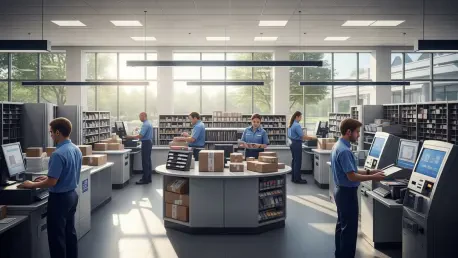
With roughly 33,700 post offices, the agency maintains a physical footprint more extensive than the largest retail chains. In many rural communities where banks and pharmacies have closed, the local post office remains the only standing institutional outlet. This vast network creates a unique relationship with private carriers like FedEx and UPS. Rather than being purely competitive, the relationship is symbiotic. Private carriers frequently use the postal network to handle the last mile of delivery. Because the postal service already visits every home daily, it can complete these final deliveries more efficiently than private firms that would otherwise have to send a dedicated truck for a single package.
Navigating the Future: Delivery and Digital Shifts
The future of the postal service depends on its ability to balance its public mission with new technological and economic realities. Market trends suggest a continued shift toward e-commerce, necessitating a complete overhaul of processing facilities to handle increasing package volumes. Regulatory changes have aimed to stabilize the balance sheet, but concerns regarding cash exhaustion persist as the agency moves through 2026. Experts suggest that the organization will need to double down on its role as a package carrier while potentially exploring new revenue streams, such as expanded government administrative support, to stay relevant in an increasingly digital world.
Strategic Takeaways: Businesses and Policymakers
The major takeaway from the current state of the institution is that it is too deeply integrated into the social fabric to be viewed strictly as a business. For businesses, the agency remains the most cost-effective way to reach rural customers and manage high-volume small-parcel shipping. For policymakers, the evidence suggests that a fix focusing solely on cutting service could dismantle a vital public utility. The best approach involves recognizing the agency as a critical infrastructure partner for private industry and a necessary service provider. Maintaining this connectivity is an investment in the overall economic health of the nation, ensuring market access for all.
Sustaining the Backbone: The National Economy
The analysis confirmed that the postal service functioned as a massive employer, a driver of middle-class stability, and a cornerstone of rural infrastructure. Its scale was a direct result of its legal mission to serve every citizen regardless of geography or income level. The study highlighted that the organization provided the connective tissue allowing the national economy to function as a unified market. Looking back, the findings emphasized that the goal was not merely to achieve profitability but to ensure a reliable and accessible utility. Preserving this institution was essential for ensuring that no community was left behind in the modern global economy. Strategies for future resilience included diversifying revenue and modernizing the last-mile network.