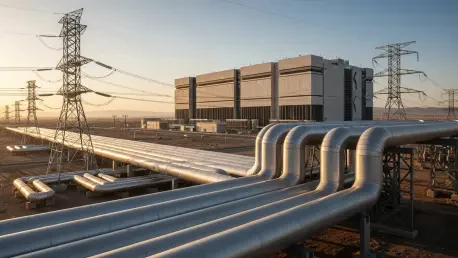

Across the vast and politically fragmented landscape of the United States, a surprising consensus has emerged among voters that threatens to derail the next phase of the digital revolution. While the nation usually finds itself deeply divided on almost every significant policy issue, the rapid and aggressive expansion of data centers has forged an unlikely alliance between the left and the right. This bipartisan pushback is not just a fringe movement; it has reached the highest levels of state government, forcing leaders who are typically ideological opposites to adopt similar stances. For instance, Republican Governor Greg Abbott in Texas is currently pushing for much stricter regulations on these facilities, while Democratic Governor Kathy Hochul in New York is grappling with intense public pressure to halt new construction altogether. This shared skepticism marks a significant shift in how technological infrastructure is viewed by the American public, moving away from being seen as a symbol of progress to being perceived as a direct threat to local resources and community stability.
The core of this friction lies in the technological pivot toward high-performance computing required for artificial intelligence applications. Unlike the traditional cloud storage facilities that characterized the last decade, modern AI-ready data centers demand an unprecedented amount of electricity and water to function. These facilities house advanced hardware that generates immense heat, necessitating massive cooling systems that can consume millions of gallons of water daily, often in regions already struggling with drought. This insatiable hunger for power has turned these digital warehouses into high-profile political targets, as residents watch their local utility grids stretch to their breaking points. Consequently, state governments are being forced to intervene as the hidden costs of the AI boom, such as rising electricity prices and the rapid depletion of natural resources, become too significant for the average taxpayer to ignore. These challenges have created a volatile political environment where the tech industry’s growth is no longer guaranteed by economic promises.
The Intersection of Public Distrust and Resource Scarcity
Polling data from 2026 reveals a remarkable level of agreement among Americans who are otherwise polarized on most legislative and social issues. Roughly 70 percent of voters across the country have expressed clear opposition to the development of massive AI data centers within their own local communities. This sentiment is surprisingly consistent regardless of political affiliation, with approximately 75 percent of Democrats and 63 percent of Republicans voicing their disapproval of these projects. Such a high degree of consensus is nearly unheard of in an era where infrastructure developments, from highways to energy pipelines, are typically viewed through a strictly partisan lens. The data suggests that the localized nature of the impact, specifically the threat to basic utilities like water and electricity, transcends traditional party platforms and creates a unified front against the tech industry’s expansion. Voters are increasingly prioritizing their immediate environment over the abstract benefits of a digitized economy.
Furthermore, research into voter demographics highlights a fascinating alignment between the most ideological wings of both the Democratic and Republican parties. Conservative Republicans are currently more likely to oppose the construction of local data centers than their more moderate peers, which places them in closer alignment with the views of liberal Democrats. This unusual convergence suggests that the issue of digital infrastructure expansion is currently in a pre-partisan phase, where the tribal politics of the national stage have not yet fully dictated a rigid party-line stance. This window of time has allowed diverse advocacy groups to unite over shared concerns regarding land use, resource management, and the preservation of local community standards. By focusing on these immediate, tangible impacts, these groups have managed to build a powerful coalition that effectively challenges the dominance of major technology corporations. This alignment has shifted the political calculus for many lawmakers who must now answer to a broader base of resistance.
Financial Consequences of Localized Grassroots Resistance
The movement against data center expansion has already resulted in significant financial and operational disruptions for the global technology industry. By early 2026, dozens of major infrastructure projects with a combined valuation exceeding $100 billion were either indefinitely delayed or completely canceled due to organized local opposition. This resistance is not a centralized campaign led by a single national organization but is instead composed of hundreds of decentralized local groups operating in nearly every state across the nation. These activists have become increasingly sophisticated in their tactics, using legal challenges and public hearings to halt massive investments by questioning the long-term benefits of the AI boom. Their effectiveness lies in their ability to frame the conversation around the immediate needs of the community rather than the abstract promises of technological advancement or national economic growth. This grassroots power has forced even the largest tech firms to pause their aggressive expansion plans.
Most of these organized protests are grounded in practical, everyday grievances that resonate deeply with residents who feel their quality of life is being compromised. Families are primarily concerned about the mounting strain on the local electrical grid, which many fear will inevitably lead to higher monthly utility bills and potential service interruptions during peak demand. In the more arid regions of the country, the use of millions of gallons of water for cooling data hardware has become a major flashpoint, pitting the tech industry against agricultural and residential needs. Furthermore, there is a growing sense of frustration regarding the fairness of providing massive tax breaks to multibillion-dollar tech corporations. Critics often point out that while these companies receive significant public subsidies, they offer very few long-term employment opportunities for the local workforce compared to the sheer size of the facilities they build. This perceived imbalance of benefits has fueled a sense of injustice that crosses all political boundaries.
Divergent Framing and Geographic Case Studies
While the opposition to data centers is broad and bipartisan, the language used to describe the problem often shifts depending on the political orientation of the officials involved. Republican leaders generally focus their criticism on the reliability of the power grid and the perceived unfairness of using taxpayer funds to subsidize wealthy corporations. They often frame their arguments around the preservation of state sovereignty and the protection of the traditional energy sector. In contrast, Democratic officials are more likely to express their concerns through the lens of environmental justice, highlighting carbon footprints, climate change, and the unsustainable consumption of public resources. Despite these different rhetorical approaches, the underlying goal remains the same, creating a unique political landscape where diverse groups are essentially fighting the same battle for vastly different reasons. This convergence of interests has allowed legislative roadblocks to persist despite the differing motivations of those who build them.
Real-world examples from across the country illustrate how these localized concerns are playing out on the ground in very different cultural contexts. In Box Elder County, Utah, a heavily conservative voter base has successfully fought against several proposed projects by arguing for the protection of the Great Salt Lake and demanding an end to property tax breaks for tech firms. Meanwhile, in the liberal-leaning community of Monterey Park, California, residents successfully pushed for a ban on new data center construction by focusing on public health concerns and the preservation of local water quality. These geographic case studies demonstrate that whether the focus is on fiscal conservatism or environmental conservation, the end result is a unified front against the expansion of digital infrastructure. This suggests that the tech industry can no longer rely on a one-size-fits-all strategy to gain local approval for their massive building programs. Local identity and the protection of shared resources have become the primary drivers of this national movement.
Public Perception and the Evolution of Industry Trust
A major contributing factor to the current backlash is the steadily declining public image of the leadership within the big tech industry. Personalities who were once celebrated as visionary innovators are now increasingly viewed with skepticism by a public that is currently struggling with high inflation and a rising cost of living. Trust in tech CEOs has reached an all-time low, making voters much less willing to share their limited natural and financial resources with an industry they perceive as elite and largely indifferent to the needs of the average citizen. This erosion of trust has made it significantly harder for companies to argue that their presence will bring meaningful benefits to a community. Instead of being seen as partners in progress, these firms are often viewed as extractive entities that take more from a region in terms of energy and water than they give back in jobs or taxes. This perception gap has created a significant hurdle for any future development that requires public cooperation or legislative support.
Industry analysts frequently point to the historical trajectory of the hydraulic fracturing industry as a cautionary tale for how this bipartisan unity might eventually dissolve. In the early stages of the fracking boom, opposition was often localized and bipartisan, centered on immediate concerns about water quality and land use. However, once political strategists and national media outlets reframed the issue as a binary choice between economic growth and environmentalism, the cross-partisan alliances quickly began to crumble. There is a legitimate concern that the debate over data center expansion will follow a similar path as it becomes a more prominent talking point in upcoming election cycles. If the issue is successfully absorbed into the national culture war, the current window for collaborative resource management and thoughtful infrastructure planning could close, leading to a much more polarized and less productive policy environment. For now, the decentralized nature of the resistance remains its greatest strength.
As the 2026 midterm elections approached, the complex politics surrounding data center development emerged as a critical juncture for both the technology sector and the American public. This movement served as a powerful check on the expansionist goals of major tech firms, forcing them to reconsider their approach to community engagement and resource consumption. Moving forward, the industry was required to adopt more transparent water management practices and invest in localized energy generation to mitigate the strain on public grids. Policymakers eventually focused on creating standardized federal frameworks that balanced national technological competitiveness with the protection of local interests. By prioritizing the development of sustainable cooling technologies and more equitable tax structures, the sector attempted to rebuild its damaged reputation. Ultimately, the future of American AI infrastructure depended on whether these firms could shift from being perceived as resource consumers to becoming active contributors to local community resilience.