
As the global security landscape shifts toward increasingly autonomous and high-volume warfare, Donald Gainsborough stands as a pivotal figure in deciphering these complex geopolitical maneuvers. As the head of Government Curated, his expertise in policy and legislation provides a unique lens through which to view the rapid industrialization of the Kremlin’s war machine. In this discussion, we explore the alarming expansion of Russia’s drone manufacturing capabilities in the Tatarstan region and what this domestic pivot means for the future of European stability in an era of persistent aerial threats.
The conversation delves into the strategic expansion of the Alabuga-Volokno factory, a move designed to decouple the Russian military supply chain from its current dependence on external partners. We analyze the technical necessity of aerospace-grade carbon fiber in modernizing the drone fleet, the staggering projected increase in annual production units, and the broader implications of these industrial milestones on the security of neighboring nations. Furthermore, we examine the disconnect between ongoing diplomatic peace missions and the reality of a state-funded infrastructure designed for long-term aerial dominance and hybrid aggression.
Given the recent documents detailing the expansion of the Alabuga-Volokno factory, how do you perceive Russia’s shift toward large-scale domestic production of military-grade carbon fiber impacting the long-term trajectory of the conflict in Europe?
The move to expand the Alabuga-Volokno facility in Tatarstan is a clear signal that Moscow is preparing for a sustained, high-intensity aerial campaign that extends far beyond the immediate front lines. By aiming to produce an additional 500 tons of military-grade aerospace carbon fiber annually by 2029, the Kremlin is essentially building the skeletal structure for a massive increase in its “Geran” drone fleet. This expansion is estimated to translate into an additional 28,000 weaponized drones every year, representing a 78% increase in production capacity for the very tools that have already left scores of civilians dead and struck critical infrastructure like the passenger train near the Polish border this month. We are seeing a transition where the air war is no longer just about tactical strikes but about the sheer saturation of defenses through volume, a strategy that places the security of the entire European continent at risk. The Lightweight, strong nature of this material is the “secret sauce” that allows these drones to maintain the range and payload capacity necessary for deep-strike missions, ensuring that no target in Europe feels truly safe from these mass volleys.
With satellite imagery confirming that land is already being cleared for this project, what are the specific technical and logistical hurdles Moscow is trying to overcome by in-housing this technology?
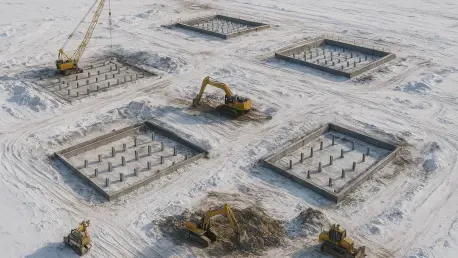
The logistical heart of this project lies in “import substitution,” a desperate but calculated attempt to reduce a heavy reliance on Chinese imports for critical dual-use items. Internal documents reveal that despite a disguised shipment of 46 tons of carbon-fiber chemicals from a Chinese state corporation earlier this year, Russia knows it cannot rely on external supply chains forever, especially with increasing Western sanctions on entities like UMATEX. The construction of a modern polyacrylonitrile (PAN) plant within the Alabuga Special Economic Zone is designed to produce the UMT42S-3K grade carbon fiber specifically required for the aerospace industry. Without this specific fibrous chemical, the Russian military cannot keep the weight of their drone airframes down, which is essential for the structural integrity of fuel tanks and engines. Expert observations of the site indicate that the foundation is being prepared for a 2027 completion, a timeline that demands a feverish pace of construction to meet the growing hunger of the military-industrial complex.
The reports suggest a staggering increase in production numbers, aiming for hundreds of thousands of drones over the next decade. How does this aggressive industrial scaling redefine the concept of “hybrid warfare” for the eastern flank of the European theater?
We are moving into an era where “sub-threshold” actions—those that test the limits of NATO’s reaction without triggering full-scale war—will be powered by an industrial output of 130,000 drones by 2030, eventually scaling to 350,000 by 2035. This massive inventory allows for a type of hybrid aggression where drone violations of Polish and Romanian airspace become a regular, terrifying occurrence designed to gauge Western resolve and fatigue. The integration of jet engines into the newer designs of the Geran drones further escalates this threat, as these systems can now strike faster and penetrate deeper into sovereign territories than ever before. For countries on the eastern flank, the threat is no longer theoretical; it is measured in the fragments of drones examined by police after strikes on commuter trains and civilian hubs. This isn’t just about Ukraine anymore; it is about creating a permanent state of vulnerability for all of Europe, using Alabuga as the central hub for future campaigns of coercion.
Recent diplomatic efforts, including the dispatch of high-level envoys to Moscow and Kyiv, seem to contrast sharply with the continued drone strikes on civilian infrastructure. How should world leaders interpret these parallel tracks of peace overtures and industrial escalation?
It is a classic case of diplomatic theater being used as a smokescreen for military expansion; while figures like Jared Kushner and Steve Witkoff were in the region to jumpstart a peace process, the reality on the ground told a different story. Just a day after those envoys departed, five people were killed in missile and drone attacks on Kyiv, underscoring a blatant disregard for the very negotiations the Kremlin claims to desire. When Sergey Lavrov speaks at the United Nations about a readiness to restart talks, his words must be weighed against the concrete pouring at the Alabuga-Volokno factory and the failed attempts by officials like Vasily Nebenzya to scrub the “Situation in Ukraine” from the international agenda. The industrial momentum Russia is gaining in the air war suggests that even if a diplomatic solution is reached, the regime remains committed to a long-term military posture of confrontation with the West. Leaders must recognize that a state investing so heavily in the production of tens of thousands of killer drones is a state that has no intention of de-escalating its underlying hostility.
What is your forecast for the security landscape of Eastern Europe as these production facilities come online over the next several years?
From 2026 to 2029, we should expect a period of heightened volatility as the first fruits of the Alabuga expansion reach the front lines and beyond, leading to more frequent and more complex swarming attacks that challenge existing air defense systems. The sheer volume of production—heading toward that 130,000-unit milestone—will likely embolden the Kremlin to increase its “sub-threshold” provocations, using drones as a primary instrument of intimidation against European neighbors. We will see a persistent “deep strike” capability that targets the psychological and physical resilience of civilian populations, forcing a massive and costly redirection of European defense spending toward advanced counter-drone technologies. Ultimately, the successful in-housing of carbon fiber production means that Russia will be less susceptible to traditional economic levers, making the security of Europe dependent not on sanctions alone, but on a robust, coordinated effort to disrupt these internal supply chains and bolster the defenses of every nation within range of these Tatarstan-made weapons.