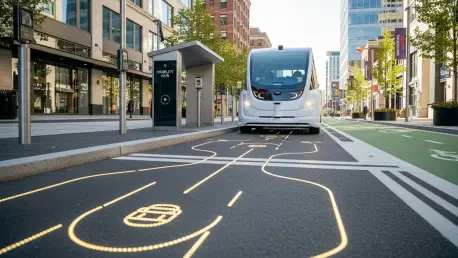

The visual landscape of the American urban core has undergone a startling transformation over the last several months as the hum of electric motors and the rhythmic spinning of lidar sensors replace the traditional roar of human-piloted engines. As of the current period in 2026, autonomous transportation has transcended its former status as an experimental novelty to become a cornerstone of the modern metropolitan mobility matrix. This shift represents more than a technological milestone; it signifies a fundamental restructuring of how physical space is utilized within the city. Municipal governments, once content to allow technology firms to iterate in isolated test bubbles, now face an urgent mandate to redesign the very fabric of the street. The transition to “transportation as a service” demands a departure from the reactive policies of the past, necessitating a proactive infrastructure overhaul that aligns with the logistical requirements of driverless fleets. Without a strategic adaptation of the urban layout, the promised benefits of efficiency and safety risk being overshadowed by a new era of digital gridlock.
Preparing for the Driverless Revolution: A Call to Action for Urban Centers
The journey toward a driverless society began over a decade ago in the secretive research labs of Silicon Valley, but the current industrial scaling has fundamentally altered the automotive landscape. In the years leading up to 2026, the model of individual car ownership, which dictated urban design for a century, has begun a steady decline in favor of fleet-based utility. Our cities were historically engineered for the “parked car,” a concept based on the reality that private vehicles remain stationary for approximately 95% of their lifespans. This resulted in vast swaths of prime real estate being dedicated to asphalt storage lots and multi-story garages. However, the rise of the “circulating car” model necessitates an entirely different architectural philosophy. Robotaxis do not require long-term storage in central business districts; instead, they require constant, fluid access to the curb for pickups and drop-offs. This historical transition is the primary reason why existing urban designs are increasingly ill-equipped for the current volume of autonomous traffic.
Understanding this shift is essential for municipal leaders because the legacy infrastructure acts as a friction point for emerging technology. When a city is designed for static objects, the introduction of a dynamic, always-moving fleet creates immediate conflict over right-of-way and curb access. The foundational concepts that shaped the 20th-century city—such as wide lanes for through-traffic and subsidized street parking—now serve as obstacles to the optimization of autonomous fleets. As the industry moves from technological proof-of-concept to mainstream mobility, the focus must shift from the intelligence of the vehicle to the intelligence of the environment. The maturity of the autonomous vehicle sector ensures that these cars can navigate complex environments, but the lack of adaptive infrastructure prevents them from doing so in a way that maximizes public throughput and minimizes local disruption.
From Silicon Valley Experiments to Mainstream Mobility
The evolution of autonomous vehicles has moved through several distinct phases, culminating in the high-volume commercial environment observed today. Waymo, an early pioneer, has successfully transitioned from a Google-backed experiment into a massive operational force, providing over 400,000 paid, fully autonomous rides every week across various American hubs. This level of scale demonstrates that the hardware and software stacks have reached a level of reliability that matches or exceeds human capability in diverse weather and traffic conditions. This transition is significant because it marks the end of the “trial phase” and the beginning of the “integration phase.” The automotive industry is no longer just selling products to consumers; it is selling miles to passengers. This service-oriented model places the burden of vehicle maintenance, charging, and routing on the fleet operator, which in turn centralizes the impact these vehicles have on municipal resources.
As the industry scales, the influence of these fleets on urban dynamics becomes more pronounced. In earlier years, a few autonomous test vehicles had a negligible impact on traffic patterns. Today, however, the sheer volume of robotaxis in cities like Phoenix, San Francisco, and Dallas has created a new set of data points for urban planners. The move away from the private car ownership model toward a fleet-based model suggests that the total number of vehicles registered in a city may decrease, yet the number of vehicle miles traveled could remain high or even increase. This paradox is driven by the fact that robotaxis are highly utilized assets. This shift requires a reconsideration of street design, as the traditional “rush hour” begins to flatten into a more consistent stream of autonomous movement throughout the day. Consequently, the municipal focus must transition from managing traffic peaks to managing the continuous flow of service-oriented vehicles.
Examining the Mechanics of Autonomous Integration
Redefining Safety Standards Through Data-Driven Benchmarks
The most compelling argument for the rapid integration of robotaxis into the urban fabric is the verifiable safety record established by these systems over millions of miles of operation. Current industry data, derived from over 127 million miles of driverless travel, indicates a nearly 10-fold reduction in crashes involving serious injuries compared to human-driven benchmarks. Even more significantly, these systems have demonstrated a 12-fold reduction in incidents involving pedestrians, who are the most vulnerable stakeholders in any urban environment. These statistics suggest that the technological hurdle of “safe driving” has been cleared. For cities, the challenge is now one of verification and public trust. Municipalities must transition from being passive recipients of safety reports to active auditors of autonomous performance.
To maintain a “social license” for these fleets to operate on public roads, cities must demand a higher level of transparency. Rather than focusing on technical glitches or “disengagements” that have little bearing on actual safety, the regulatory focus should shift to anonymized data regarding injury rates and near-miss incidents. By creating standardized benchmarks for what constitutes “safe enough” in a given district, city officials can ensure that autonomous operators are held to a rigorous, data-backed standard. This transparency is crucial for public acceptance, as sentiment regarding self-driving technology often fluctuates based on high-profile, isolated incidents rather than long-term statistical trends. Providing the public with clear, accessible safety data helps to demystify the technology and highlights the tangible benefits of removing human error—such as distraction, fatigue, and impairment—from the driving equation.
The Economic Shift and the Drive for Scalability
While the safety case for robotaxis is robust, the economic landscape remains a complex variable that will dictate the speed of future deployment. Currently, the per-unit cost of autonomous hardware—including sophisticated lidar, radar, and high-compute processing units—frequently exceeds $100,000 per vehicle. This high capital expenditure creates a significant barrier to total market saturation, as fleet operators must balance the cost of technology against the potential for long-term profitability. Major industry players like Amazon’s Zoox and Tesla are currently in a race to achieve economies of scale that will drive these costs down. For city planners, this economic trajectory suggests that the current presence of robotaxis is merely the beginning of a much larger surge. Once the cost of an autonomous ride falls below the cost of owning a private vehicle or even using traditional public transit, the demand for these services will likely skyrocket.
This looming surge in demand necessitates that cities prepare for a scenario where robotaxis become the most cost-effective and popular form of urban transit. An explosion in vehicle miles traveled is a distinct possibility, as the convenience and low cost of autonomous rides could lead to “induced demand.” This phenomenon occurs when a service becomes so efficient that it encourages more frequent use, potentially leading to increased congestion even if the individual vehicles are operating more intelligently than human drivers. To mitigate this risk, cities must consider the economic levers at their disposal. Implementing fees for “empty miles”—the distance a vehicle travels without a passenger—can incentivize operators to optimize their routing and staging. By aligning the economic interests of fleet operators with the public interest of reduced congestion, cities can ensure that the scalability of robotaxis does not come at the expense of urban livability.
Collaborative Infrastructure and the V2X Standard
A critical component of a successful autonomous transition is the development of a collaborative environment where vehicles and city infrastructure can communicate in real-time. This concept, known as Vehicle-to-Everything (V2X) technology, allows traffic signals, intersections, and even pedestrian crossings to share data with a vehicle’s onboard artificial intelligence. Projects like the University of Michigan’s Connected Environment provide a reference architecture for how this integration can function at scale. When a traffic light can inform an approaching robotaxi of an impending signal change, the vehicle can adjust its speed for a smoother transition, reducing fuel consumption and wear on components. Furthermore, V2X technology enables traffic signal priority for high-occupancy autonomous vehicles, allowing the city to manage the flow of traffic more dynamically.
Adopting these standardized communication frameworks transforms the city from a passive surface into an active participant in a safe, managed ecosystem. This infrastructure-level intelligence is particularly valuable for navigating complex merges and blind intersections where on-vehicle sensors may have limited visibility. For a municipality, investing in “smart” intersections is not merely a technical upgrade; it is a safety imperative. By reducing the friction between human-driven cars and automated fleets, V2X helps to bridge the gap during the “mixed-use” era where both types of vehicles share the road. Standardizing these protocols across different fleet operators ensures that the city maintains control over its traffic management systems, preventing any single company from creating a proprietary monopoly over urban movement.
Anticipating the Shifts in Urban Dynamics and Regulation
The future of urban mobility will be defined by an intense competition for physical space, specifically at the curb. As robotaxis eliminate the need for long-term parking, the demand for short-term access for loading and unloading passengers will intensify. The curb is rapidly becoming the most valuable real estate in the modern city, yet in many municipalities, it remains managed by 20th-century tools like static signs and physical meters. To prevent robotaxis from clogging active travel lanes or obstructing bike paths during pickups, cities are expected to implement dynamic pricing models. In this future, the cost of accessing a high-demand pickup zone will fluctuate based on the time of day and current traffic volume. By using market forces to manage the curb, cities can ensure that the most congested areas remain fluid and that the right-of-way is preserved for all users.
Furthermore, the rise of autonomous fleets will necessitate a complete reimagining of municipal revenue structures. For decades, cities have relied on parking fees, citations, and fuel taxes to fund infrastructure projects and public services. As private car ownership declines and autonomous fleets optimize their behavior to avoid citations, these traditional revenue streams will inevitably dry up. To fill this fiscal void, cities will likely transition toward “road usage charges” or specific taxes on autonomous miles. Charging a fee for every mile driven within city limits, perhaps with a higher rate for “deadheading” or empty miles, provides a sustainable way to fund the very infrastructure these vehicles rely on. This regulatory shift allows cities to regain control over their financial health while simultaneously encouraging fleet operators to be as efficient as possible with their routing.
Strategic Recommendations for Modern Municipalities
To successfully navigate the autonomous era, city officials should adopt a series of actionable strategies that prioritize flexibility and data-driven decision-making. The first priority must be comprehensive curb management. Cities should immediately begin the process of inventorying their street space and transitioning from static parking stalls to flexible pickup and drop-off (PUDO) zones. These zones can be geofenced, meaning the vehicle’s software will only allow a pickup or drop-off to occur within the designated area. This prevents the dangerous “double-parking” that often occurs with human-driven ride-hail services. By digitizing the curb, cities can manage it in real-time, adjusting the size and location of these zones based on evolving traffic patterns and special events.
The second recommendation involves a massive update to local zoning laws to facilitate the adaptive reuse of parking infrastructure. As the demand for downtown parking fades, existing garages will become largely obsolete in their current form. Municipalities should proactively create pathways for these structures to be converted into much-needed housing, commercial spaces, or logistics hubs for autonomous vehicle charging and staging. These “mobility hubs” can serve as central nodes where robotaxis are cleaned, repaired, and charged during off-peak hours, keeping them off the streets when they are not in use. Additionally, cities should look to major transit hubs, such as airports, as primary test markets. Airports like Phoenix Sky Harbor have already successfully integrated autonomous pickup services, providing a blueprint for how complex regulatory and logistical environments can be managed. By studying these early implementations, city leaders can identify potential bottlenecks and refine their policies before full-scale urban deployment.
Navigating the Path Toward a Driverless Future
The integration of autonomous vehicles into the urban landscape represented a profound shift in how the public thought about transit and technology. In the years leading up to the current state, the focus remained heavily on the technological capabilities of the individual car, yet the real victory was found in the civic adaptation that followed. Municipalities that chose to inventory their physical assets and embrace dynamic pricing models were able to avoid the gridlock that plagued more reactive regions. The transition from static street management to a data-rich, real-time ecosystem allowed cities to reclaim vast amounts of space once dedicated to the storage of private vehicles. This reclaimed space was subsequently utilized for wider sidewalks, protected bike lanes, and green infrastructure, which enhanced the overall vibrancy of the urban fabric.
As the industry matured, the safety benefits of autonomous systems became an undeniable reality that justified the initial disruption. The significant reduction in traffic fatalities and serious injuries proved that the removal of human error was the most effective safety intervention of the century. Strategic insights gained from early test markets provided a clear path for broader implementation, showing that when vehicles and infrastructure communicated effectively, the entire system became more efficient. Ultimately, the rise of the robotaxi did not merely change how people moved; it changed the very nature of the city itself. By treating the street as a dynamic resource rather than a passive surface, urban planners ensured that the driverless revolution served the public good. The long-term significance of this era lies in the successful synthesis of technological innovation and thoughtful civic regulation, creating a urban environment that prioritized people over parked cars.