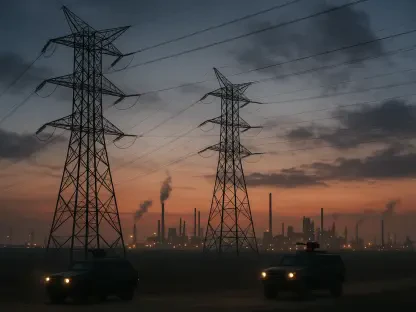

The massive transformation of the American industrial landscape has entered a critical phase where the physical acquisition of high-voltage energy and vast tracts of government land now dictates the global hierarchy of technological influence. This trend is nowhere more apparent than in Paducah, Kentucky, where the proposed American Energy Hub represents a staggering $100 billion investment aimed at repurposing a Cold War-era uranium enrichment site into a premier campus for high-performance computing. This project represents a high-stakes collaboration between the Department of Energy, private equity firms like Brookfield Corp., and utility leaders such as NextEra Energy, signaling an era in which federal industrial legacies are rapidly being converted to meet the world’s insatiable demand for data processing.
The race for artificial intelligence supremacy has fundamentally shifted from software development to the physical acquisition of land and energy. In Paducah, the proposed development is not merely a data center but a strategic asset intended to bridge the gap between legacy industrial capacity and the requirements of the twenty-first century. As hyperscale developers look for sites that can offer both massive space and proximity to power generation, former government installations have emerged as the most viable candidates for this rapid expansion. This transition highlights a new era where federal land is increasingly viewed as a crucial resource for maintaining American dominance in the digital sphere.
Evaluating the Rapid Evolution of the Domestic AI Market
The current domestic AI market is no longer defined solely by software breakthroughs or the efficiency of neural networks but by the raw ability to build and power the physical infrastructure that sustains them. Developers are increasingly targeting regions with established industrial footprints, seeking out sites that offer a combination of available land and existing electrical connectivity that can be scaled to meet massive requirements. This move toward large-scale, vertically integrated hubs reflects a strategic shift away from urban data centers toward massive rural campuses that can operate as independent power producers.
As compute needs increase, the market has begun to favor projects that include their own generation capacity, insulating tech firms from the volatility of public energy markets and the limitations of aging transmission lines. This evolution has spurred a competitive race among states to offer the most streamlined permitting processes and the most reliable energy incentives. Kentucky’s positioning in this market is particularly strong due to its existing energy infrastructure and its willingness to embrace large-scale industrial projects. The market is witnessing a fundamental decoupling of tech growth from traditional urban tech hubs, favoring instead the vast, energy-rich landscapes of the interior United States.
Strategic Integration of Massive Computing Power and Regional Energy Grids
One of the most significant shifts driving the Paducah project is the convergence of hyperscale data centers with industrial-grade energy production. Rather than relying on the traditional municipal grid, which is often ill-equipped to handle such sudden surges in demand, the hub plans to generate 1.2 gigawatts of computing capacity supported by its own 2.6 gigawatt battery storage and gas-fired generation plants. This approach allows the facility to function almost as a self-sustaining energy ecosystem, effectively bypassing the bureaucratic bottlenecks of local utility providers while offering a clear template for sixteen other federal sites currently being considered for similar development.
Moreover, the integration of these massive campuses into regional grids serves a secondary purpose of stabilizing the local energy supply. By creating a surplus of power through their on-site generation, these hubs can theoretically feed energy back into the grid during peak demand periods, acting as a massive buffer for residential consumers. This dual-use strategy is intended to mitigate some of the public pushback regarding the high energy consumption of AI training. If successful, the Paducah model will demonstrate that high-performance computing can exist in a symbiotic relationship with local utility networks rather than merely competing with them for resources.
Long-Term Growth Forecasts for the Paducah Digital Campus
Projections for the Paducah digital campus suggest a profound impact on the regional economy, potentially sparking a digital rebirth in a part of Kentucky that has long struggled with the decline of traditional manufacturing. The construction phase alone is expected to require more than 8,000 workers between 2026 and 2028, leading into an operational phase that will support 600 high-paying technical roles by 2032. Market data indicates that these types of integrated energy-and-data hubs will be essential to maintaining American competitiveness as AI model training requirements continue to double every few months, necessitating a permanent and scalable infrastructure.
Furthermore, the long-term viability of the project depends on its ability to attract secondary industries, such as server manufacturing and advanced cooling technology providers, to the Western Kentucky region. The concentration of such massive computing power is expected to create a localized tech cluster, drawing in research and development firms that require low-latency access to hyperscale processing. This clustering effect could transform Paducah into a central node in the national digital economy, diversifying the state’s economic base and providing a new trajectory for growth that is less dependent on traditional heavy industry.
Balancing Industrial Progress Against Severe Ecological and Local Constraints
Despite the massive economic promise, the Paducah hub faces intense scrutiny regarding its potential environmental footprint and its impact on the local community. Critics frequently highlight the extreme water requirements necessary for cooling high-performance servers, a demand that could place a significant strain on local aquifers and impact the surrounding agricultural community. Moreover, the project’s reliance on natural gas for power generation has become a major friction point with national decarbonization goals, sparking debates over whether the rapid expansion of AI should be allowed to slow the transition toward cleaner energy sources.
Addressing these ecological constraints will require developers to implement advanced, closed-loop cooling technologies that minimize water consumption. There is also a growing demand for a more transparent strategy regarding how the site will eventually transition to renewable energy sources as the project matures. Without these safeguards, the project risks alienating the local population and inviting further regulatory intervention from federal agencies tasked with environmental protection. The friction between industrial progress and environmental stewardship remains a defining challenge for the project’s developers as they move forward with their construction timelines.
Deciphering the Regulatory Hurdles and Federal Land Use Restrictions
Perhaps the most significant threat to the long-term survival of the project is the emergence of the No AI Data Centers on Federal Lands Act, a legislative movement aimed at blocking large-scale private infrastructure on government-managed property. Proponents of this act argue that public land should not be leveraged for the profit of private technology firms, especially when the environmental and utility costs are localized to the surrounding communities. The outcome of this legislative battle will likely determine whether federal sites like the Paducah Gaseous Diffusion Plant remain accessible for private-sector industrial innovation or are restricted exclusively to government functions.
This regulatory uncertainty has created a cautious environment for investors who fear that a sudden shift in federal policy could derail billions of dollars in infrastructure spending. Legal scholars have noted that the intersection of federal land use law and private development is historically fraught with litigation, and the Paducah project is unlikely to be an exception. If the legislative push to restrict AI centers on federal lands gains traction, it could force a major restructuring of how tech companies approach site selection, pushing them toward more expensive and less efficient private land acquisitions.
The Path Forward for American Technological Dominance and Infrastructure
The future of the domestic AI industry relies heavily on the ability of project developers to navigate the growing partisan divide over land use and energy policy. If the Paducah project manages to survive these federal legislative challenges, it will likely serve as the definitive blueprint for the industries of the future that prioritize rapid-build timelines and the reuse of brownfield industrial zones. However, the emergence of more stringent global frameworks for AI safety and sustainability could force a pivot toward even more decentralized or renewably powered infrastructure models, potentially complicating the investment case for massive natural gas-powered hubs.
Success in this arena will ultimately require a more collaborative approach between federal agencies and private developers to ensure that technological advancement does not come at the expense of national security or environmental health. The development of a clear, standardized regulatory framework for AI infrastructure on federal lands could provide the certainty that the market needs to continue its aggressive expansion. As the industry moves toward 2030, the ability to rapidly deploy these massive hubs will be the primary factor in determining which nations lead the next wave of the digital revolution.
Final Assessment: The Viability of Large-Scale Tech Investment in a Polarized Era
The investigation into the Paducah American Energy Hub revealed a project caught between the gears of economic necessity and regulatory caution. Observers noted that while the technical and financial foundations of the hub were solid, the political environment remained highly volatile, requiring developers to adopt more transparent strategies for resource management. Stakeholders were encouraged to focus on enhancing regional water recycling systems and integrating renewable offsets to mitigate the project’s fossil fuel dependency. Ultimately, the successful deployment of this hub depended on bridging the gap between national technological ambition and the localized environmental safeguards that defined the modern legislative landscape.
Future considerations for the industry included the implementation of more robust community benefit agreements to ensure that the economic windfall from these projects was distributed more equitably. Analysts recommended that developers prioritize sites with the least environmental impact and the highest potential for energy self-sufficiency to avoid the pitfalls seen in the Paducah debate. The industry moved toward a model where sustainability and local cooperation were as critical to a project’s success as its computing capacity. As federal land use continued to be a contested issue, the ability of private firms to demonstrate a clear public benefit became the primary metric for project approval. This shift in focus provided a new set of priorities for the next generation of AI infrastructure developers.