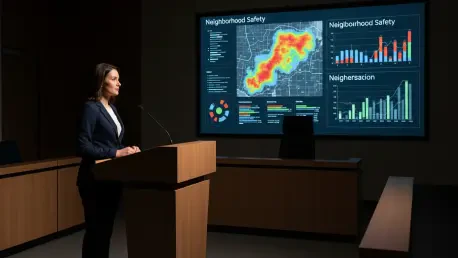

A child welfare professional stands before a family court judge today, presenting a risk assessment report not compiled solely through traditional home visits but synthesized by a sophisticated neural network designed to predict household stability. This transition from manual observation to algorithmic interpretation represents one of the most significant shifts in the history of the legal-social work nexus, forcing practitioners to defend data points they did not personally calculate. As machine learning models like the GuardianPath 4.0 system become standard across state agencies from 2026 to 2028, the ability of a human caseworker to explain the internal logic of a generative model becomes a matter of life-altering importance for families. The central tension lies in whether a social worker can truly provide competent testimony when the evidence relies on proprietary algorithms that developers might struggle to audit in real-time. This requires professionals to be as skilled in data literacy as they are in clinical psychology, ensuring that every digital recommendation is backed by a human understanding of the complexities of the human condition and the factors that often skew raw data.
Technological Evolution of Predictive Welfare Modeling
The Mechanics of Algorithmic Risk Scoring
Modern social work increasingly utilizes platforms such as the CaseInsight Pro suite, which aggregates thousands of data points ranging from past criminal records and housing instability to school attendance and social media sentiment analysis. These systems generate a safety score that influences whether a child remains in a home or is placed in foster care, a decision that used to rest entirely on the qualitative judgment of a seasoned professional. By analyzing patterns that are often invisible to the human eye, these tools promise to eliminate individual bias, yet they introduce a new layer of complexity when the caseworker is asked to justify a specific recommendation. In the courtroom, the social worker is no longer just a witness to a family’s circumstances but also an interpreter of a digital oracle, requiring a deep understanding of how specific inputs like unstable employment are weighted against community support networks within the current algorithmic framework. The profession must now treat the machine’s output as a hypothesis that requires manual verification before it is ever presented as a forensic fact.
Defending these outputs requires moving beyond a simple acceptance of the software’s results, as defense attorneys have become increasingly adept at challenging the validity of automated findings. When a caseworker presents an AI-generated timeline of neglect based on sensor data or digital footprints, they must be prepared to discuss the data’s provenance and the specific training sets used to calibrate the model for a local population. Since the implementation of the Federal AI Evidence Standards in early 2026, courts have demanded more than just a summary; they require an explanation of the decision-making pathway used by the AI. This shift has turned social workers into accidental data scientists who must explain how the synthesis of disparate data points leads to a definitive conclusion about a parent’s fitness. Without this technical literacy, the caseworker risks having their entire testimony struck from the record, leaving children without the protection these tools provide. Agencies must prioritize training that focuses on the limitations of these models to prevent over-reliance on flawed automated logic.
Authenticity and Admissibility Challenges
The legal admissibility of AI-generated evidence hinges on the Daubert standard, which requires that any scientific testimony be based on reliable principles and methods that have been subjected to peer review. For a social worker, this means that simply citing a high-tech tool is insufficient; they must be able to prove that the specific version of the software used has been validated for the specific demographic in question. From 2026 to 2029, legal scholars anticipate a surge in motion to exclude hearings where the primary focus is the algorithmic reliability of welfare prediction models. Social workers must therefore maintain detailed logs of how the AI was used, including any instances where the practitioner manually overrode the machine’s suggestion. This documentation serves as the bridge between the opaque world of neural networks and the transparent requirements of the court, ensuring that the evidence stands up to the scrutiny of opposing counsel who may question the model’s inherent logic and the possibility of data corruption or tampering during the ingestion phase.
Furthermore, the black box nature of advanced generative AI presents a significant hurdle for social workers who must testify to the truth of a child’s situation under oath. When a machine produces a recommendation based on non-linear data processing, the practitioner must find a way to translate that complexity into layman’s terms that a judge can easily understand. This often involves the use of proxy variables or simplified analogies that describe the weight of certain risk factors without getting bogged down in the underlying code. The challenge is to maintain accuracy while ensuring the testimony remains persuasive and grounded in the social worker’s own professional observations. If the judge perceives the caseworker as being overly reliant on a tool they do not understand, the credibility of the entire agency may be compromised. Therefore, the successful defense of AI evidence relies on the worker’s ability to weave technological insights into a traditional narrative of human behavior. This hybrid approach ensures the court remains focused on the welfare of the individual rather than the technical prowess of the software.
Navigating Ethical and Legal Hurdles
Addressing the Reality of Algorithmic Bias
The reliance on AI-generated evidence brings the persistent issue of systemic bias to the forefront of judicial proceedings, particularly when historical data reflects long-standing racial or socioeconomic disparities. If an algorithm is trained on records from an era where certain neighborhoods were over-policed, the resulting evidence presented by a social worker may inadvertently perpetuate those same biases under the guise of objective technological analysis. In current practice, a social worker defending such evidence must be able to demonstrate that the tool has been audited for disparate impact and that the AI’s hallucination rate is within acceptable legal margins. This is not merely a theoretical concern; in recent cases, the use of predictive modeling has been challenged on the grounds that it violates the Due Process Clause by relying on secret logic. Consequently, the professional must balance the efficiency of AI with a rigorous commitment to social justice. It is no longer enough to claim the machine is neutral; one must prove it is fair through constant monitoring and human-led adjustments.
Professional liability has expanded significantly as social workers are now held accountable for the accuracy of the digital tools they employ in their daily practice. If a caseworker presents an AI-generated risk score that leads to a wrongful removal of a child, the legal repercussions can be severe for both the individual and the agency, especially if it is found that they did not adequately vet the software’s findings. This necessitated a shift in professional training programs from 2026 onward, where ethics courses now include modules on algorithmic transparency and human-in-the-loop verification processes. The challenge remains that as AI systems become more autonomous, the window for human intervention narrows, creating a paradox where the social worker is legally responsible for a process they cannot fully control. To successfully defend this evidence, practitioners must develop a testimony style that combines traditional clinical observation with a defense of the technological methodology. This requires a proactive stance on software governance and a refusal to use tools that do not allow for detailed auditing.
Implementing Rigorous Standards for Digital Testimony
To maintain credibility in this new environment, agencies have begun implementing rigorous internal validation protocols that must be completed before any AI-generated report is submitted to the court. These protocols involve a secondary review by a digital forensics expert who can attest to the integrity of the data used by the generative models, providing a seal of authenticity that social workers can reference during their testimony. Furthermore, practitioners are increasingly using explainable AI interfaces that provide a visual map of how specific variables influenced a final recommendation, making it easier to communicate complex technical concepts to a judge or jury. This transparency is crucial because it allows the social worker to point to specific, observable behaviors that align with the machine’s findings, thereby grounding the abstract data in the reality of the client’s life. By treating the AI as a collaborative assistant, the worker leverages technology while upholding professional standards. This internal check prevents the normalization of error and ensures that the machine remains subservient to human ethics.
The integration of AI into social work testimony required a fundamental reassessment of how evidence was gathered and presented within the American judicial system. Legal experts and social work administrators collaborated to establish new certification standards for Technologically Assisted Evidence, ensuring that every practitioner possessed a baseline level of algorithmic literacy. This collective effort led to the development of standardized disclosure forms that detailed the specific AI models used, the dates of their last bias audits, and the margin of error associated with their predictions. Looking forward, the emphasis shifted toward creating permanent interdisciplinary task forces that continuously monitor the evolution of machine learning tools in welfare settings. These groups provided the necessary oversight to ensure that as technology advanced, it did so in a way that protected civil liberties. By embracing these changes, the profession ensured that AI remained a tool for empowerment. The focus turned toward ensuring that these advanced systems served as an extension of human empathy rather than a replacement for it.