
As a political strategist and the leader of Government Curated, Donald Gainsborough has spent his career at the intersection of legislative policy and global market dynamics. With the world currently reeling from energy shocks sparked by the conflict in Iran and the intensifying rivalry between Western powers and China, Gainsborough offers a unique perspective on how nations can navigate the “green dilemma.” His expertise focuses on the delicate balance between achieving urgent climate goals and maintaining national sovereignty in a landscape where one superpower controls the lion’s share of the clean-tech supply chain.
Fossil fuel import costs have recently surged by billions of dollars, forcing some regions into four-day workweeks and fuel rationing. How do these immediate economic shocks reshape long-term energy transition timelines, and what specific steps can governments take to bridge the gap during such extreme volatility?
The sheer scale of the current crisis is staggering; since the onset of the conflict in Iran, the European Union alone has seen its fossil fuel import bill skyrocket by over €22 billion in just 44 days. These shocks act as a violent catalyst, proving that as long as economies run on volatile commodities, they are at the mercy of geopolitical “choke holds” like the Strait of Hormuz. We see nations like the Philippines and Bangladesh adopting four-day workweeks to conserve power, which creates a desperate, immediate mandate for electrification. To bridge the gap, governments are moving toward “independence through electrification,” but in the short term, they must implement emergency measures like Cambodia’s decision to slash import taxes for green goods. The goal is to move from a system of recurring fuel payments to one of one-time technology investments, even if that means navigating a period of painful, high-cost adjustments.
With one nation controlling nearly 80% of solar panel production and 90% of rare earth refining, how can allies balance rapid decarbonization with the risks of supply chain dominance? What metrics should leaders use to determine when cheap technology becomes a national security liability?
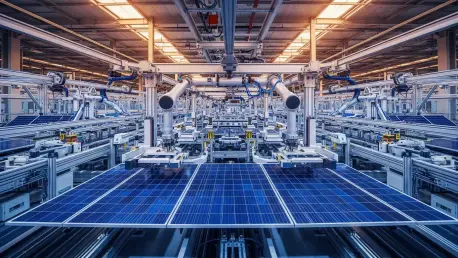
This is the central paradox of modern geopolitics: the faster we decarbonize, the more we lean on Beijing, which currently produces nearly 80 percent of the world’s solar panels and an even higher share of essential components like wafers and cells. Leaders must look at “concentration risk” as a primary metric; when a single player refines 90 percent of the rare earths used in wind turbines and EVs, it stops being a market and starts being a monopoly that can be weaponized through export restrictions. We’ve already seen China restrict rare earth exports in response to U.S. tariffs, which serves as a warning that “cheap” technology has a hidden cost in sovereignty. National security concerns become paramount when unexplained communication devices are discovered in imported solar tech, or when domestic industries like steel and chemicals are threatened by state-driven overcapacity.
New industrial laws often prioritize domestic green manufacturing, yet local products frequently cost significantly more than imports. In what ways do these higher prices threaten the overall speed of the energy transition, and how can policymakers mitigate the resulting financial burden on lower-income households?
There is a legitimate fear that if you tilt too heavily toward protectionism, you sacrifice the speed of decarbonization because “made-in-Europe” or “made-in-America” goods simply cannot match the price point of Chinese mass production. This creates a friction point where environmental urgency clashes with economic reality, potentially slowing the rollout of clean alternatives for those who can least afford them. To mitigate this, some nations are finding middle ground; for instance, Canada recently adjusted its 100 percent tariff on Chinese EVs to allow a limited number into the market, specifically to provide affordable price points for consumers. Policymakers can also use targeted subsidies for domestic goods while maintaining a “bridge” of imports, ensuring that the transition doesn’t become a luxury available only to the wealthy.
Some nations are moving away from total bans toward tariffs that encourage foreign firms to build local factories. How effective are these “carrots and sticks” in capturing tax revenue and jobs, and what are the primary hurdles in transferring complex manufacturing knowledge to a domestic workforce?
The “carrots and sticks” approach is proving to be a highly effective middle path for emerging economies like Brazil and Thailand that want the technology without the total dependency. By imposing tariffs on finished EVs while offering incentives for local assembly, these countries are forcing Chinese firms to bring their capital and knowledge across borders. The primary hurdle is the “knowledge gap”; manufacturing complex items like lithium batteries or high-efficiency solar cells requires a specialized workforce that isn’t built overnight. However, the logic here is to accept Chinese capital today to capture the jobs, tax revenue, and process knowledge of tomorrow. It is a calculated gamble to turn a trade deficit into a domestic industrial base.
There is a fundamental difference between the daily flow of oil and the one-time purchase of a solar panel. How does shifting from commodity dependence to technology dependence change a country’s geopolitical leverage, and what new cybersecurity risks arise from integrated green infrastructure?
The shift from a commodity-based energy system to a technology-based one fundamentally alters the nature of vulnerability. Unlike oil, which requires a continuous, daily flow that can be cut off at any moment with immediate economic paralysis, a solar panel is a one-time purchase that provides power for decades regardless of future trade relations. This reduces the “leverage of the tap” that traditional energy superpowers hold, but it introduces a “leverage of the hardware.” This hardware brings new digital risks; integrated green grids rely on complex electronic components, and we have already seen reports of unexplained communication devices in imported tech. The threat shifts from physical blockades to cyber vulnerabilities where a foreign power could theoretically “switch off” or disrupt an entire nation’s decentralized energy infrastructure.
Diverging international strategies see some administrations doubling down on domestic oil production while others race for clean-tech leadership. What are the long-term economic consequences of relinquishing the renewable market to global competitors, and how does this impact the influence of traditional energy superpowers?
Relinquishing the renewable market is a massive strategic risk because China’s clean-tech exports are already beginning to overtake the sales of traditional fuels. If a nation like the U.S. pivots back toward “energy dominance” via fossil fuels, it risks fighting yesterday’s war while China wins the future by becoming the indispensable partner for global decarbonization. This creates a vacuum; while one side focuses on oil deals in the Middle East, China is showing up with capital and speed in markets that Western firms find too risky. In the long run, traditional energy superpowers may find their influence waning as the rest of the world builds energy systems that don’t require their specific commodities, effectively leaving the old guard with a product that the world is actively trying to stop buying.
What is your forecast for global energy security?
I forecast a world of “fragmented interdependence” where the era of globalized, low-cost energy is replaced by a more expensive but resilient regionalism. We will see a permanent shift away from the “just-in-time” delivery of fossil fuels toward a “just-in-case” domestic stockpile of technology and minerals. While China will remain the dominant force in the near term, the current shocks are forcing a massive, multi-decade diversification effort. Ultimately, energy security will no longer be measured by the size of a country’s oil reserves, but by the sophistication of its manufacturing base and the security of its mineral supply chains. The transition will be messy and expensive, but the alternative—total exposure to the whims of global oil markets—is a price that most nations are no longer willing to pay.