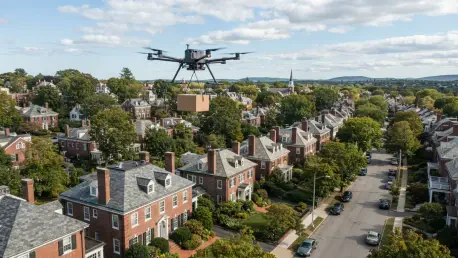

Despite Amazon’s claims of job creation and carbon reduction, the project remains stalled by a complex web of state-level regulatory and zoning requirements. The skyline of Westborough, once characterized by its quiet suburban sprawl and historic architecture, is now the frontline of a high-stakes legal battle over the future of American commerce. As Amazon attempts to pivot its facility at 64 Otis Street into a bustling aeronautical hub, the friction between technological progress and established local governance has reached a boiling point. The company envisions a logistics revolution where packages weighing up to five pounds soar over more than a dozen municipalities within a 7.5-mile radius, including major sections of Worcester. This proposal, however, involves more than just a new delivery method; it signifies a massive shift in how public space is utilized and managed. With plans for up to 1,000 daily flights, the initiative has transitioned from a small-scale pilot program into a major infrastructure debate that challenges the very definition of a fulfillment center in the modern digital age.
State Authority: The Battle for Jurisdictional Control
A primary roadblock for Amazon’s Massachusetts ambitions is the firm stance taken by the Massachusetts Department of Transportation, which argues that federal permission does not grant a total exemption from state laws. While the Federal Aviation Administration retains clear authority over the navigable airspace—essentially the “highways in the sky”—MassDOT has invoked its power over the physical infrastructure required for takeoff and landing. Under Massachusetts General Laws Chapter 90, Section 39B, any facility used for commercial aviation must receive a formal certificate of approval from the state’s Aeronautics Division. This distinction is crucial because it allows the state to regulate the “ground side” of drone operations, regardless of the FAA’s technical certifications. By asserting this right, state officials have effectively created a mandatory screening process that forces Amazon to justify its presence on a site-by-site basis within the Commonwealth’s borders.
The state-level review process is designed to be far more than a simple administrative box-checking exercise, as it entails a rigorous evaluation of the long-term impacts of high-frequency drone traffic. MassDOT’s requirements include a comprehensive suitability review to determine if a suburban warehouse is an appropriate site for what essentially becomes a small-scale commercial airport. Furthermore, an environmental assessment must analyze how the noise and physical presence of a thousand daily flights will impact local ecosystems and the daily lives of those living nearby. Public hearings are also mandatory, providing a platform for transparency that Amazon has sought to minimize in other jurisdictions. As of late 2026, the state noted that the retail giant had yet to submit the formal notifications required to trigger this review, a procedural delay that ensures the delivery fleet will remain grounded until state officials are fully satisfied with the site’s safety.
Political Resistance: Balancing Innovation and Public Safety
Opposition to the rapid deployment of Prime Air has found a powerful voice within the executive and legislative branches of the Massachusetts state government. Governor Maura Healey has consistently argued that the state’s primary responsibility is to ensure the safety and quiet enjoyment of its residents, rather than facilitating the aggressive expansion timelines of corporate entities. This perspective is shared by a bipartisan coalition of local legislators who represent the communities most directly affected by the proposed flight paths. These leaders have criticized the “move fast and break things” culture that often defines the technology sector, suggesting that such an attitude is inherently incompatible with the careful, community-focused permitting processes that define New England governance. Their collective stance emphasizes that technological innovation must prove its social value before it is permitted to disrupt the established routines of residential neighborhoods across the state.
On the federal stage, members of the Massachusetts congressional delegation have joined the skeptical chorus by calling for more detailed investigations into the cumulative effects of mass drone deployment. Concerns raised by national representatives center on the lack of existing data regarding the environmental and psychological impact of constant, low-altitude aerial traffic. There is a persistent fear that current federal regulations have not kept pace with the scale of Amazon’s vision, leaving a regulatory void that state leaders must fill to protect their constituents. This unified front among local, state, and federal officials indicates that Amazon will face a protracted struggle as it attempts to prove its model is safe and beneficial. The demand for exhaustive studies on noise pollution and mechanical reliability suggests that the burden of proof has shifted entirely onto the corporation, requiring a level of transparency that goes well beyond standard commercial disclosures.
Community Governance: Local Response to Aerial Commercialization
Local resistance in Westborough has manifested in direct legislative action, as residents recently voted overwhelmingly to protect their town’s traditional character through new zoning regulations. At a Special Town Meeting, a vote of 510-13 established a specific bylaw aimed at controlling the takeoff, landing, and delivery activities of commercial drones within the municipality’s borders. This measure includes a $300 fine for violations, serving as a symbolic and legal barrier against unauthorized aerial operations. While the Massachusetts Attorney General must still review the bylaw for potential conflicts with federal law, the landslide victory for the measure highlights a profound lack of local consent for Amazon’s project. This move by Westborough residents represents a growing trend of municipal pushback where communities utilize their land-use powers to address technological disruptions that federal agencies might otherwise overlook in their broader regulatory frameworks.
Neighboring Worcester has also taken a proactive stance, with the City Council demanding a series of public forums to ensure that the voices of urban residents are heard. The primary anxieties expressed by these communities focus on three main pillars: privacy, noise, and safety. There is a widespread fear that drones, which utilize advanced cameras and sensors for navigation, will inadvertently act as constant surveillance tools over private property and residential backyards. Furthermore, the acoustic profile of these machines is a major point of contention, as the prospect of up to a thousand daily flights creates concerns about a persistent high-pitched buzzing that could degrade the quality of life in once-peaceful neighborhoods. Finally, the physical risk of five-pound packages traveling at speeds up to 74 miles per hour over streets and homes has led many to question the wisdom of allowing such high-velocity operations in densely populated areas without proven safety records.
Future Considerations: The Path Toward Resolution
In its defense, Amazon has emphasized that its Prime Air fleet represents a significant step forward in both safety and environmental sustainability within the logistics sector. The company highlighted its proprietary “sense-and-avoid” technology, which allowed drones to autonomously detect and navigate around obstacles like power lines, trees, and other aircraft without human intervention. From an ecological perspective, Amazon argued that moving small packages via air was significantly more efficient than using traditional delivery vans, which contributed to road congestion and carbon emissions. Furthermore, the company projected that the Westborough hub would generate high-skilled jobs in fields such as aviation safety, remote operations, and hardware engineering. By framing the project as an economic and environmental boon, the retail giant attempted to shift the narrative from one of community disruption to one of necessary modernization for a more efficient and greener future.
The conflict over the Westborough facility eventually became a landmark case study for the integration of autonomous technology into traditional residential zones. Stakeholders recognized that a successful rollout required a delicate balance between federal aviation authority and the sovereign right of states to manage their own land and infrastructure. Moving forward, the state determined that several actionable steps were necessary to bridge the gap between corporate goals and public interest. First, the establishment of standardized noise-level thresholds for residential corridors provided a clear benchmark for compliance. Second, the implementation of third-party privacy audits ensured that camera-equipped drones operated within strict surveillance limits. Finally, the state mandated that any expansion include a dedicated community liaison to address grievances in real-time. These measures demonstrated that technological adoption was most effective when built upon a foundation of transparency and municipal cooperation, setting a precedent for future aerial logistics.