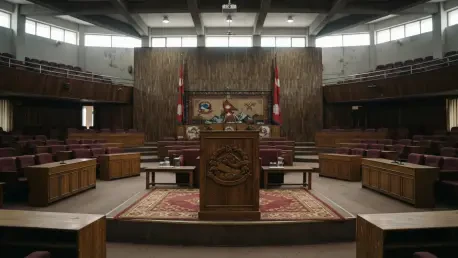

The current legislative paralysis within the Sudurpaschim Provincial Assembly has reached a critical juncture where fiscal policy and political maneuvering are inextricably linked to regional stability. While the provincial assembly technically ratified the financial plan for the current fiscal cycle nearly a month ago, the underlying disputes regarding its formulation, allocation, and transparency remain fundamentally unresolved. This situation has not only paralyzed specific legislative mechanisms but has also triggered a significant internal crisis within the ruling coalition, primarily affecting the Nepal Communist Party and its partners. This administrative stagnation threatens to undermine the developmental trajectory of the region as constituents wait for promised infrastructure and essential services to materialize under the new fiscal framework.
Navigating the Fiscal and Legislative Landscape of Sudurpaschim
Examining the state of provincial governance in Nepal reveals a complex interplay between federal oversight and regional autonomy. The annual financial plan serves as more than just a ledger; it is the cornerstone of regional stability, dictating how resources are distributed across diverse geographic and social sectors. In Sudurpaschim, the budget framework consists of segments dedicated to infrastructure, social welfare, and administrative overhead, all of which require a delicate balance to satisfy the competing needs of nine different districts. However, the role of coalition politics has introduced a layer of volatility that often shifts the focus from strategic planning to political survival, as small factions leverage their votes for specific local project funding.
The regulations governing the formulation and ratification of the provincial budget are designed to ensure transparency, yet they are frequently challenged by the realities of legislative gridlock. Lawmakers must navigate a landscape defined by strict deadlines and the necessity of achieving a majority in an environment where alliances are fluid. When the budget was introduced in October, the process was intended to be a collaborative effort, but it quickly transformed into a point of contention. The current stalemate underscores the difficulty of adhering to formal budgetary guidelines when the underlying political foundations are fractured by competing interests and a lack of unified vision among the ruling partners.
Emerging Patterns and Financial Projections in Provincial Governance
Shifting Trends in Coalition Management and Resource Allocation
Recent behaviors among ruling coalition partners indicate an evolving trend where political leverage is prioritized over cohesive economic policy. There is a visible rise in fragmented project funding, where small-scale, localized initiatives are funded at the expense of strategic, large-scale infrastructure. This pattern reflects a defensive approach to coalition management, as the administration attempts to quell lawmaker dissatisfaction by distributing resources across a wide array of minor projects. Consequently, this fragmentation hampers the province’s ability to undertake significant development that could drive long-term economic growth, leading to a cycle of inefficiency that frustrates both legislators and the public.
Lawmaker dissatisfaction has direct consequences for legislative continuity, as seen in the frequent interruptions of assembly sessions. The emergence of these patterns suggests that the current governance model is struggling to transition from a survival-oriented coalition to a development-oriented administration. Despite these challenges, the current environment also presents opportunities for fiscal transparency and reform. The demand for a more equitable allocation of resources has forced a public conversation about how provincial funds are managed, potentially paving the way for more rigorous oversight mechanisms that could benefit the region from 2026 to 2028 and beyond.
Market Data and Long-Term Economic Growth Projections
The evaluation of the 37.70-billion-rupee provincial budget reveals a heavy reliance on external funding sources rather than internal generation. Growth projections are largely based on federal equalization and conditional grants, which constitute the vast majority of the province’s revenue. Performance indicators for internal revenue generation remain low, with the province only expected to raise approximately 1.72 billion rupees from its own mechanisms. This disparity highlights a significant challenge for provincial financial sustainability, as the government must factor in nearly 9.65 billion rupees in savings from the 2025 to 2026 fiscal cycle just to balance the current books.
Forward-looking forecasts indicate that without a fundamental shift in revenue strategy, the province will remain vulnerable to federal policy changes and economic fluctuations. The reliance on 10.24 billion rupees from revenue sharing and over 15 billion in various federal grants suggests that Sudurpaschim lacks the fiscal autonomy needed to drive independent growth. For the province to achieve long-term economic health, it must transition toward a model that incentivizes local investment and expands the tax base. If the current trend of dependency continues, the ability of the provincial government to respond to regional crises or initiate independent development projects will be severely limited.
Primary Obstacles Hindering Legislative and Fiscal Progress
Addressing the failure to honor supplementary budget agreements remains the most immediate hurdle for the Bhatta administration. The promise of a revised financial plan was the primary concession used to secure the budget’s passage, yet the executive branch has been slow to move toward implementation. This inaction has paralyzed the high-level parliamentary study committee, which was designed to be the vehicle for bipartisan budget review. Despite the formal announcement of the committee’s formation, it has failed to convene or meet its deadlines, leaving a vacuum of leadership that the opposition has been quick to exploit.
Strategies for overcoming the internal fracturing within the Nepal Communist Party and its UML partners must involve a return to transparent negotiations and a redistribution of project priorities. The impasse created by opposition prerequisites, such as the demand for a total halt on non-essential budget implementation, has further complicated the path forward. Resolving these disputes requires a solution that reduces the heavy dependency on federal revenue sharing by identifying new provincial income streams. Without a consensus on how to manage these internal and external pressures, the legislative progress of the province will likely remain stalled, affecting everything from road construction to healthcare delivery.
The Regulatory Framework and Compliance in Sudurpaschim
Significant laws governing provincial assembly budget amendments dictate that any changes to the financial plan must pass through a rigorous committee review process. The role of the Speaker is paramount in this regard, as they are responsible for managing legislative deadlocks and ensuring that parliamentary committees function as intended. In Sudurpaschim, the Speaker has faced the difficult task of balancing the demands of a restless opposition with the stalling tactics of a divided ruling coalition. Standards for transparent budget implementation and resource management are embedded in provincial statutes, but compliance has been inconsistent, leading to allegations of favoritism in project selection.
The impact of these compliance measures, or the lack thereof, is felt most acutely in the delivery of essential services. When budget implementation is delayed or contested, funds for hospitals, schools, and local infrastructure are often held in escrow, preventing timely execution of vital programs. The security of financial equalization grants and federal transfers depends on the province’s ability to demonstrate effective and legal use of previously allocated funds. If the provincial government cannot resolve its internal disputes and adhere to the regulatory framework, it risks a reduction in future federal support, which would further jeopardize the region’s financial stability.
Future Outlook for Sudurpaschim’s Political and Economic Growth
Potential Market Disruptors in the Provincial Administrative Structure
The influence of veteran political resignations, such as that of Veer Bahadur Thapa, represents a potential market disruptor that could reshape future leadership within the province. Such departures signal a deep-seated frustration with the current administrative structure and may lead to a more fragmented assembly where consensus is even harder to achieve. Projected shifts in constituent development preferences suggest a growing demand for transparency and large-scale infrastructure over the “distributive” spending that has characterized recent budgets. This shift could force a realignment of political priorities as parties look toward the next election cycle to regain public trust.
Innovation in Internal Revenue Generation to Enhance Fiscal Autonomy
To enhance fiscal autonomy, Sudurpaschim must look toward innovation in internal revenue generation, such as digitizing tax collection and expanding levies on natural resource extraction. The impact of national economic conditions, including inflation and federal deficit pressures, makes it imperative for the province to build its own financial cushion. By diversifying its income streams, the province can reduce its vulnerability to the political whims of the federal government. This evolution would not only provide more stability for provincial planning but also create a more attractive environment for private investment in sectors like tourism and hydropower, which remain largely untapped.
Concluding Viewpoint on the Provincial Political Crisis
The findings regarding the Bhatta administration’s legitimacy suggest that the government faces an uphill battle in maintaining coalition discipline. The fiscal deadlock serves as a structural consequence of a governance model that prioritizes short-term political appeasement over long-term strategic investment. It was observed that the failure to activate the study committee and the subsequent resignation of key figures significantly weakened the administration’s standing. Achieving multi-party consensus appears to be the only viable path forward, yet it requires a genuine commitment to transparency that was often absent in recent sessions.
Future prospects for investment and infrastructure development depend heavily on the resolution of these legislative conflicts. Actionable next steps include the immediate formalization of the supplementary budget and the implementation of a digital project tracking system to ensure funds reach their intended destinations. Stakeholders identified that diversifying revenue through local resource management is a critical solution for reducing federal dependency. By addressing these structural flaws, the province could transition from a state of crisis to one of sustainable growth, provided that leadership prioritizes provincial welfare over partisan maneuvering.