
Cabinet members have authorized a cautious, evidence-based approach that requires a successful pilot phase before the remaining millions are released. Staffordshire County Council has adopted this localized strategy to modernize the region’s transportation infrastructure, specifically targeting the barriers preventing electric vehicle (EV) adoption among residents without private off-street parking. By pivoting from broad regional collaborations to a tailored county-wide model, the council seeks to ensure that every pound of public investment is precisely aligned with the unique demographic needs of its communities. This shift signals a departure from the one-size-fits-all approach previously favored in regional consortiums that often overlooked the specific geographic nuances of smaller towns. The objective is clear: to bridge the gap between early adopters with driveways and the tens of thousands of households currently locked out of the green energy transition due to logistical constraints. Through a blend of community hub charging and residential trials, the administration is building a truly inclusive charging network that can scale effectively across various environments.
Strategic Reorientation
Shifting to Local Control
The decision to reclaim autonomy over the county’s green energy trajectory stems from a strategic withdrawal from a large-scale Midlands consortium. Previously, the county was part of a multi-authority procurement exercise that allocated the vast majority of its funding to a generalized regional model. However, following a transition in council leadership, officials determined that the previous framework did not adequately address the specific demographic challenges faced by Staffordshire’s unique mix of urban centers and rural villages. By reclaiming direct oversight, the council has gained the flexibility to develop a business case tailored specifically to local residents and businesses rather than following a standardized regional template. This move reflects a growing trend in local governance where authorities prioritize localized delivery models to ensure that infrastructure projects align more closely with community demands. The resulting strategy allows for more agile decision-making and a higher degree of accountability throughout the procurement and installation phases.
Financial Framework
Supporting this strategic pivot is a substantial £4.6 million allocation from the federal government’s Local Electric Vehicle Infrastructure (LEVI) fund, which has been carefully partitioned to maximize its impact. The council has earmarked approximately £2.588 million for the development of publicly accessible charging stations in existing parking lots and community centers, while an additional £2 million is reserved for innovative residential solutions. To ensure the long-term viability of this network, the administration plans to adopt a concession-style delivery model. Under this arrangement, the council uses its capital funding to attract and leverage private sector investment, making it commercially attractive for specialized companies to install and maintain chargers in locations that might otherwise be overlooked by market forces. This approach effectively mitigates financial risks to the local taxpayer while accelerating the rollout of essential technology. By fostering these public-private partnerships, the county ensures that the charging infrastructure is not only built but also professionally operated and maintained.
Infrastructure Expansion
Targeting Local Hubs
A critical component of the expansion involves the identification of 88 potential sites for new charging stations, ensuring that the network reaches into both high-traffic urban areas and secondary towns. In the town of Stone, for instance, planners have highlighted locations such as the Anglers Parking Lot, Christchurch Way, and Riverside as primary candidates for development. These indicative sites serve as a blueprint for the initial phase, with the final selection contingent on rigorous technical feasibility studies and federal approval. The focus on integrating chargers into established commercial and recreational hubs is intended to normalize the charging process by placing it where residents already spend their time. This strategy directly addresses range anxiety by providing visible and reliable charging options that are woven into the fabric of daily life. As these projects move from planning to execution, the emphasis remains on creating a seamless user experience that encourages broader adoption among those who might have previously felt the network was too fragmented.
Solving the Parking Gap
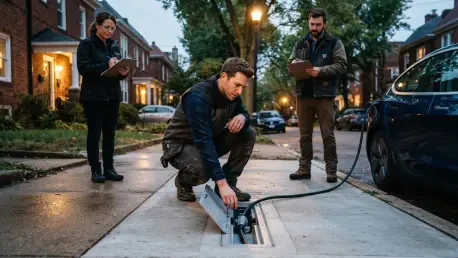
Perhaps the most pressing challenge identified in the council’s analysis is the residential parking dilemma, with over 80,000 households in Staffordshire lacking the off-street parking necessary for conventional home charging. For these residents, the prospect of owning an electric vehicle is often dismissed as impractical because existing highway safety regulations strictly prohibit running unmanaged cables across public sidewalks. These regulations are essential for protecting pedestrians and individuals with mobility issues from tripping hazards, yet they create a significant barrier to EV ownership. To resolve this, the council is exploring managed cross-sidewalk charging solutions that involve installing specialized channels or infrastructure directly into the sidewalk. This technology allows a resident to safely connect their vehicle to their home electricity supply while maintaining a clear and hazard-free path for foot traffic. By focusing on these specific logistical hurdles, the strategy aims to democratize access to green technology, making it a viable option for all residents regardless of their housing situation.
Implementation and Oversight
Pilot Program Safeguards
Recognizing the potential technical and legal complexities of modified sidewalk infrastructure, the council has initiated a focused £250,000 pilot program to evaluate cross-sidewalk charging solutions before a wider rollout. This trial phase is a critical safeguard designed to gather empirical evidence on several fronts, including the technical durability of the equipment under varying weather conditions and high foot traffic. Furthermore, the pilot will assess the financial sustainability of the program, looking at the feasibility of resident contributions and the long-term maintenance costs associated with the infrastructure. Legal liability and safety are also paramount considerations, as the council must ensure that any new installations do not compromise the accessibility of sidewalks for the public. The findings from this study will be presented to the cabinet for a comprehensive review, ensuring that public funds are only spent on solutions that have been proven safe and effective. This measured approach prevents premature investment in unproven technologies while allowing for controlled innovation.
Future Roadmap and Administration
The final implementation of this ambitious policy was marked by a rigorous administrative review process that ensured every aspect of the plan was both technically sound and financially responsible. Following the formal approval by the cabinet, the strategy moved into a standard call-in period, allowing for final internal scrutiny before the policy took full effect. This structured governance model was complemented by the requirement for a revised business case to be submitted to the Office for Zero Emission Vehicles (OZEV) for final federal authorization. This multi-layered approval process ensured that the transition to a localized charging network was grounded in realistic projections and sound engineering principles. Looking forward, the focus shifted toward the procurement phase, where the council sought to partner with industry leaders to turn these strategic goals into tangible infrastructure. By prioritizing the needs of households without driveways and leveraging private investment through a concession model, the authority established a framework that could be adapted by other regions facing similar urban infrastructure challenges.